• About
  • La Micaela Farm Shop

fincafood

~ culinary and horticultural life on a Spanish farm

Category Archives: Fish

Sajur Lemeng

16 Saturday May 2020

Posted by Nevenka in Fish, Main Courses, Vegan

≈ Leave a comment

Tags

coconut curry, Indonesian food, Sajur Lemeng

This Indonesian vegetable curry is adapted from one of my old cookery books, South East Asian Food, written by the Australian academic Rosemary Brissenden who fell in love with Indonesia and its cuisine as a student in the 1960’s.

I made this as a vegan curry which was delicious, the original recipe was with prawns and prawn paste so I will give amounts of those for making the non vegan version.

For 2

about 250 grams in total of various vegetables. You can choose between red and green peppers, green beans, aubergine, bean sprouts and the following that I used on this occasion –

asparagus

leeks – cut into thin strips

courgette – Cut into bite sized chunks

mange toute peas

small green peppers

mizuna and Pak Choi

1 red fresh chilli – chopped

2 cm square, more or less, fresh ginger or better still galangal – chopped

2 garlic cloves – cut in half

1 small sweet onion – roughly chopped

5 macadamia nuts / 10 hazelnuts

1 teaspoon / 5 ml ground coriander

1/2 teaspoon shrimp paste – if making a vegan curry omit this

1 tablespoon / 15 ml coconut oil

400 coconut milk

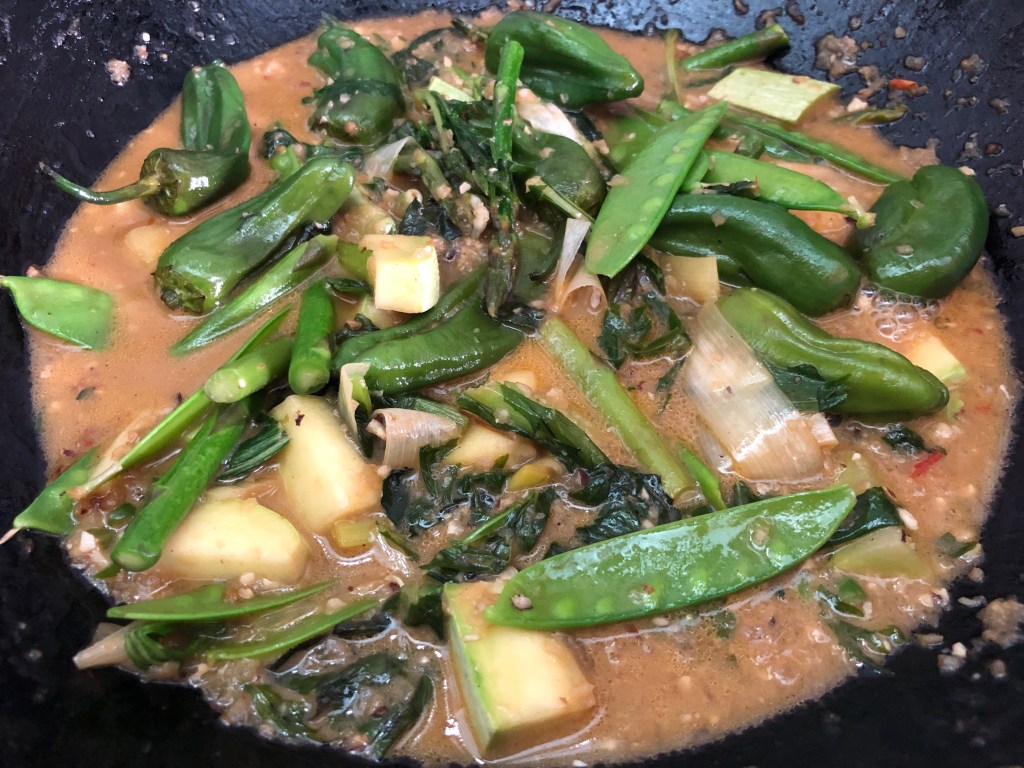
First make a curry paste. In a small food processor whizz together the chilli, ginger, garlic, onion, nuts, shrimp paste and coriander together with the coconut oil.

Gently fry the curry paste in a large wok for 5 – 10 minutes until it is cooked.

Add the coconut milk and heat to a simmer.

Add the vegetables that need the longest cooking first, then after a few minutes the more tender vegetables and the prawns if using. Simmer until the vegetables are just done with some bite remaining and the prawns cooked through.

Serve with jasmine rice or sesame sprinkled rice noodles.


Share this:

  • Share on X (Opens in new window) X
  • Share on Facebook (Opens in new window) Facebook
  • Share on WhatsApp (Opens in new window) WhatsApp
  • Email a link to a friend (Opens in new window) Email
Like Loading...

Baby Squid with Garlic & Chilli

13 Tuesday Jan 2015

Posted by Nevenka in Fish, Food for One, Main Courses, Starters

≈ Leave a comment

IMG_1493

Whenever I go to look at the fresh fish at my local market, everything is so fresh and glistening that I just want to buy it all. This week I limited myself to some small and tender squid and the last of the crabs. The crabs that we get here are small but very tasty, so will make a fantastic soup.

The squid was quickly fried with garlic and chilli for lunch.

SMALL SQUID WITH GARLIC, CHILLI AND PARSLEY

This is so simple it is almost not a recipe.

For 2 as a main course, for 4 as a starter

500 grams small squid
Olive oil
3 cloves garlic – finely chopped
Fresh red chilli – to taste
Small bunch flat leaved parsley – roughly chopped
Juice of half a lemon

The cleaning of the squid is the most time consuming job in preparing this dish.

Cut the tentacles off just above the squid’s eyes, and then remove the sharp beak type mouth in the centre of the tentacles. Pull the innards out of the squid and discard. A cat will love you if you send these their way.

IMG_1489

Put the empty bodies and tentacles into a colander and wash thoroughly.

Leave to drain while you chop the garlic, chilli and parsley.

Heat the oil in a shallow pan and add the garlic and chilli. Fry for a couple of minutes.

Add the squid and keep frying on a medium heat, turning from time to time.

The squid are cooked once they are opaque and a bit pink, which should take about 7 minutes. Add the parsley and lemon juice. Stir to blend and to moisten the tasty bits at the bottom of the pan.

IMG_1490

That’s it!

Serve with a simple tomato salad and some fresh bread.

Share this:

  • Share on X (Opens in new window) X
  • Share on Facebook (Opens in new window) Facebook
  • Share on WhatsApp (Opens in new window) WhatsApp
  • Email a link to a friend (Opens in new window) Email
Like Loading...

Nicoise Salad

09 Tuesday Sep 2014

Posted by Nevenka in Fish, Food for One, Main Courses, Starters, Vegetable Dishes

≈ Leave a comment

Tags

Egg, French Beans, Nicoise, Salad, Tuna

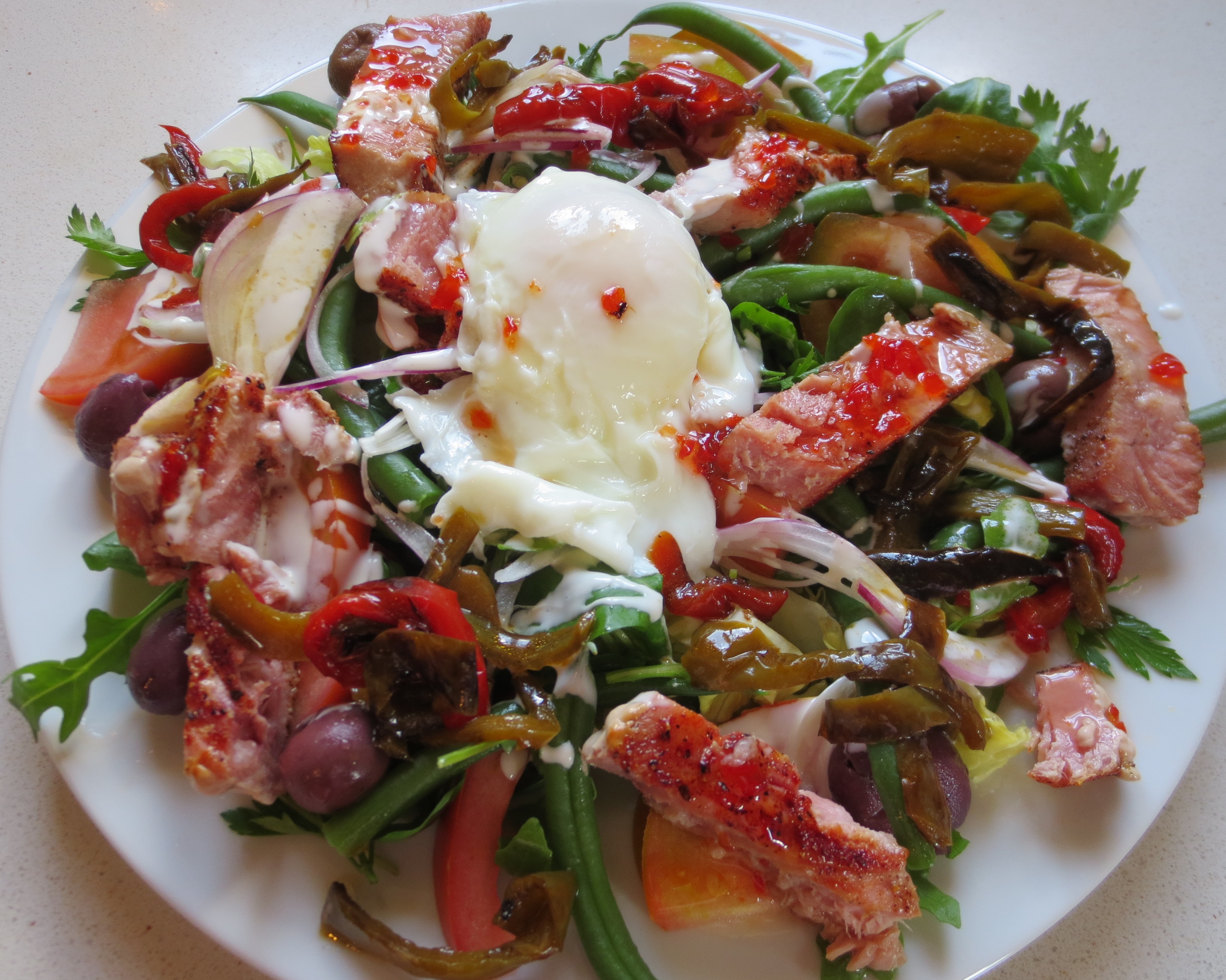
Composed salads with their mixture of textures, tastes and colours are very close to being perfect food, and a Nicoise Salad is one of the great classics in this category. Its mixture of green leaves and French beans, red tomatoes and peppers, black olives, white and yellow egg and the pinky brown of tuna make it a delight to look at.

IMG_1312

At the market today, my favourite fish stall had some superb fresh tuna, so I decided to sear it fairly rare and have it as part of a Nicoise Salad in place of the usual tinned tuna. Without losing the elements that make a salad a Nicoise, ie Tuna, Egg, French Beans, Tomatoes and Black Olives, there is room for you to make the salad your own. I prefer a poached egg to boiled as I like to mix the runny yolk into the salad. I also like to thin down the mayonnaise with a little water before pouring it over the salad. And I do love Chilli Jam with tuna, so although it is not traditional…..

Share this:

  • Share on X (Opens in new window) X
  • Share on Facebook (Opens in new window) Facebook
  • Share on WhatsApp (Opens in new window) WhatsApp
  • Email a link to a friend (Opens in new window) Email
Like Loading...

Arroz Negro – Black Rice

21 Saturday Jun 2014

Posted by Nevenka in Fish, Food for One, Main Courses

≈ Leave a comment

Tags

arroz, Arroz Negro, mussels, Paella, prawns, Rice, squid

IMG_1199

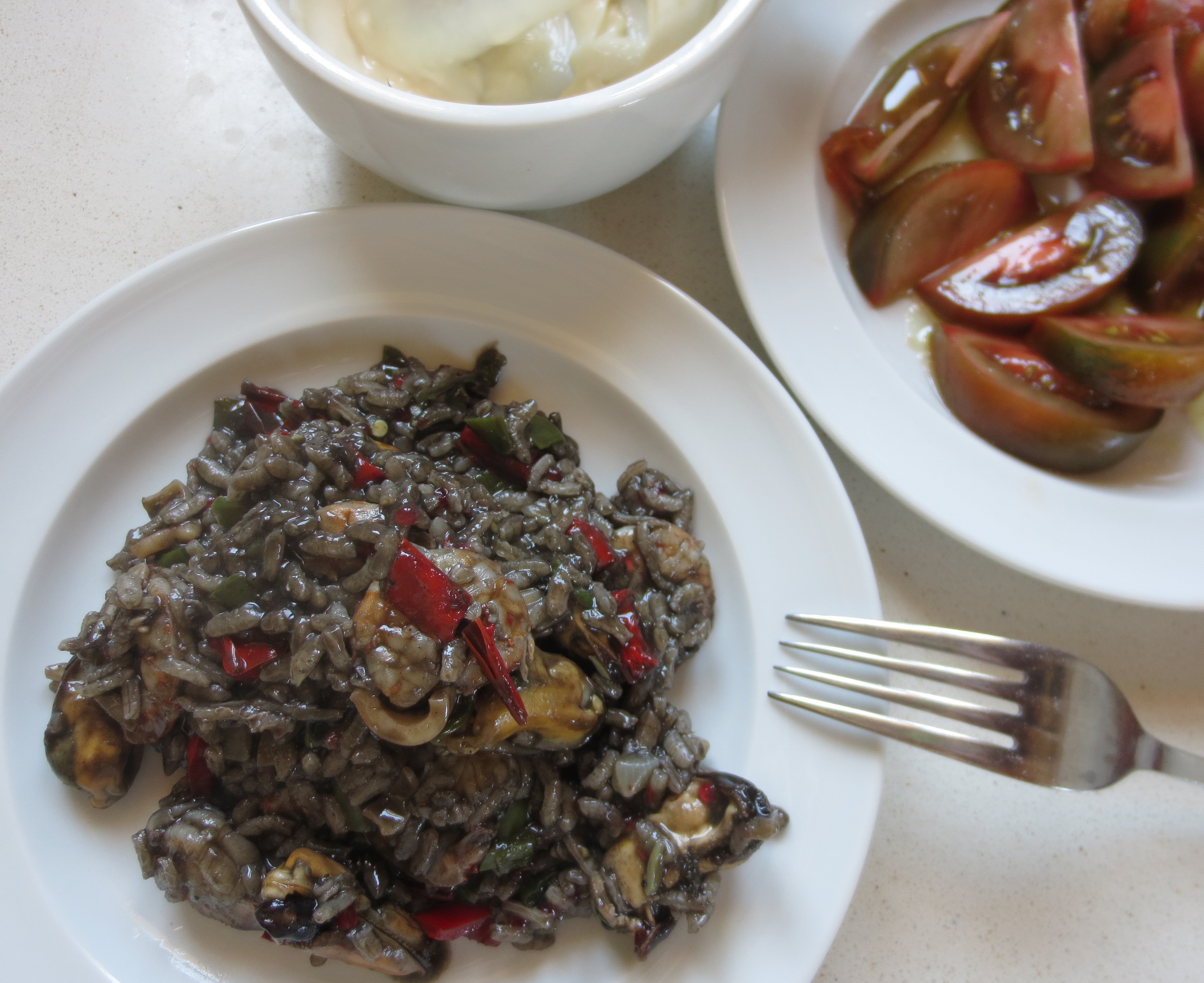
Continuing on the rice theme, here is my favourite seafood and rice dish. It is fairly simple to make and does not have many ingredients, but the flavour of the squid ink and seafood mixed with that of the chilli and onion makes for a rich tasting dish. I regularly cook it just for myself.

FOR 6
3 tablespoons olive oil
1 medium onion – finely chopped
1 red pepper – chopped into small squares
1 green pepper – chopped into small squares
Half a red chilli – finely chopped
500 grams squid
500 grams mussels
500 grams prawns
250 grams rice
500 ml fish stock
500-750 ml chicken stock
Salt and pepper

Let’s start by preparing the fish.

Remove the innards from the squid and carefully remove the ink sacks into a small bowl. Cut the tentacles from the innards and save discarding the rest.

With the ink sacs, you need to break them open to release the ink and press them with the back of a spoon to make sure that it is all out before discarding the sac. In some places it is possible to buy the ink frozen in little sachets which saves on the fiddle of extracting the ink.

Wash the squid bodies and tentacles and dry them on kitchen paper. Cut the bodies into thin circles. If the tentacles are small leave them whole, but if large cut them smaller.
Clean the mussels and steam them open.

A lot of cooks like to cook the mussels in the rice, but I find that there is often grit in the mussel shells and so prefer to open them separately and then sieve the liquid. Also some mussels are extremely salty, so if you have their liquor apart, you can taste it for saltiness before deciding how much to add to your dish.

If I am making this rice just for myself, I use ready cooked and shelled mussels that I buy frozen and keep in the freezer for these sort of mixed fish dishes that only require 5 or 6 mussels.

The prawns can be left in their shells to be opened at the table, but if you prefer for easier eating, they can be de-headed and peeled now.

Heat the oil in a large shallow pan and add the onions. Fry gently until translucent.

Add the peppers and chilli and keep cooking gently for five to ten minutes.

Add the squid and and continue frying gently for another five minutes.

Add the rice and stir well to coat with all the other ingredients in the pan. Fry for about five minutes.
Mix a little of the fish stock into the ink to dilute it and add it to the pan with the rest of the fish stock. Mix well.

Cover and leave to simmer for about five minutes. If it is starting to look dry add some of the chicken stock.
After another five minutes add the prawns if they are in their shells and the liquor from the mussels. Check the seasoning in the liquor in the pan and add salt and pepper as required. Add more chicken stock if needed.

Continue cooking until the rice is at the al dente stage – cooked but with firmness in the centre.

using unshelled prawns add at this stage and then a couple of minutes later add the mussels and let them warm through.

Let the rice rest for five to ten minutes.

Serve with Alioli and a tomato salad.

IMG_1201

Share this:

  • Share on X (Opens in new window) X
  • Share on Facebook (Opens in new window) Facebook
  • Share on WhatsApp (Opens in new window) WhatsApp
  • Email a link to a friend (Opens in new window) Email
Like Loading...

Polenta………& learning to love it.

01 Thursday May 2014

Posted by Nevenka in Fish, Main Courses, Techniques, Vegetable Dishes

≈ Leave a comment

Tags

Bacon, Fennel, Polenta, Polenta Cake, Polenta Souffle, Vegetables

I know that there are plenty of you out there who are as I previously was with Polenta. You started off curious so tried it in various restaurants and found yourself underwhelmed. It was allright, but you couldn’t see what the fuss was about.

Not types to give up, and armed with the opinion that Italians know about food, so it would be worth giving it another chance, you have a go at cooking it at home. Armed with an authentic Italian recipe from a reliable source you boil, and stir, and stir, and cool, and cut and reheat with a sauce………and still find yourself unexcited.

So you abandon Polenta for a number of years…..

…….then when you have forgotten all about it you are served in a restaurant to accompany the meat, a golden cake lightly browned and crisped on the edges and creamy in the centre. Filled with tiny strips of fried bacon and diced vegetables, flavoured with garlic and chicken stock. It is absolutely delicious. It takes you some time to realise that the main ingredient is the polenta that you have up to now been unimpressed by.

???????????????????????????????????????

A re-evaluation is obviously in order. This is where the path to loving Polenta starts, let me lead you through my trials to success and enjoyment.

Firstly the Polenta itself. I read somewhere that it is only good during the first six months after it is milled. I have tried fresh and It does have a slightly more corn flavour, but not so much that it makes that much difference. Having said that any dried goods – beans, lentils, quinoa, rice, flour, and polenta should not be kept for more than a couple of years and preferably used within a year. These are products where the use by dates should be taken note of, you won’t get food poisoning but the grains lose their ability to reconstitute and stay dry and hard and of course the flavour of them slowly fades.

Cooking liquid. I have read debates as to whether water or milk are the best and most authentic cooking liquids, but I am not impressed with either. Let’s face it, polenta is a pretty bland grain, and so any extra flavour that can be added should be. I like to cook the polenta in a light stock, either chicken, veal, or if you are vegetarian, a vegetable stock.

Stirring. Every recipe I have come across, and the instructions on the polenta packet, tell you to bring the liquid to the boil, whisk in the polenta, stir until boiling again and then keep stirring for forty minutes with the heat turned low. Well, I haven’t got the time or patience to stand around stirring for forty minutes and I suspect neither do Italians or you. I find that stirring from time to time during the first ten minutes will do, then turn off the heat, cover with a well fitting lid and leave it to continue cooking in its own steam for forty minutes. Alternatively once it is back boiling after adding the polenta, pour into a slow cooker and continue cooking on a low setting for half an hour, then turn of the cooker and leave the polenta to cook in the residual heat for another half hour.

BASIC RECIPE – for 8-10 servings

350 grams polenta

1.75-2 litres light stock

salt and freshly ground black pepper

If you want a very firm polenta for leaving to cool and form into a cake, use the smaller amount of stock, and if you want a softer puree consistency for eating immediately, then the larger amount of stock.

Put the stock in a thick based saucepan with half a teaspoon of salt and bring to the boil.

Pour in the polenta in a steady stream stirring continually. Turn down the heat and keep stirring as the polenta thickens, this should take about 10 minutes.

Either put a lid on the polenta and turn of the heat leaving the polenta to continue cooking in its own steam or transfer the polenta to a slow cooker on the lowest setting and leave to cook for 30 minutes before turning off the heat and giving it a stir.

Continue with your chosen recipe.

POLENTA AND VEGETABLE CAKE – Pictured above

I make this when I have a lot of people to feed as almost all can be prepared the day before, all that has to be done on the day is slicing the loaf and putting it onto a hot tray in the oven. Plus it is the vegetable and starch all in one.

It is great with something saucy like a stew. Last time I made it was to go with Pork Bourgignon – see previous post on Pigs Cheeks.

If you want to make a vegetarian version of this substitute nut pieces for the bacon and use olive oil for the frying

100 grams streaky bacon – cut into small dice

30 grams bacon fat – cut into small dice

1 clove garlic – finely chopped

1 small onion or half a large one – finely chopped

200 grams vegetables – cut into small dice – choose three or four from the following – carrots, parsnips, peppers, mushrooms, sweet peas, Florence fennel, broccoli, celeriac, butternut squash. Try to mix the colours to make it interesting.

Thick polenta as master recipe – cooked in vegetable stock if making the meatless version.

Heat a thick based frying pan and add the dice bacon fat. Cook on a low heat until it has rendered down and released its fat.

Add the bacon and cook for five minutes.

Add the onions and garlic, stir in and fry for a couple of minutes.

Add the diced vegetables and fry for about 10 minutes until the vegetables are about half cooked and have lost some of their moisture.

Add the vegetable and bacon mix to the polenta while both are still warm and gently mix the whole together. Season with plenty of freshly ground black pepper and check if it needs more salt.

Turn into a small loaf tin lined with cling film. Gently flatten to make sure that there are no pockets of air and smooth out the top. Fold the cling film over the top and put the loaf in the fridge to cool and firm up.

About 45 minutes before you need to serve the loaf, heat the oven to 180 centigrade. When the oven is hot, put in a shallow baking tray containing a couple of tablespoons of tasty dripping or olive oil.

Take the loaf out of the fridge and remove from tin. Peel off it’s cling film and cut into slabs about one and a half centimetres thick.

Put onto the now hot fat in the baking tray. Put back In the oven and roast for about 15 to 20 minutes until browned and crispy at the edges.

WHITE POLENTA PURÉE WITH FENNEL AND ORANGE.
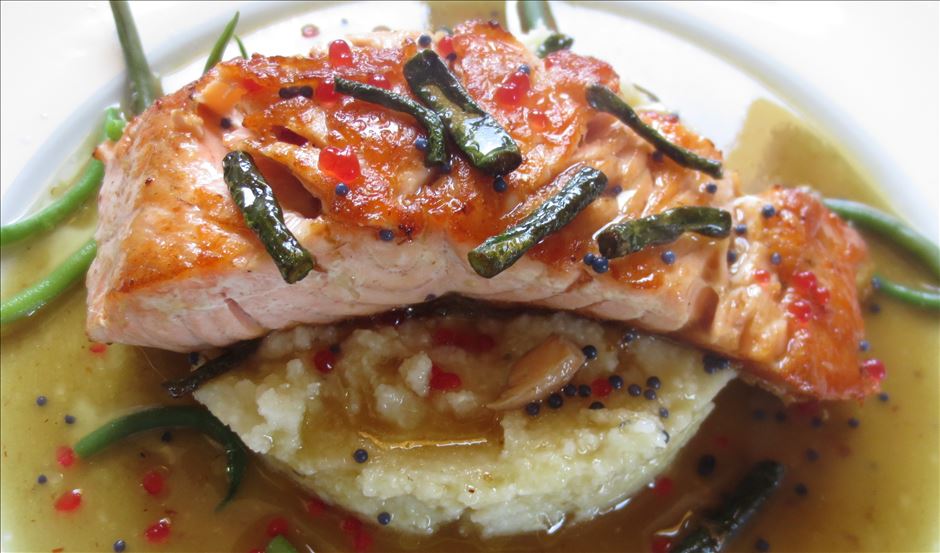
Salmon, White Polenta, Saffron Sauce

White polenta is traditionally eaten with fish in Italy. It has a slightly softer smoother texture. Don’t worry if you can’t find white polenta, this is still good with the more easily available yellow.

Master recipe soft polenta made with white grains.

100 grams Florence fennel – cut into small dice

25 grams butter

Grated zest and juice of one orange

Salt and freshly ground black pepper.

Fry the diced fennel slowly in the butter until cooked but still with a little firmness.

Cook the polenta as the recipe. Add the orange zest and juice. Stir well to mix in.

Add the fennel and stir gently to mix in.

Serve with fish of your choice.

SOUFFLED POLENTA

Use either white or yellow polenta

Firm polenta as master recipe

3 eggs

50 grams finely grated Parmesan cheese

Cook the polenta as recipe and leave to cool a bit.

Heat the oven to 170 centigrade.

Grease an ovenproof dish about the right size to take the soufflé, individual ramekins can be used if you like.

Separate the eggs. Add the yolks to the polenta and beat to mix in.

Add most of the cheese to the polenta keeping back enough to sprinkle on the top of the soufflé. Mix well.

Beat the egg whites until very firm and white.

Fold into the polenta mix trying not to lose too much air about of the egg whites.

Turn into the greased dish and bake for about half an hour until risen and golden on top.

Serve immediately.
 

Share this:

  • Share on X (Opens in new window) X
  • Share on Facebook (Opens in new window) Facebook
  • Share on WhatsApp (Opens in new window) WhatsApp
  • Email a link to a friend (Opens in new window) Email
Like Loading...

Bodega Aranda – Almeria City

11 Monday Nov 2013

Posted by Nevenka in Fish, Food for One, Snacks and Tapas, Starters, Sweet Things, Vegetable Dishes

≈ 1 Comment

Tags

Ajo Blanco, Blue Cheese, Blue Cheese Ice Cream, Corn Salad, Escabeche

IMG_0760

After visiting the central market in Almeria we had worked up an appetite for lunch, and remembered that this ancient tapas bar was not far away.

Having installed ourselves at a table we asked the waitress to bring us a selection of what was good at the moment. She suggested the house salad, a couple of plates of fish and fried potatoes topped with broken eggs and the local made chorizo and morcilla. Perfect we said, not realising what culinary delights lay behind these simple descriptions.

The house salad arrived. Rich green corn salad, walnuts, pine nuts, raisins, and a halo of tomatoes surrounding a mound of blue cheese ice cream. The waitress had a small bowl of dressing – olive oil and sherry vinegar with seasonings – which she poured over the salad, then she cut the ice cream into pieces and gently mixed it with the salad.

IMG_0753

It was heavenly. I am working on a recipe for the ice cream – maybe have it perfected for the next post.

The fish course was next –

IMG_0755

Fillets of baby Cod and Smelts in light batter and fried served with the best Ajo Blanco I have ever tasted. You could taste the slight bitterness of the almonds, a hint of garlic that was not overpowering, the sauce was made smooth with bread and olive oil and balanced with white wine vinegar.

IMG_0754

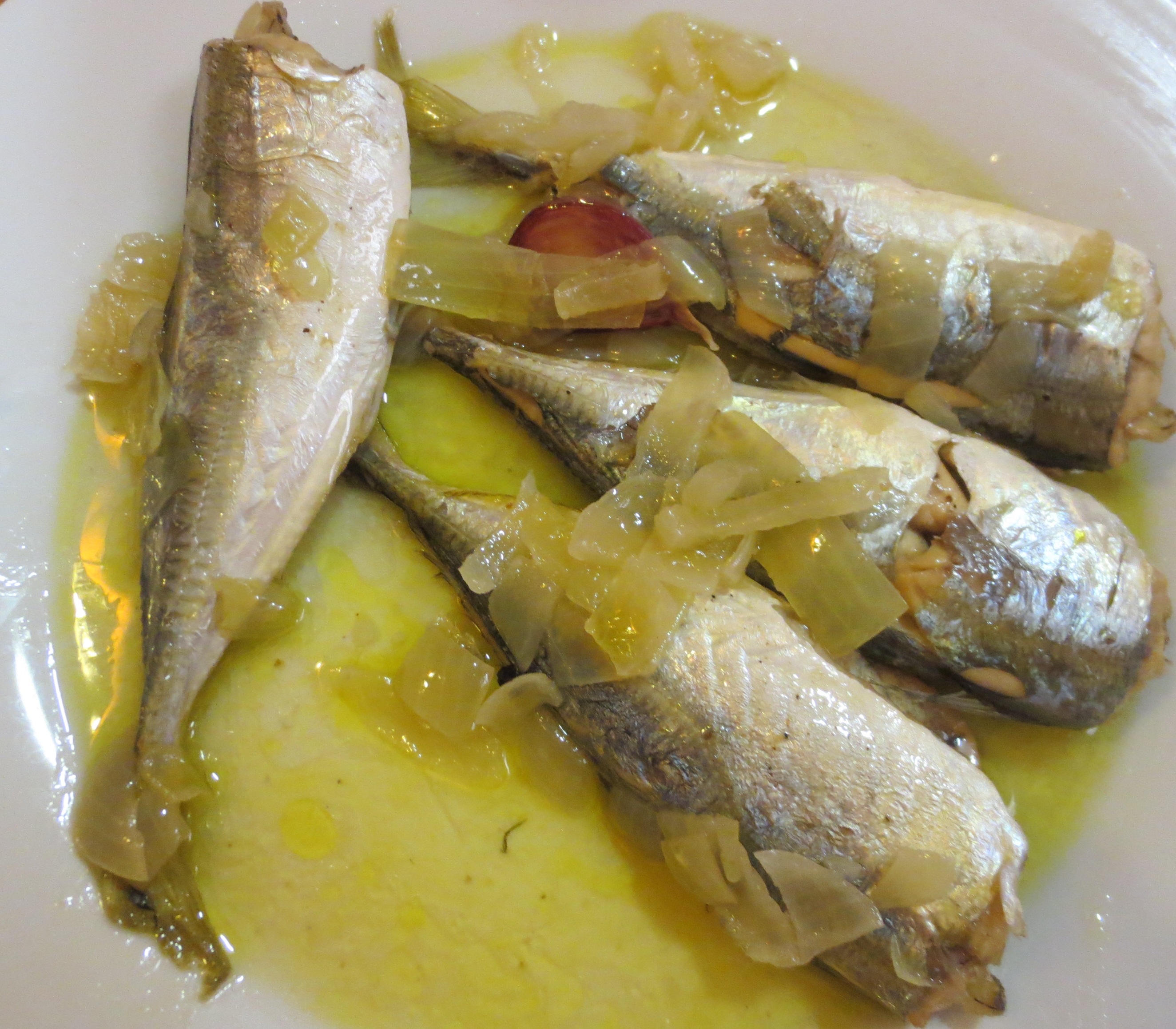
Jureles en Escabeche. Escabeche is a way of mildly pickling fish. It is gently poached in a broth of olive oil, white wine vinegar and water which is flavoured with onions, peppercorns, saffron and bayleaves. Frequently smoky Pimenton is added as well, but in this dish of small fish it wasn’t needed.

IMG_0756

Next was the Potatoes with Chorizo, Morcilla and broken eggs.

IMG_0758

To finish the meal a succulent large date each, dark chocolate covered raisins and mint tea.

Share this:

  • Share on X (Opens in new window) X
  • Share on Facebook (Opens in new window) Facebook
  • Share on WhatsApp (Opens in new window) WhatsApp
  • Email a link to a friend (Opens in new window) Email
Like Loading...

Sweet & Spicy Fish with Pineapple

14 Saturday Sep 2013

Posted by Nevenka in Fish, Food for One, Main Courses

≈ Leave a comment

Tags

Fish, Pineapple, Thai

IMG_0533We have the first Yard Long Beans of the season ready in the garden. I get excited about these because even though in appearance they look like an extended French bean, the flavour and particularly the texture are quite different. These beans have a crunchy and crispy texture even when cooked, and a fresh flavour.

IMG_0536

The other crop now ready are the pale green mild chillis. I can eat these straight from the plant and they are super pickled in mild vinegar.

I have to cook a dish that can use both of these ingredients. I bought a fresh pineapple in the market this week, and that reminds me of a fish dish that I had in Thailand some years ago. It was spicy and sweet and a little bit sour from the pineapple. Here is my recreation of that dish.

SWEET & SPICY FISH WITH PINEAPPLE

IMG_0545

Per person

1 clove garlic

1 mild chilli

Piece ginger aprox 2cm x 1cm

1 cm Lemon grass stalk finely sliced

Olive oil

150 grams mixed fish and seafood – prawns, mussels, white meaty fish

Yard long beans

Bean sprouts

Half slice of fresh pineapple 1cm thick

Tablespoon sweet chilli jam/sauce

Teaspoon fish sauce/Nam Pla

20 grams dry roast Peanuts – roughly crushed

1 teaspoon chopped chives

Start with the aromatics, peel and finely chop the ginger and garlic. As thin as you can slice the lemon grass and chilli.

Prepare the fish. Peel and dehead the prawns, cut the fish into chunks, steam open the mussels if using them.

Heat some oil in a wok and add the above aromatics. Cook on a low heat for a few minutes.

Next the pineapple, cut out the woody centre and cut the rest into smallish pieces. Add to the pan and continue cooking .

Add the yard long beans cut into 3 cm lengths.

Add the bean sprouts

The pineapple by this time should have given out some of its juices. Add to these the fish sauce and chilli jam and mix in.

Add the fish, stir to mix with the sauce. Cover and leave to cook for five minutes.

Stir again and look at how cooked the fish is. It will most likely need a few more minutes but be careful not to overcook.

To serve, sprinkle with the crushed peanuts and chives and serve with plain boiled rice or noodles. If you want you can mix these into the pan of fish and pineapple to absorb the flavours in the sauce.

Share this:

  • Share on X (Opens in new window) X
  • Share on Facebook (Opens in new window) Facebook
  • Share on WhatsApp (Opens in new window) WhatsApp
  • Email a link to a friend (Opens in new window) Email
Like Loading...

Thai Green Curry with Seafood & Oriental Salad

26 Monday Aug 2013

Posted by Nevenka in Fish, Food for One, Main Courses, Sauces, Vegetable Dishes

≈ Leave a comment

Tags

Oriental Salad, Salad, Seafood, Thai Green Curry

THAI GREEN CURRY WITH SEAFOOD

I fell in love with Thai cooking on a visit there many years ago, and took copious notes of everything that I ate. Once home I set about recreating the dishes that I had enjoyed while there. I started by buying in the curry pastes, but now that I grow all the essential ingredients on the farm, I make my own, and I am not sure that I could now go back to the bought ones. The difference is the freshness of the taste, that if you do not over process you can have texture to the paste, and also of course that you can balance the proportions of the ingredients depending on how spicy you require it to be.

For a seafood curry, I like spice, but not overpoweringly so, but I still want a good strong flavour of ginger, garlic and lemon grass, so I put with them a milder pale green chilli which still has spice together with a good pepper flavour.

????????????????????????

For the paste – enough for a curry for 4

4 cloves garlic

2 stalks of lemon grass

A piece of ginger, or galangal if you can get it, roughly 5 cm x 2 cm

2 tablespoons Nam Pla – Thai fish sauce

Roughly chop the garlic and pound to a pulp in a mortar.

Take the outer leaves off the lemon grass and cut off the tough base. Finely slice the tender part at the base, usually you get about 2 cm of tender part.

Add to the garlic.

Scrape the skin off the ginger and grate into the mortar with the garlic and lemon grass. Mash with the pestle until a paste adding the fish sauce as you go along.

This paste can be made in advance and be left developing its flavours in the fridge until needed.

For the fish –

Large peeled prawns

Mussels

White meaty fish like swordfish, shark, monkfish, cod, haddock

1 tablespoon each of red and black fish eggs

A large sweet onion or 5-6 spring onions

Large can of coconut milk

Good bunch of basil leaves or Thai parsley

Olive oil for frying

Peel and slice the onion. In a pan big enough to take the curry, soften the onions in oil.

Add the curry paste and fry for a few minutes.

Add the coconut milk and stir well to mix in. Bring to a simmer and start adding the fish.

Keep the curry on a low heat while the fish cooks to ensure that it doesn’t overcook.

The white fish wants to be cut into chunks. If you think that all the fish requires the same amount of cooking, you can add it all in one go.

The fish shouldn’t need more than five minutes to cook.

Lastly add the fish eggs. I had assumed before putting these in hot dishes that they would melt into the sauce, but they don’t and so add colour and texture to fish dishes. They look particularly effective on Salmon with pasta.

Garnish with the chopped herbs and serve with plain boiled rice.

ORIENTAL SALAD

This is adapted from a recipe in Sri Owens fabulous book of Indonesian recipes. I would not call this a fixed recipe as I use whatever is fresh in the vegetable garden. If I plan ahead enough, I get some beansprouts sprouting a few days in advance. They are not available to buy fresh here in Spain, so you have to grow your own. If you cannot get fresh ones, miss them out rather than use the cooked ones that come in jars, the flavour and texture are just not the same.??????????????????????????????????

A selection of the following –

Fresh bean sprouts

French or Yard Long beans – blanched by pouring boiling water over them, leaving them a minute, and then draining and leaving to cool

Chinese leaves or other greens – finely shredded

The following all cut into fine julienne –

Radishes

Carrots

Small tender courgettes

Green peppers

Red peppers

Plus –

Basil leaves – Thai is best, but the usual or Lettuce Basil will do – shredded

Fresh mint leaves

For the dressing – these amounts are for a salad for 4

100 gms roasted peanuts

1-2 cloves of garlic – finely chopped

1teaspoon crumbled shrimp paste or 1 tablespoon Thai fish sauce

Red chilli – to taste – it wants to be quite spicy – finely chopped

1teaspoon soft brown sugar

Juice of a lime

Salt to taste

Put all the prepared vegetables in a dish with the herbs and mix together.

Prepare the dressing. In a mortar pound all the ingredients except the lime juice until a rough paste with the nuts still having some bigger bits for texture. Add the lime juice and mix. Add just enough water to make into a sauce.

Pour over the salad and mix well. Serve at room temperature.

Share this:

  • Share on X (Opens in new window) X
  • Share on Facebook (Opens in new window) Facebook
  • Share on WhatsApp (Opens in new window) WhatsApp
  • Email a link to a friend (Opens in new window) Email
Like Loading...

Catalan Fish Stew – Suquet

27 Wednesday Feb 2013

Posted by Nevenka in Fish, Food for One, Main Courses

≈ 2 Comments

Tags

Almonds, Catalan Fish Stew, Linguine Vongole, Suquet

I thought while I was thinking of fish stew that I ought to share with you the recipe for one that originates from much closer to my home. This is a dish that is quintessentially Spanish. Garlicy Mediterranean fish in a tomato sauce, thickened and flavoured with toasted almonds and saffron, spiced with pimenton picante and served up with chunks of crusty country bread and green salad fresh from the huerta. And just as easy to cook for one or ten.

IMG_0055

For 4

Selection of fish and shellfish.

Monkfish is traditional, but now that it is endangered I choose other white meaty fish –Cod, Hake, Swordfish, Shark, Grey Mullet. Haddock and Conger Eel we don’t get in this part of the Med but would be suitable. Squid – if you are buying squid in a Mediterranean country be aware that there are several varieties of encephalopods and not all of them a tender.  Make sure that it is Calamar that you buy and not Poton which is tasty but requires a long slow cooking. If in doubt the calamares are usually a bit pricier and smaller in size than the poton.

For the shellfish

3-4 largish prawns per person – if they still have their heads and shells they will add more flavour to the stew.

3-4 mussels per person – in their shells

Clams – in their shells

Olive oil for frying

Half a head of garlic – peeled and finely chopped

1 medium onion – finely chopped

50 grams whole almonds

2 pinches saffron strands

1 heaped teaspoon pimenton picante / spicy paprika

3 large tomatoes – peeled, de seeded and chopped or 5 tablespoons passata

Fish stock

Flat leaved parsley – chopped

Prepare the fish. Remove any skin and bones and cut into large chunks. In some restaurants here they leave everything on and also use small fish like Red Mullet, but I find that Suquet is messy enough to eat with getting the shellfish out of their shells and peeling the prawns without having to try to skin and bone fish as you eat the dish as well. Also some fish skin has quite a different and stronger flavour than the flesh and this can ruin a dish.

Clean the mussels and clams and steam them open. Just put them in a frying pan, cover and put on a low heat. Turn them from time to time until they are all open. Put to one side until needed.

Put the saffron in a thick based pan over a low heat and toast to dry the strands and bring out the flavour. Be careful with this as the expensive strands can easily burn.

Put the strands in a mortar with a pinch of salt and grind up.

Put the almonds in the same pan as where the saffron was and toast moving from time to time until they are a light golden brown.

Add to the mortar and grind to a rough powder. You still want some bigger bits in the powder for texture. Put to one side until needed.

Heat the oil in a pan large enough to take all the ingredients for the stew. Add the garlic and fry over a low heat until golden.

Add the onions and fry until translucent.

Add the tomatoes and fry down for 5 minutes, or add the passata.

Put in the fish pieces, the prawns and the almond and saffron from the mortar. Season with the pimenton. Add the strained liquid from the mussels and clams.

Stir all to mix in the ingredients.

The liquid wants to just cover the fish, if it looks a bit dry add some fish stock, or chicken if you don’t have fish.

Cook slowly for 5-10 minutes until the fish is almost cooked.

Add the mussels and clams and chopped parsley.

Heat to warm through.

Check the seasonings and add salt and freshly ground black pepper as required. This is done at the very end as some shellfish can be quite salty and so until it and its stock are added you won’t know how salty the dish is.

Serve with crusty bread and a green salad.

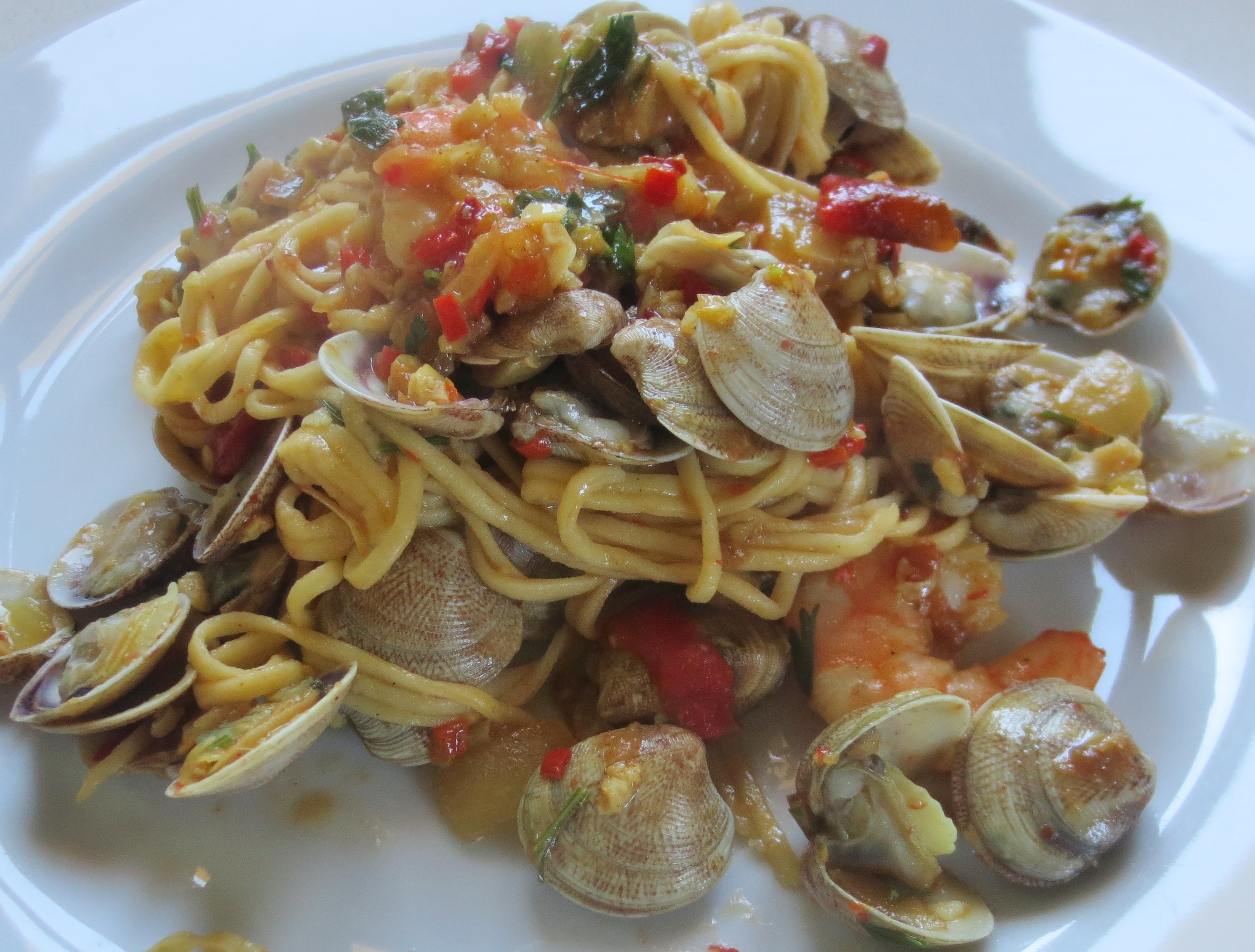
The leftovers with extra clams added make a great sauce for pasta the next day……..

IMG_0066

Share this:

  • Share on X (Opens in new window) X
  • Share on Facebook (Opens in new window) Facebook
  • Share on WhatsApp (Opens in new window) WhatsApp
  • Email a link to a friend (Opens in new window) Email
Like Loading...

Spicy Fish Stew & Yuca Dumplings

20 Wednesday Feb 2013

Posted by Nevenka in Fish, Food for One, Main Courses

≈ Leave a comment

Tags

Fish Stew, Passata, Yuca Dumplings

IMG_0033  Here is the fish stew to go with yesterdays Yuca Dumplings as promised.

Per person

100 gms meaty fish – swordfish, salmon, conger eel, haddock

4 large prawns in the shells

Juice of half a lime

Half a teaspoon turmeric

Quarter of a teaspoon sumac

Quarter of a teaspoon chilli powder or half a teaspoon fresh finely chopped chilli

Quarter of a teaspoon fresh thyme finely chopped or half that amount of dried thyme

Salt and freshly ground black pepper

Olive oil for frying

Half a sweet red pepper cut into chunks

Green beans, washed and cut into slices

20 gms sweetcorn, either frozen or tinned is fine

Small jar passata – the recipe can be found in the preserves section

3 or 4 yuca dumplings

Cut the fish into biggish chunks. Put into a bowl with the prawns. You can remove the shells from the prawns at this stage if you prefer, but they do add extra flavour to the dish.

Pour over the lime juice and add all the spices; turmeric, sumac, chilli, thyme, and season with salt and pepper.

Mix well to coat the fish pieces and prawns with the marinade. Leave for an hour for the spices to permeate the fish.

When this time has passed, heat some oil in a shallow saucepan and add the peppers. Fry for 5 minutes or so.

Add the beans and fry for another 2-3 minutes.

Add the passata and stir in. Turn the heat down and let the vegetables cook for 5 minutes.

Add the fish and any juices with it. Gently stir in. Leave to cook for 5-7 minutes until just on the verge of being done.

Add the sweetcorn and the dumplings. Cook for a few minutes to heat them through turning the dumplings in the sauce to coat them.

Serve.

Share this:

  • Share on X (Opens in new window) X
  • Share on Facebook (Opens in new window) Facebook
  • Share on WhatsApp (Opens in new window) WhatsApp
  • Email a link to a friend (Opens in new window) Email
Like Loading...
← Older posts
Newer posts →

Create a free website or blog at WordPress.com.

Privacy & Cookies: This site uses cookies. By continuing to use this website, you agree to their use.
To find out more, including how to control cookies, see here: Cookie Policy
  • Subscribe Subscribed
    • fincafood
    • Join 103 other subscribers
    • Already have a WordPress.com account? Log in now.
    • fincafood
    • Subscribe Subscribed
    • Sign up
    • Log in
    • Report this content
    • View site in Reader
    • Manage subscriptions
    • Collapse this bar
 

Loading Comments...
 

    %d