Spring Greens with a Difference

Tags

,

After the rain that we have had and now that the temperatures are warming up, it is not only the greens in the veg patch that are sprouting. The hillsides are not only covered in beautiful spring flowers, little pink wild orchids, tiny bee orchids and miniature wild irises only a few centimeters tall, but there is also wild garlic with delicate pink flowers and wild asparagus which is worth the fight with the thorns from last years plant that protects it.

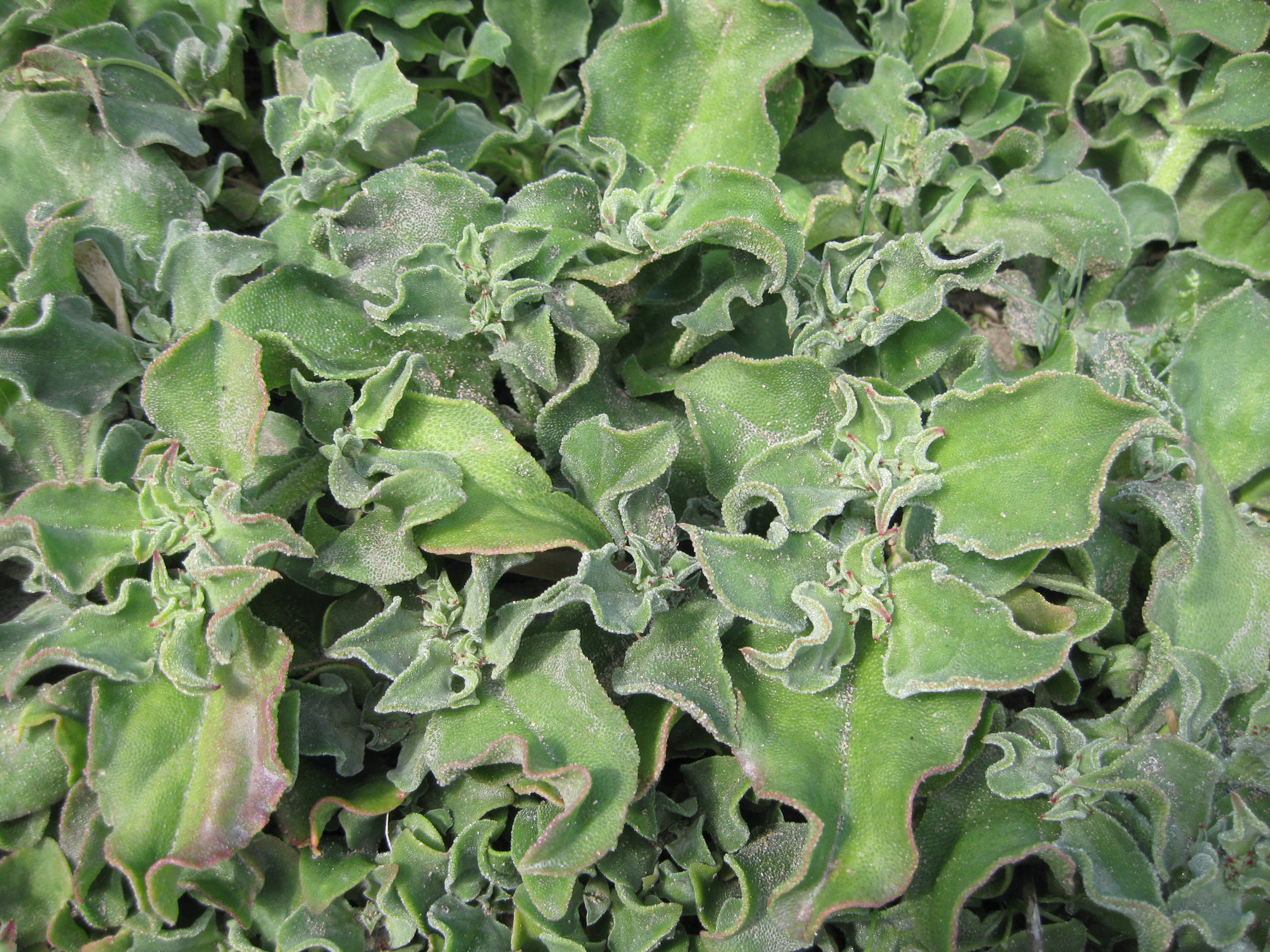
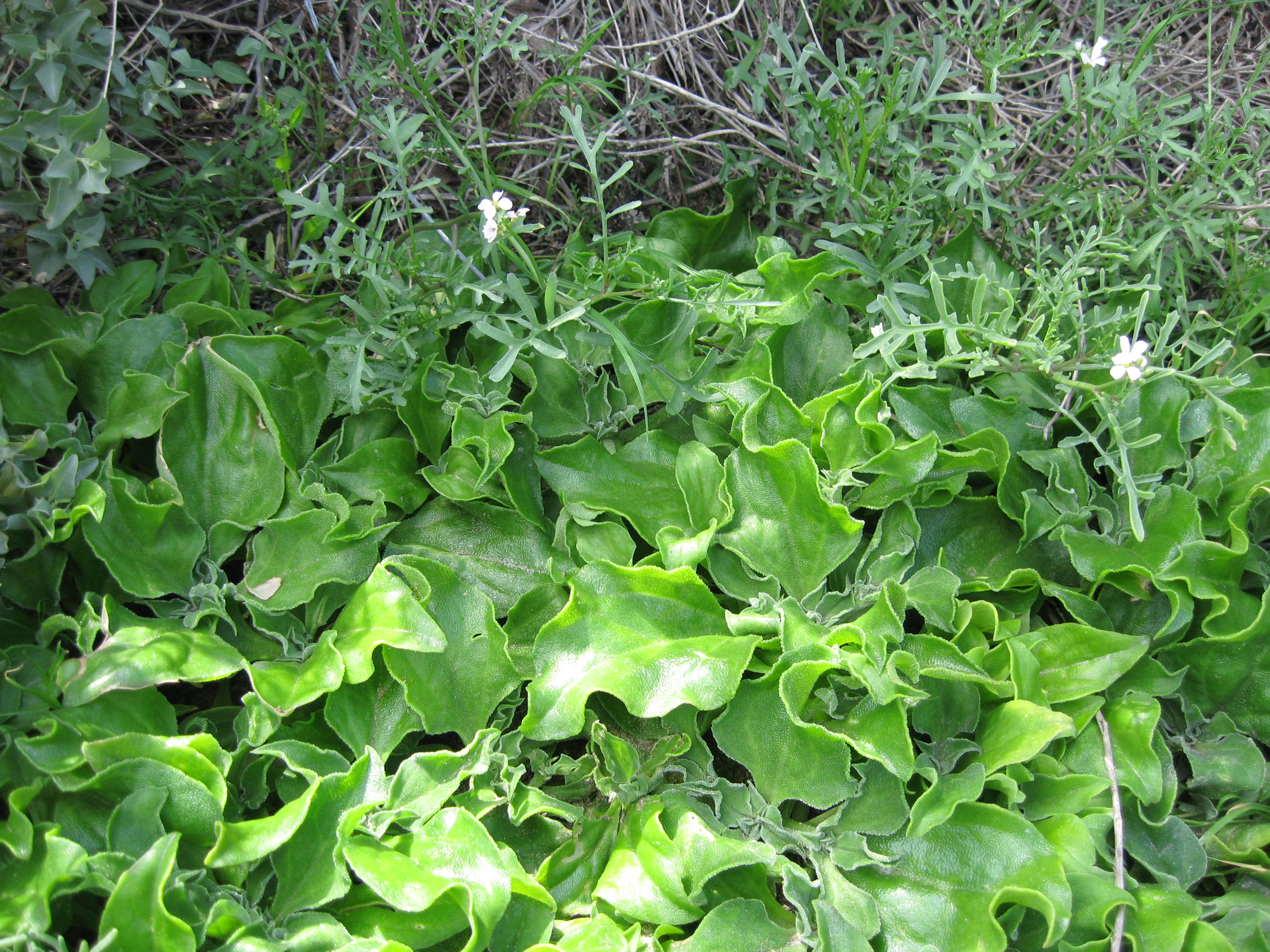
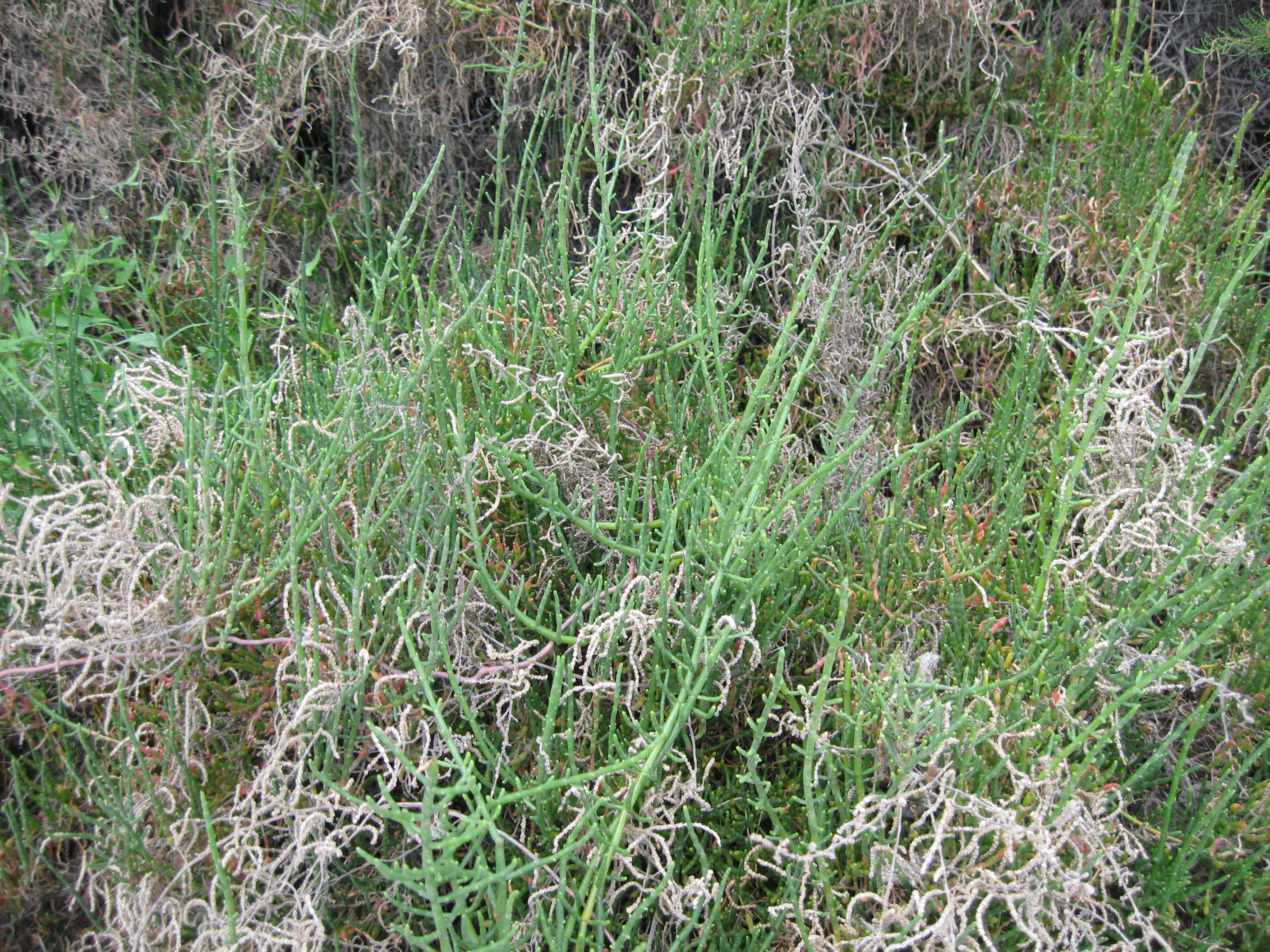
Along the seashore there are delicacies to harvest as well. Crispy bright green Samphire and the succulent leaves of the Ice Plant which are only tender enough  for a short time in the spring to be harvested. Even at this time of the year the Samphire that is in full sun all day has a tendency to be tough, so it is worth searching out bright green sprouts in shady spots. You need to take a pair of scissors and just trim off the tender ends into your bag. You can see from the photo just how you have to seek out this years tender shoots from last years dried out remains.Samphire

The Ice Plant – Mesembryanthemum Cristallinum – is so call because of the crystal-like cells that it has on its surface, particularly the underside of the leaves. To harvest the most tender of the Ice Plant leaves the same applies as the Samphire, look for brighter green leaves in the shade.

For both plants the uses are the same. You can give them a good wash and put them in your salads, steam them and add butter and a touch of lemon and have them to accompany fish, add them to stir frys and Thai curries. The Andalucian way is to make a Revuelto. This would include the wild garlic greens and asparagus, and if you are a bit flush some prawns. Fry the prawns and all your greens in some good olive oil until the prawns are half cooked and the greens a brighter colour. Add some beaten and seasoned eggs and over a very low heat stir until the eggs thicken into a creamy mass. Turn out onto warmed plates and eat immediately with crunchy fresh bread.

Meatballs & Chestnuts in Tomato Sauce

Tags

,

These are to go with the Potaoto Gnocchi of the previous post.

For four people

2 cloves of garlic

125 gms lean pork

olive oil

salt and pepper

small jar of passata

150 gms cooked and peeled whole chestnuts

Parmesan cheese grated

Sage leaves – fresh whole ones

In the food processor, finely chop the garlic. Cut the pork into cubes and add to the food processor with seasonings. Process to a fine mince.

Turn the mince out onto a floured board and with floured hands form into small meatballs. You will note that there is no egg to bind these meatballs, if you have lean meat then as it cooks the protein binds together, so you don’t need any extra binding. Likewise when you are making beefburgers, use good lean meat and seasoning, and you don’t need anything else.

Heat some oil in a shallow pan and fry the meatballs on a gentle heat until lightly browned on all sides. Cook a few at a time if the pan is not very large.

Once they are all browned, add the passata to almost cover the meatballs. Cook gently for another 15 minutes.

Passata is a wonderful sauce to have in your storecupboard. I make enough jars in the summer when the plum tomatoes are at their most flavoursome to last me for the whole year. It is not only a great way to preserve a bumper crop of tomatoes, but as you are making it yourself you can vary the flavours that you add to it. I do a batch with chilli added, one with coriander and lemon grass, one with strong basil flavour, another with oregano as the predominant flavour. Check out the blog in July for the passata recipe.

So back to the meatballs. Once they are cooked add the chestnuts to heat them through.

Now for the finishing touches.Heat some oil in a small sauce pan, and when hot add the sage leaves and fry until they are crisp. Drain on kitchen roll. Save the oil for flavouring future dishes.

Grate the parmesan.

Add the hot cooked gnocchi to the meatballs and gently stir to coat with the sauce. Dish up onto warm plates. Sprinkle over the grated parmesan and the fried sage leaves. Enjoy.

Potato Gnocchi

We are having rain showers at the moment which has cooled the air and heightened the fragrance of all the blossom that is in bloom. I have 400 lime trees and the nieghbouring finca several thousand orange trees that are all in bloom. The scent is heady. I wish I could bottle it and send it to you.

There is still plenty of fruit on the trees, the limes fruit and flower pretty much all the year round, so I am still busy making marmalades, pickles and conserves to sell in the farm shop. I will be sharing with you some of my tried and tested recipes for these in due course, but today lets think about lunch.

I have some boiled potatoes left over from a previous meal, so I thought potato gnocchi would be nice. If your only experience of gnocchi are those terrible heavy bullets that you get in the supermarket, think again and try these. Gnocchi can be made with semolina or with potatoes, and I by far prefer the potato version which is a light and fluffy dumpling. They are superb with a blue cheese sauce as a starter, or in this case make a great lunch mixed with meatballs and chestnuts in a tomato sauce.

POTATO GNOCCHI

500 gms floury potatoes – peeled weight

1  organic egg

75 gms plain flour

50 gms semolina – fine ground

salt and pepper

Cut the potatoes into cubes and boil in salted water until cooked but not too mushy. You don’t want them to be too wet. Drain and leave to cool completely.

In a bowl mash the potatoes. Add the beaten egg and mash to amalgamate with the potato. Check for seasoning and add freshly ground pepper and sea salt to taste.

Add the sifted flour and and the semolina, mash this in. By this time you should be able to form the dough into a ball. If it is too soft and wet, add a little more flour and semolina.  Handle the dough lightly so as to keep it soft.

Dust the work surface with plenty of flour and turn your dough out onto it. Taking a small ball of dough at a time roll it out with your hands into a cylinder, and then cut it into even sized pieces. Roll these again, very lightly between your hands to make small cylinders. Don’t worry if they are not all exactly the same, this is rustic food that we are making and light handling is more important than having your gnocchi identical.

Bring a large pan of water to the boil, add a little salt. When boiling start to add your gnocchi a few at a time. They want to be only one layer in the pan. After few minutes they will float to the surface. You can at this point scoop them out and either reheat them later or let them cool completely and dry a bit and then freeze them for another occasion. If you are generally cooking for one, then this is a good option as this recipe makes easily enough gnocchi for four meals.

If you are eating the gnocchi straight away, then let them cook for another three minutes after they have started to float. Drain them and then mix with whichever sauce you fancy.

I am afraid that you will have to tune into tomorrows blog for the Meatballs and Chestnuts in Tomato Sauce……….

Planning ahead

Tags

,

I had friends from England coming to stay for the weekend and wanted to invite more chums for dinner on the Friday night, but didn’t want to spend too much precious time away from my guests preparing the meal. I needed a menu where I could prepare much of the meal well in advance.  The obvious choice for the main course is a stew, which will only improve by having a day or two in the fridge to enable its flavours to deepen. My style of cooking is to keep it as simple as possible without compromising on flavour, so a well flavoured beef stew which only needs the accompaniment of a plain boiled potatoes or noodles, fits the bill.

In the storecupboard are some lovely dried ceps and chanterelles that my friends Ali and Peter brought back from one of their trips for me, so they will add richness and depth to my stew.

While checking through my storecupboard, I came across some mini pastry tartlets left over from Christmas, so I thought they could make the basis of the starter. Prawns bound together with egg custard and flavoured with chives fresh from the garden. There are plenty of fresh green leaves in the garden, rocket, coriander and various endives, with which to surround the tartlets.

And why not continue the storecupboard theme in the pudding? As fruit on the farm comes into season, we generally eat as much as possible fresh, but there are nearly always surpluses which if there is a lot would get preserved in syrup in jars, and if a small amount would be cooked and then frozen. Of the frozen there is a choice between red plums or caramelised pears. I fancy the tart plums with a crumble topping made in the usual way but with the addition of oats and crushed hazelnuts to add some extra texture and flavour. I did the crumbles in little individual ramekins so that once cooked all I needed to do was add a scoop of plain ice cream to them.BEEF AND CEP STEW

Pork fat, cut into tiny cubes

Stewing beef, preferably with some streaks of fat in it

Flour seasoned with plenty of salt and pepper

Dried ceps

Good stock

Stew vegetables – onion, carrot, garlic, celery, leek.

I have been deliberately vague about the amounts that you need in this recipe, as it depends on how many people you are feeding, and what size of appetites they have. Plus stew making is not an exact science, so you can add and substract depending on ingredients available and personal taste.

For this stew I wanted the flavour of plenty of vegetables in it, but without being able to see them. So to begin with  cut up all the stewing vegetables and added them to the stock in a large saucepan. Heat and then leave to simmer for at least half an hour or until the vegetables are very tender. Put the stock and vegetables through the coarse disk of a mouli so that you have a thin vegetable puree.

Put your mushrooms in a bowl and pour over enough boiling water to just cover them. Leave them to soak and reconstitute.

Next render the pork fat in a large shallow pan on a very low heat until all the fat has melted out of the pork.  Pork fat is great  for giving extra flavour, so when you are trimming pork of its excess fat, cut it into little cubes as you go along and keep it in small amounts in the freezer.

Cut the beef into pieces roughly 5 cm by 3 cm. Dust liberally with the seasoned flour and then brown and seal the pieces in the fat, turning to make sure that they are sealed on all sides. If you are cooking a large amount of beef, then brown the pieces a few at a time.

Once all the beef pieces are browned return them all to the pan and put in the stock enriched with vegetables to almost cover the beef. Drain the mushrooms reserving the juice and add them to the beef. Stir in. Add enough of the mushroom juice to just cover the beef, saving the rest in case it will be needed later to moisten the stew. Note that quite often there is a bit of grit in dried mushrooms, so when using the juice let any sediment settle to the bottom of it, and then pour the good carefully from the top leaving the last bit in the container.

Bring the stew to a simmer and cook very slowly for at least four hours. I have to admit that here is where I have a secret weapon, the wood burning oven featured above. I get this up to 180 degrees centigrade, put my stew in and let it bubble for a while and then I don’t add any more fuel at all. I let the stew cook all night in the slowly cooling oven. The result is a richness to the stew and a tenderness to the meat that is just superb. So do do try to replicate this method, and don’t be afraid of cooking your stew over a long period of time. Modern ovens are well insulated, so bring your stew to a simmer on the hob, put it in the oven at the above temperature for 40 minutes, then turn off the heat and go to bed. Try not to eat the stew for breakfast.

The next day once the stew is cool enough, put it in the fridge until needed. It will be fine for 2-3 days.

I like to serve stews with a Gremolata. Which is simply finely chopped parsley, garlic and finely grated lemon rind. Put a bowl of it on the table for your guests to season their stew with.

Green Aliolli

Tags

Some French cooks have laid claim to mayonnaise being an invention of theirs, but there is no logic to this claim. Notwithstanding that Mahon, which is the origin of Salsa Mahonesa, and thence Mayonnaise, is a port on the Island of Menorca in the Baleriac Islands of Spain, but spanish cuisine is rich with oil based sauces. There are several types of Aliolli which is a sauce flavoured with garlic, then there is Salsa Romesco flavoured with dried peppers and garlic and thicken with almonds which is served with shellfish, plus a myriad of green sauces with different combinations of herbs, garlic and chillies that are used to enliven everything that can be grilled, from spatchcocked quail to lamb chops to ‘Secreto de Cerdo’ (the secret bit of pork) in the meat range plus every type of fish.

I would like to lead you through the range of Aliollis. I am not going to start with the most basic, which is made by pounding garlic cloves and salt in a mortar with a pestle, and then slowly adding extra virgen olive oil until you have a thick sauce, for the simple reason that at this time of the year the dry garlic has been in store for quite some time and is not at its best for eating uncooked. The best garlic at the moment is spring garlic, with which one makes a light sweet Aliolli that is a beautiful pale green colour.

This sauce uses all of the egg and sunflower oil rather than olive. If you have had Aliolli in a restaurant while visiting spain, wether it was made with green garlic or the while cloves, the chances are that it was made this way. The texture of this Aliolli is much more solid and light at the same time than when using olive oil.Image

The other key thing to mention before you get started, is that all your ingredients must be at room temperature or above for the sauce to thicken. It is impossible to make any sort of oil based sauce with cold ingredients.

GREEN ALIOLLI

4 Spring garlic

I large egg

pinch of salt

300 ml sunflower oilImage

Clean off the outside layer and any tough green leaves of your garlics and then wash them. Chop them into chunks and put into the food processor, then blitz them to cut them up.

Add the egg and the pinch of salt. Process to cut the garlics smaller and mix the egg well.

Very slowly add the oil. It is ideal if your processor has a tube where you can add the oil as the mixer is on. If the sauce looks thin at any time, stop adding the oil until it thickens again.

Eat your sauce with crusty bread instead of butter, as a dressing on plain boiled potato cubes, with fish, with pork chops, with………..

The Dinner that Started it all……

Tags

, , , ,

This is the meal that inspired my friend Gines to insist that I start to write a diary of what I cook, which then led on to this blog, so I thought you would be interested to see the menu and recipes for this dinner.
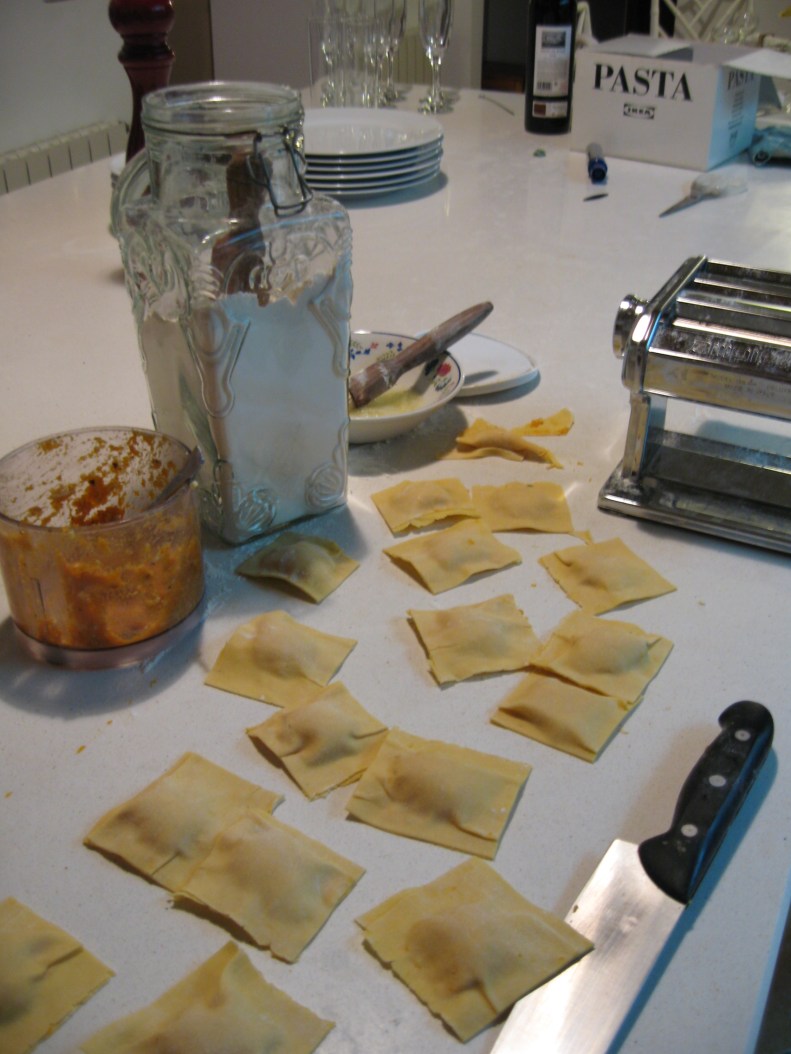
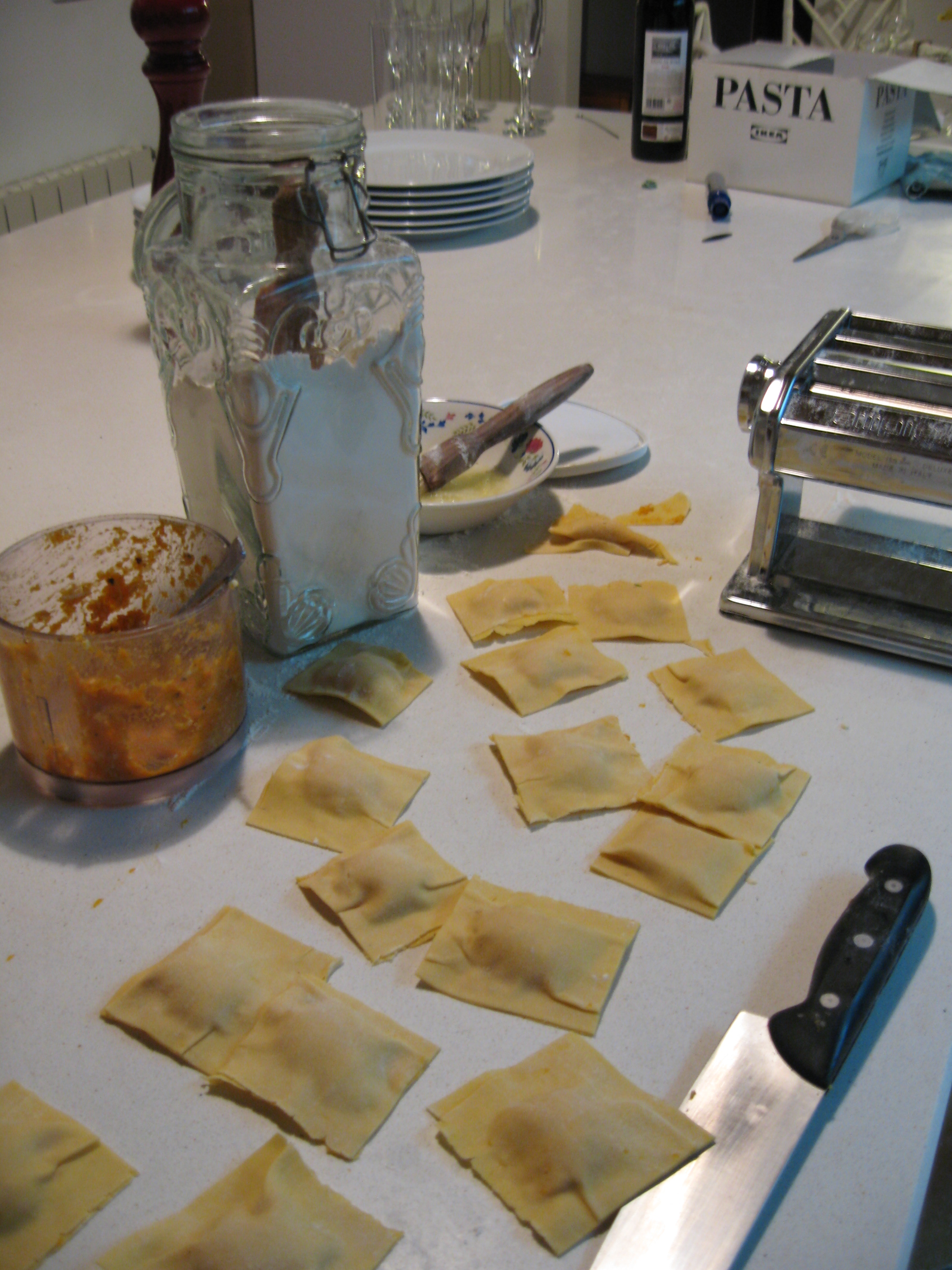
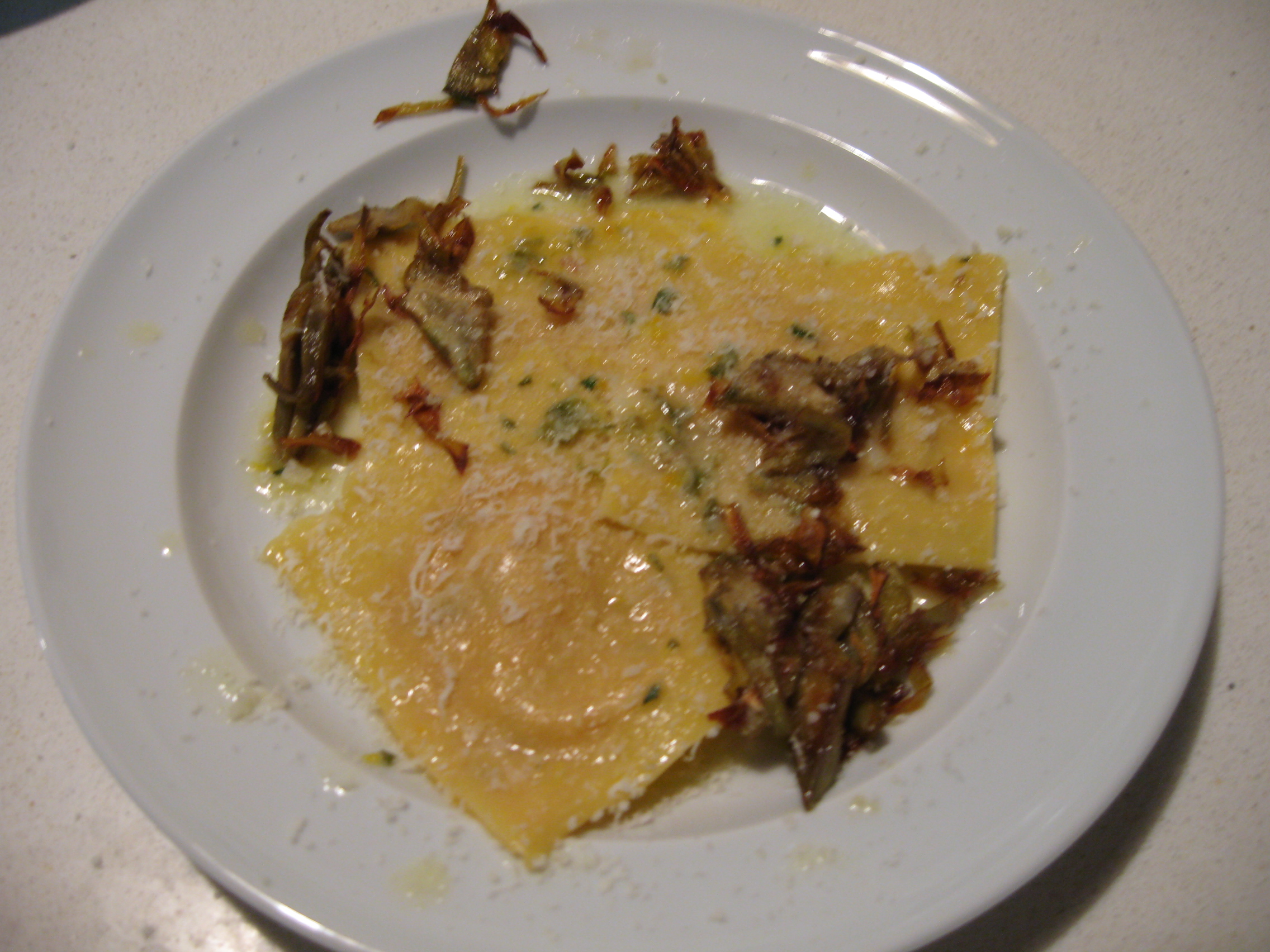
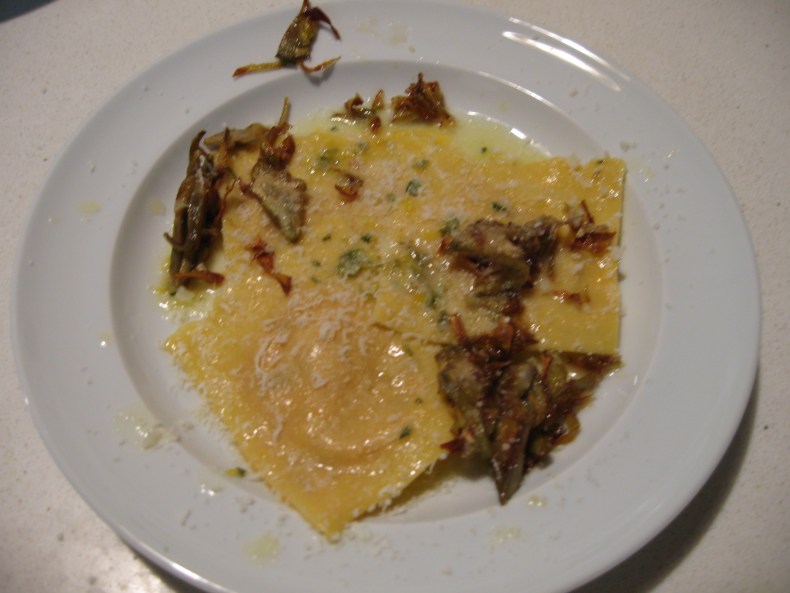
The starter was Butternut Squash Ravioli served with Lemon and Sage Butter. The tartness of the lemon in the sauce cuts thought wonderfully the sweetness of the butternut squash. In the photo I have garnished the ravioli with some fried artchoke slices – just in case you were wondering what it was.

After a soft textured and saucy starter the main course needed to be something crunchy. I always have a selection of salads in the vegetable patch, so a crispy green salad to accompany a nice fat piece of grilled fish, salmon in this instance.

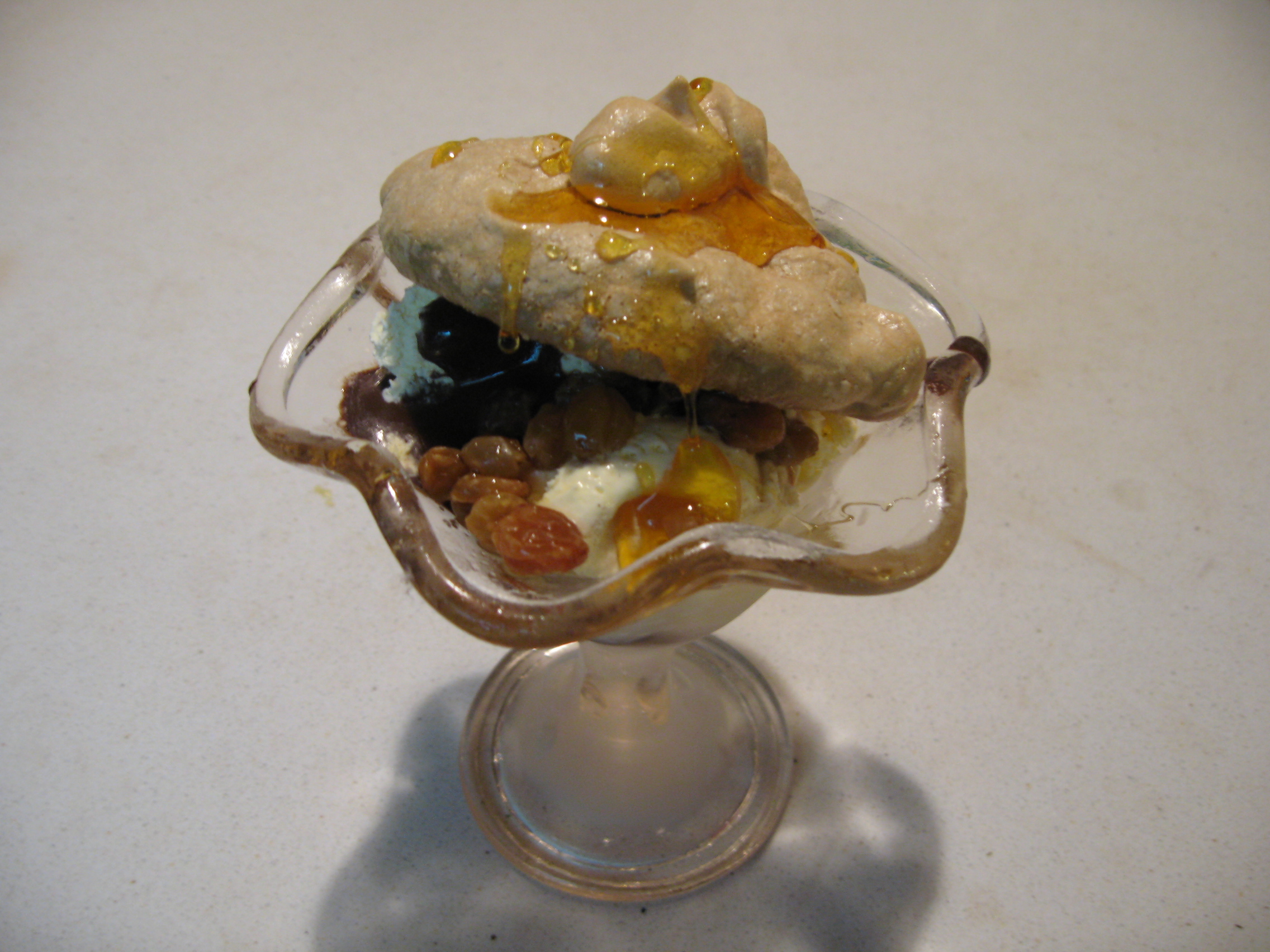
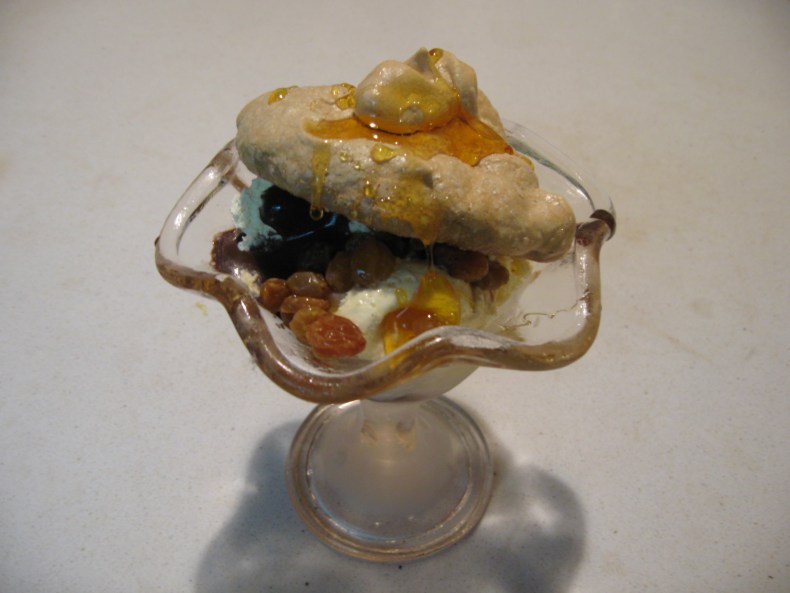
For dessert a grown up sundae. Vanilla ice cream, bitter chocolate sauce, rum soaked raisins topped with a coffee meringue and maple syrup. I see no shame in using a good shop bought vanilla ice cream as the basis for this type of dessert. Buy a sample tub from each of your local supermarkets to see which you like best, it may not be the one you expect. My favourite comes from a well known German supermarket chain.

BUTTERNUT SQUASH RAVIOLI

For 4 people
The pasta – 40 grammes 00 flour

2 large egg yolks

good pinch of salt

The filling – Half a medium sized butternut squash

30 grammes butter

2 tablespoons breadcrumbs

an egg white

50 grammes grated cheese

Salt and pepper

Another egg white for sticking the ravioli

The sage and lemon butter

                   50 grammes butter

                   grated zest and juice of half a large lemon

                    teaspoon finely chopped fresh sage

To serve – finely grated parmesan cheese

Firstly make the pasta. Put all of the pasta ingredients into a small food processor and blitz until you have a lumpy dough that will stick together. Remove dough and form into a ball. Wrap in cling film and put in the fridge until needed.

The filling. Peel and deseed the butternut squash and cut into rough cubes about 2cm square. Place in a saucepan with the butter. Cover and gently stew in its own moisture until tender, stirring from time to time to prevent sticking.When done put in the food processor and puree. Add the egg white, breadcrumbs and seasonings. Pulse to mix. Add the grated cheese and pulse again. Check seasonings. Put aside in the fridge for the breadcrumbs to absorb the moisture and bind the mixture.

Using a pasta machine roll the pasta in the usual way and roll into thin sheets – number 7 on my machine.  Cut into squares of the desired size – mine usually end up about 5 cm square. Put a blob of the butternut mixture in the centre of the squares, brush with egg white around the edges, put another square on top and gently squeeze the edges together. Dust liberally with flour and put in a tray in the fridge until needed.

Prepare the sage and lemon butter. Put all ingredients in a saucepan. Cover until needed.

All the above can be prepared some time in advance. Shortly before serving bring to the boil a large pan of water to which you have added salt and a tablespoon of olive oil. When boiling add the ravioli – they will only need three or four minutes to cook. Meanwhile put the sage and lemon butter on a low heat and swirl regularly to combine the ingredients. You do not want this to boil, only heat enough to amalgamate the ingredients then turn off the heat. Drain the ravioli and add to the pan containing the butter and swirl around to coat the ravioli.

Serve on warm plates and sprinkle with finely grated parmesan.

SOPHISTICATED SUNDAE

 Vanilla ice cream, raisins soaked in rum, bitter chocolate sauce topped with a coffee meringue and maple syrup. This turned out to be an absolute wow with my guests. Remember to put your sundae dishes in the freezer to chill them down at least two hours before they will be needed. They look so pretty with the frosting of condensation on the cool glass and help keep the sundae from melting before it gets to your guests.
For  coffee meringues for four, beat 5 egg whites until really stiff having added about half way through the beating half a sachet of instant expresso coffee powder. To this I beat in 250 grammes of caster sugar.

To bake the meringues, heat the oven to 180 degrees F. Line your baking tray with baking paper and make mounds of meringue. This amount of mixture made 14 – more than was needed – but they do keep.

Once the oven is hot put in the meringues and turn the oven down immediately to 140 F. Bake for one hour by which time they should be crisp and crunchy on the outside and still a bit gooey on the inside. Let cool before removing them from the tray and using or storing.

It is very easy to make your own chocolate sauce and it gives you control over the sweetness or richness that you want for your dish.

For this sauce put a couple of heaped tablespoons of good cocoa powder – the unsweeted one – in a small saucepan and add black coffee bit by bit to make a thin sauce. At this stage add a dessert spoon of brown sugar. Heat slowly until the sauce comes to the boil. Continue cooking on a low heat for 20 minutes stirring regularly. The sauce will thicken and darken during this cooking time. If you think that it is too thick add a bit more coffee. Taste the sauce and add more sugar to your taste if you like but stir the sugar in well to dissolve it.

Once cooled this sauce will keep quite a long time in a jar in the fridge. It can also be frozen for an intense sorbet. If you want a richer sauce to serve hot you can add a knob of butter at the beginning.

To assemble the sundae start with a spoon of the vanilla ice cream, a dribble of chocolate sauce, a spoon of raisins with some of their rum. Repeat these layers then top with a coffee meringue and a drizzle of the maple syrup. Enjoy!

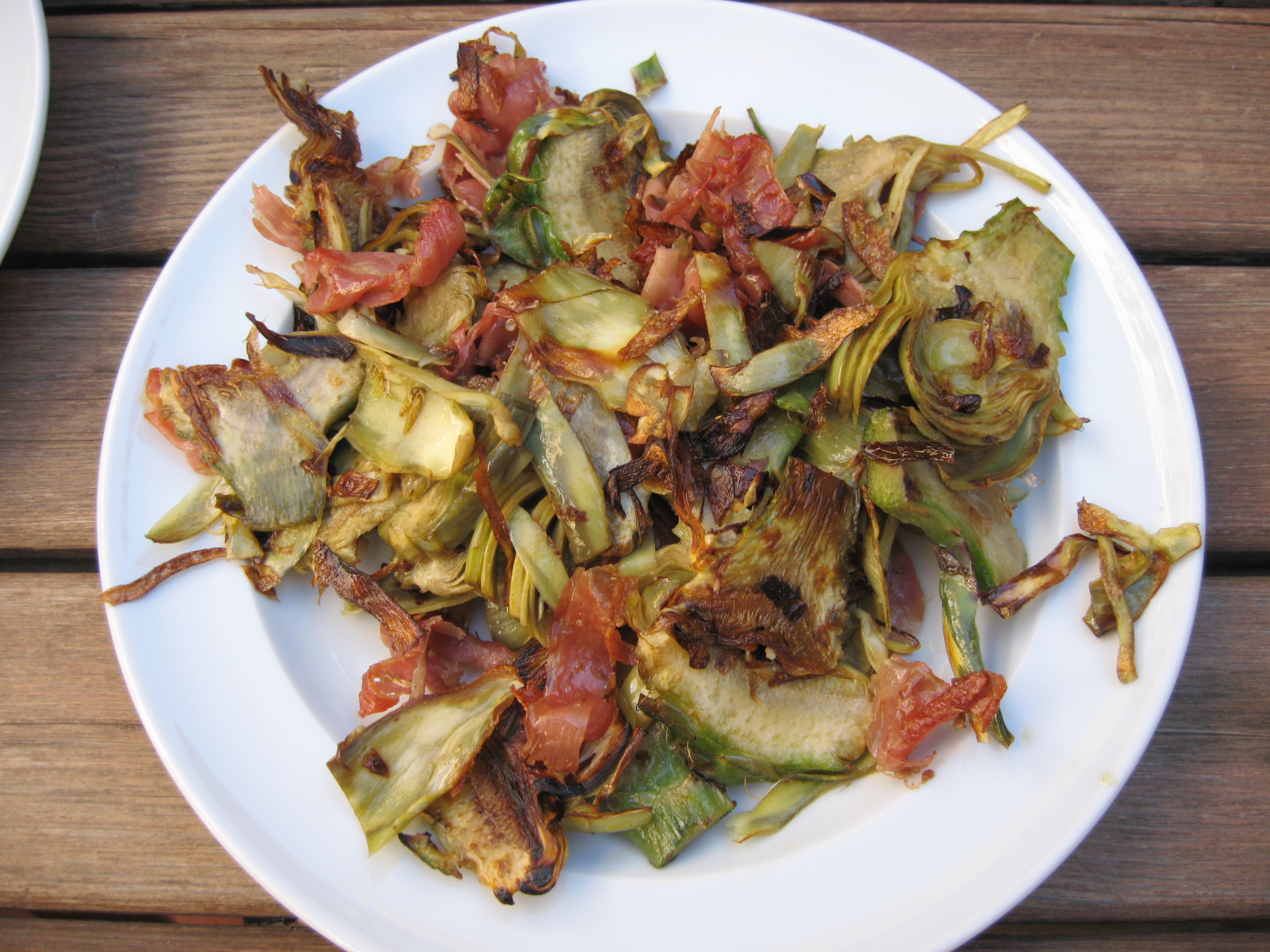
Artichokes with Ham

Put some extra virgen olive oil into a shallow pan and heat slowly. Finely slice the artichokes and immediately put into the hot pan in a single layer. Work as quickly as you can, putting each artichoke into the pan as soon as it is sliced before it has the time to discolour. Once you have all your artichokes in the pan start to turn them over and toss them. At this point the heat can be turned up a little to cook the artichokes more briskly. Add more oil if you think that the contents of the pan are too dry..

Have ready sliced and cut into bite sized pieces some Serrano or Parma Ham. Add to the artichokes and continue cooking. The artichokes taste best if they are allowed to brown a little and to crisp slightly round the edges. Check the seasoning and add salt as necessary. Serve on warmed plates.

Globe Artichokes

I have Globe Artichokes in my veg patch, but mine are a late variety and so are not ready yet. Every year I say that I am going to put in a few plants of an earlier variety and every year I don’t get round to it. So as I am impatient to eat artichokes I will just have to go to the market and buy some.

Some of you out there are still quite fazed by this tasty and versatile vegetable, not helped by the styles of growing and preparing them being different in each country that grows them. I will take you through how to select, prepare and cook artichokes in the manner that is done here in Spain.

The part of the artichoke plant that is generally eaten is the flower bud. For these to be tender you want to select smallish tightly closed buds. If the buds are opening in the centre then the hairy choke has developed too much and does not make for pleasant eating. Another point to bear in mind is that the early season artichokes that are in the markets when the weather is still quite cold will be much more tender than the late season ones. As soon as the weather starts to really heat up then the artichokes will toughen to protect themselves against the heat.

When it comes to preparing the artichokes, you have to do it fast as any cut parts discolour quite quickly. You can put them into water acidulated with lemon juice, but if you are going to fry them as we are today, then you want them dry.

Firstly cut the stalk about a centimeter below the bud. Then start pulling of the tough outer petals from the bottom. You will know when you have pulled off enough and reached the tender part of the artichoke as the flesh of the petals changes colour to a much paler green as in the photo below.

Then you cut off the tips of the petals, again you will see where the colour changes from a darker green to a paler more yellow colour, this is the line where you cut. The artichokes can be either left whole or halved or quartered or sliced depending on your recipe.

Rocket and Walnut Pesto

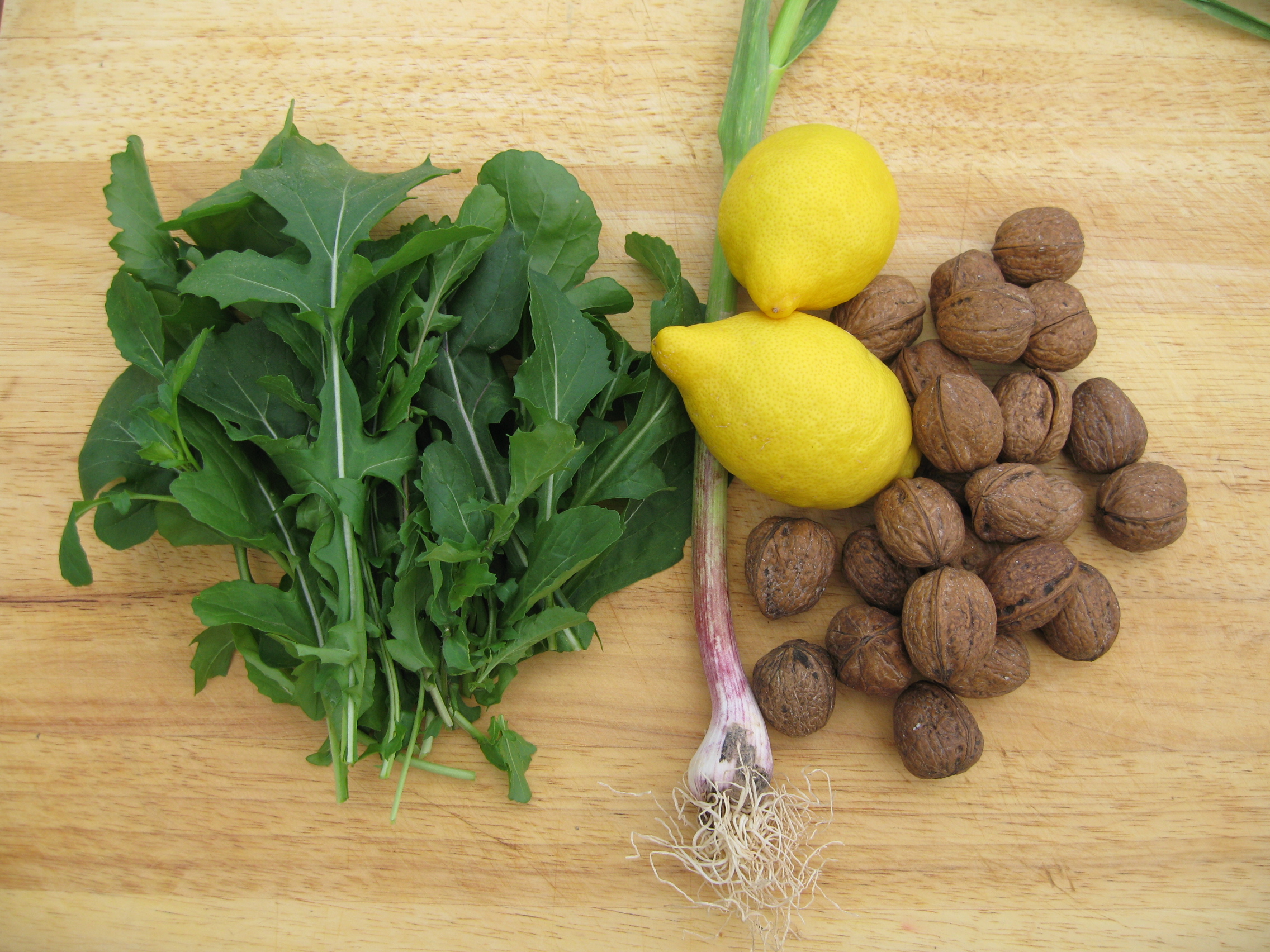
Spring has suddenly arrived and the the warmer weather is making the rocket in my vegetable patch race away. What I cannot use fresh I make into pesto. Although pesto made with basil is the best known, it is a very useful method of preserving all the more delicate herbs that do not dry well.

This recipe combines the peppery flavour of rocket with the sweetness of roasted walnuts and the acid of fresh lemon juice, but you can also make a more oriental version with fresh coriander, lemon grass and lime bound together with either sesame oil or olive oil. These sauces will keep up to ten days in the fridge, but if you pack the paste into sterilised jars making sure that there are no air bubbles and then pour at least one centimeter of oil on it to create a seal, it will keep for several months if stored in a cool dark place.

For Rocket and Walnut Pesto you will need;

100 gms rocket – washed and dried

100gms walnut pieces

1 stem spring garlic

walnut or extra virgen oilive oil

the juice of half a lemon

salt

Firstly roast the walnuts. Heat a thick bottomed pan on a low heat and add the walnuts.  Toss from time to time to turn the nuts. They are done when the oils in the walnuts give off a rich odour.

Put the nuts together with the rocket, chopped garlic and a couple of tablespoons of oil into the food processor and whizz to a pulp. Add more oil to get to a paste consistency. Add the salt and lemon juice bit by bit tasting as you go along until you find that the seasoning and balance is right.

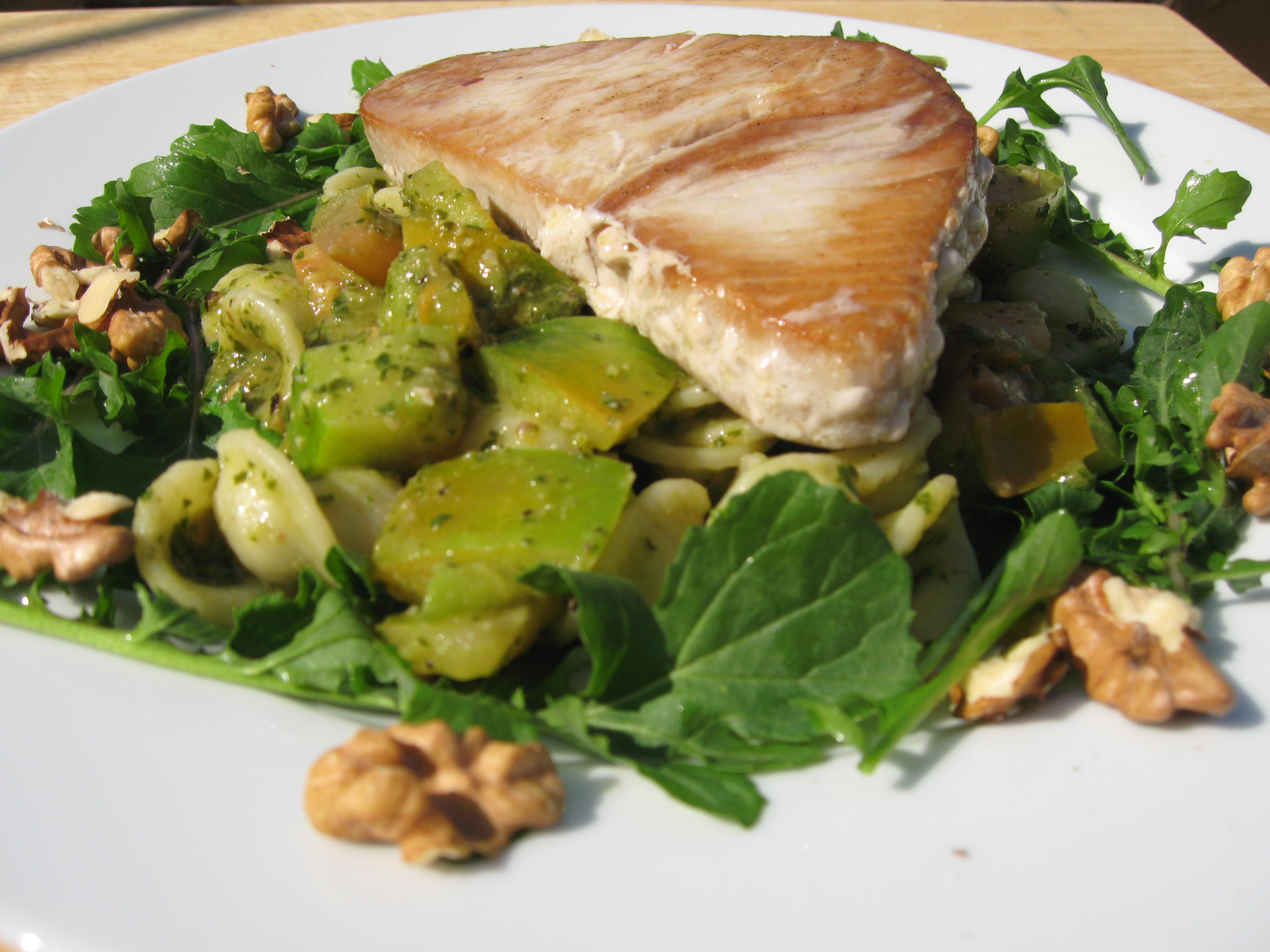
Thats it. This pesto goes particularly well with fish and that is what I am having it with today. I’ve used it as a sauce on the pasta shells to accompany a piece of grilled tuna.