• About
  • La Micaela Farm Shop

fincafood

~ culinary and horticultural life on a Spanish farm

Author Archives: Nevenka

Sweet,Salty & Spicy Almonds

29 Friday Aug 2014

Posted by Nevenka in Snacks and Tapas

≈ Leave a comment

Tags

Allspice, Almonds, Cardamoms, Cloves, Coriander, Salt & Sweet

This years almond crop is being harvested and the creamy fresh nuts always make me think of Ajo Blanco, a cooling and delicious soup that is a speciality of the area around Cordoba. The best one that I was served there was in the restaurant Casa De La Judia in the old town. Pale and smooth with no one flavour dominating and the consistency of a light cream, it was garnished with tiny cubes of sweet apple and halves of white grapes which added to the balance of the flavours.
IMG_1301

Of course once I got home I had to perfect my own recipe – but you are going to have to wait until the next post for that, firstly I want to use up the few remaining almonds from last year.

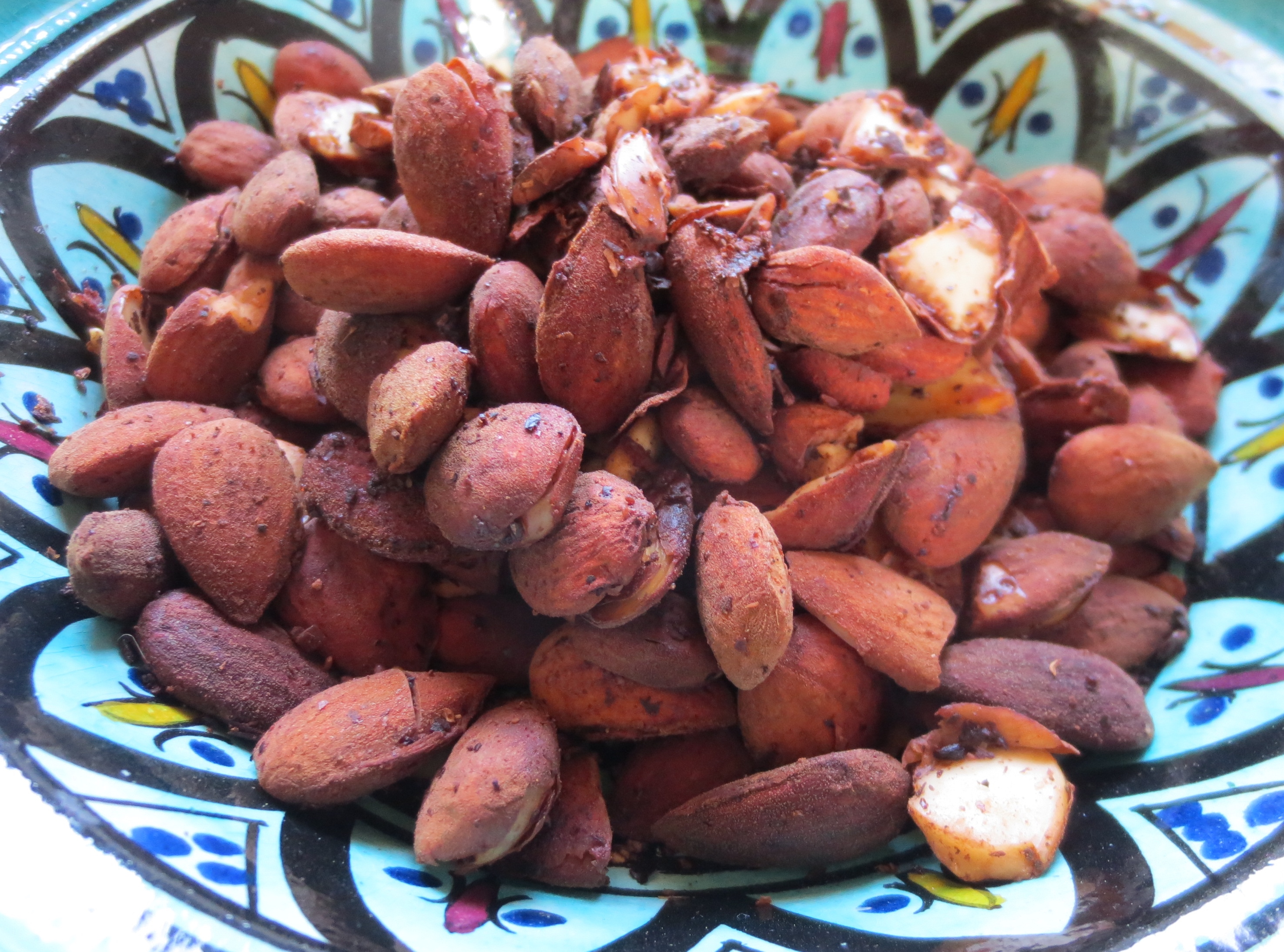
At some time in the dim and distant past I remember making sugared almonds but with a difference – they had spices mixed into the caramel. They were delicious and I may well make them again, but this time I wanted to include the spices but cut down drastically the amount of sugar used, and I like the mixture of salt and sweet, so I added some salt. Here is the resulting recipe.

IMG_1298

SWEET, SALTY AND SPICY ALMONDS
200 grams almonds – with or without the brown skin
Half teaspoon salt
1 teaspoon brown sugar
3 cloves
6-8 allspice berries
Half a teaspoon coriander seeds
The contents of 3 green cardamom pods
Quarter of a teaspoon hot chilli powder

Firstly we need to toast the spices before grinding them. Put the cloves, allspice berries, coriander seeds and cardamom seeds in a thick based pan and toast them on a low heat shaking from time to time until you can smell the aromas of them starting to be released.

Put them in a mortar and grind to a powder.

Add the chilli powder, salt and pepper, and mix.

Warm a thick based shallow pan on a low heat and add the almonds. Toast slowly moving the almonds around for even browning.

After a couple of minutes add the spice mix and continue toasting and stirring.

Once the almonds are browned add about a tablespoon or so of water and stir to mix well.
This will help the spice and seasonings stick to the almonds.

The water may disappear quite quickly, or you may need to continue on the heat until the almonds are dry again.

Let cool and serve as an aperitif……. and try not to sample too many before your guests arrive!

Share this:

  • Share on X (Opens in new window) X
  • Share on Facebook (Opens in new window) Facebook
  • Share on WhatsApp (Opens in new window) WhatsApp
  • Email a link to a friend (Opens in new window) Email
Like Loading...

The Larder – Bethnal Green – London

11 Monday Aug 2014

Posted by Nevenka in Food for One, Main Courses, Snacks and Tapas, Vegetable Dishes

≈ 5 Comments

Tags

Beans, breakfast, guacamole, mexican, mushroom, Vegetarian

I don’t generally consider restaurant reviews to be part of what this blog is about, but the food in this vegetarian cafe is so good that it cannot not be mentioned. All the meals that I have ordered here have been so thoughtfully composed, executed and presented. Whoever designs the dishes has a real understanding of how to mix flavours and textures, and never forgets to consider how the components will look on the plate.

Today I treated myself to a Mexican breakfast – which I had for lunch.

IMG_1283

In the little brown pot beneath the grilled half mushroom, fried egg, guacamole and fresh coriander leaves was a rich and spicy tomatoey sauce thick with black and pinto beans, corn kernels, red peppers, celery and onions. There was just enough chilli to give it oomph without overpowering the rest of the ingredients, and it was fragrant with the flavour of garlic and coriander seeds.

Below the deep fried Padron peppers in the other pot was a flavoursome but not hot jalapeño purée. The tortilla chips were freshly deep fried and crispy.

I look forward to trying their egg and chips, one of the most appetising looking egg and chips that I have ever seen. Served on one of those pasta plates that is like a shallow soup bowl, there is a base of freshly made tomato sauce topped with a stack of fat crispy polenta chips which likewise is topped with a fried egg.

I hope it is on the menu next time I visit this restaurant.

http://www.worldslarder.co.uk

Share this:

  • Share on X (Opens in new window) X
  • Share on Facebook (Opens in new window) Facebook
  • Share on WhatsApp (Opens in new window) WhatsApp
  • Email a link to a friend (Opens in new window) Email
Like Loading...

Arroz Negro – Black Rice

21 Saturday Jun 2014

Posted by Nevenka in Fish, Food for One, Main Courses

≈ Leave a comment

Tags

arroz, Arroz Negro, mussels, Paella, prawns, Rice, squid

IMG_1199

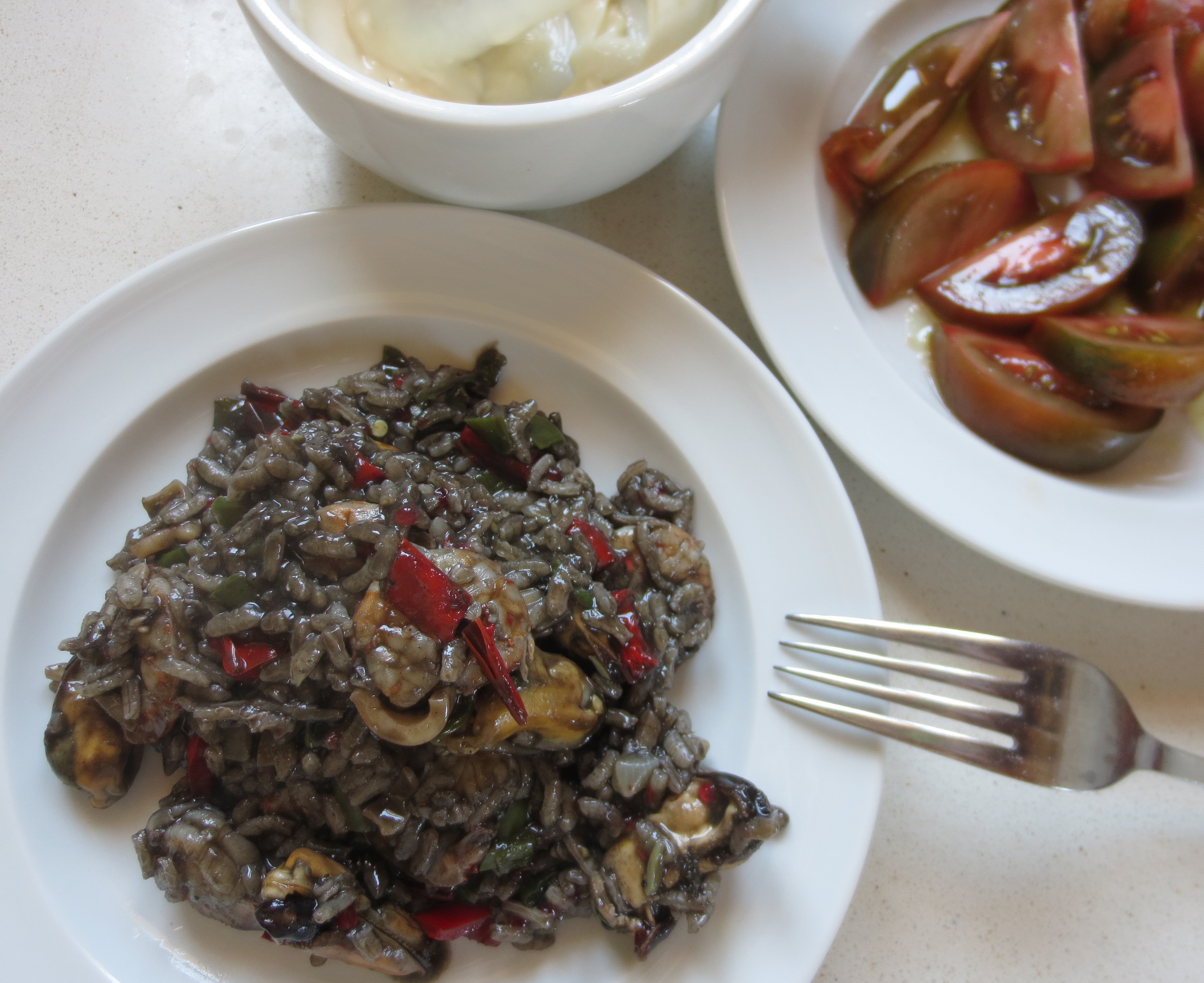
Continuing on the rice theme, here is my favourite seafood and rice dish. It is fairly simple to make and does not have many ingredients, but the flavour of the squid ink and seafood mixed with that of the chilli and onion makes for a rich tasting dish. I regularly cook it just for myself.

FOR 6
3 tablespoons olive oil
1 medium onion – finely chopped
1 red pepper – chopped into small squares
1 green pepper – chopped into small squares
Half a red chilli – finely chopped
500 grams squid
500 grams mussels
500 grams prawns
250 grams rice
500 ml fish stock
500-750 ml chicken stock
Salt and pepper

Let’s start by preparing the fish.

Remove the innards from the squid and carefully remove the ink sacks into a small bowl. Cut the tentacles from the innards and save discarding the rest.

With the ink sacs, you need to break them open to release the ink and press them with the back of a spoon to make sure that it is all out before discarding the sac. In some places it is possible to buy the ink frozen in little sachets which saves on the fiddle of extracting the ink.

Wash the squid bodies and tentacles and dry them on kitchen paper. Cut the bodies into thin circles. If the tentacles are small leave them whole, but if large cut them smaller.
Clean the mussels and steam them open.

A lot of cooks like to cook the mussels in the rice, but I find that there is often grit in the mussel shells and so prefer to open them separately and then sieve the liquid. Also some mussels are extremely salty, so if you have their liquor apart, you can taste it for saltiness before deciding how much to add to your dish.

If I am making this rice just for myself, I use ready cooked and shelled mussels that I buy frozen and keep in the freezer for these sort of mixed fish dishes that only require 5 or 6 mussels.

The prawns can be left in their shells to be opened at the table, but if you prefer for easier eating, they can be de-headed and peeled now.

Heat the oil in a large shallow pan and add the onions. Fry gently until translucent.

Add the peppers and chilli and keep cooking gently for five to ten minutes.

Add the squid and and continue frying gently for another five minutes.

Add the rice and stir well to coat with all the other ingredients in the pan. Fry for about five minutes.
Mix a little of the fish stock into the ink to dilute it and add it to the pan with the rest of the fish stock. Mix well.

Cover and leave to simmer for about five minutes. If it is starting to look dry add some of the chicken stock.
After another five minutes add the prawns if they are in their shells and the liquor from the mussels. Check the seasoning in the liquor in the pan and add salt and pepper as required. Add more chicken stock if needed.

Continue cooking until the rice is at the al dente stage – cooked but with firmness in the centre.

using unshelled prawns add at this stage and then a couple of minutes later add the mussels and let them warm through.

Let the rice rest for five to ten minutes.

Serve with Alioli and a tomato salad.

IMG_1201

Share this:

  • Share on X (Opens in new window) X
  • Share on Facebook (Opens in new window) Facebook
  • Share on WhatsApp (Opens in new window) WhatsApp
  • Email a link to a friend (Opens in new window) Email
Like Loading...

Spanish Rice Dishes – Arrozes

15 Sunday Jun 2014

Posted by Nevenka in Food for One, Main Courses

≈ Leave a comment

Tags

arroz, butifarra, conejo, La bomba rice, Paella, Paella de Conejo y Butifarra, Rabbit, Rice, sausage

The Spanish take their rice very seriously, and the other day I was discussing with a group of friends which their favourite rice dishes were, their favoured cooking methods, what variety of rice is best and should you include garlic and onions or not it? Can a good paella be made without rabbit? We all agreed, no.

It occurred to me that I had not shared any Spanish rice recipes with you. I am about to rectify that lack.
The one thing that all rice dishes here have in common, is that the rice is cooked in a flavoured liquid, and so the short to medium grain varieties of rice which absorb much liquid without disintegrating, are the ones used.
The best rice we all agreed is Bomba from Calasparra. The only rice cultivated here not at sea level, but in the flood plains of several rivers in the mountains where it grows slowly in the cool water, letting it develop lots of flavour. Consequently it is more expensive than other rice, but you get what you pay for.

IMG_1211

Cooking the rice outside on an open fire is unanimously the favoured cooking method preferred by my friends, although whether this is more to do with the atmosphere of gathering friends and family together and all pitching in with either ingredients to go in the rice or little starter dishes, rather than the actual flavour of the rice, I am not sure.

The paella illustrated above and cooked by my camera shy neighbour Paca, was made with rabbit, pork ribs, artichoke quarters and red and green peppers.

Obviously this method of cooking rice is not available to most of us, and is best suited to cooking for a good number of people, but that does not mean that a good paella for as few as one person cannot be successfully prepared in your own kitchen. The flavour of the fire can achieved by the addition of a pinch of good smoked pimenton or paprika.

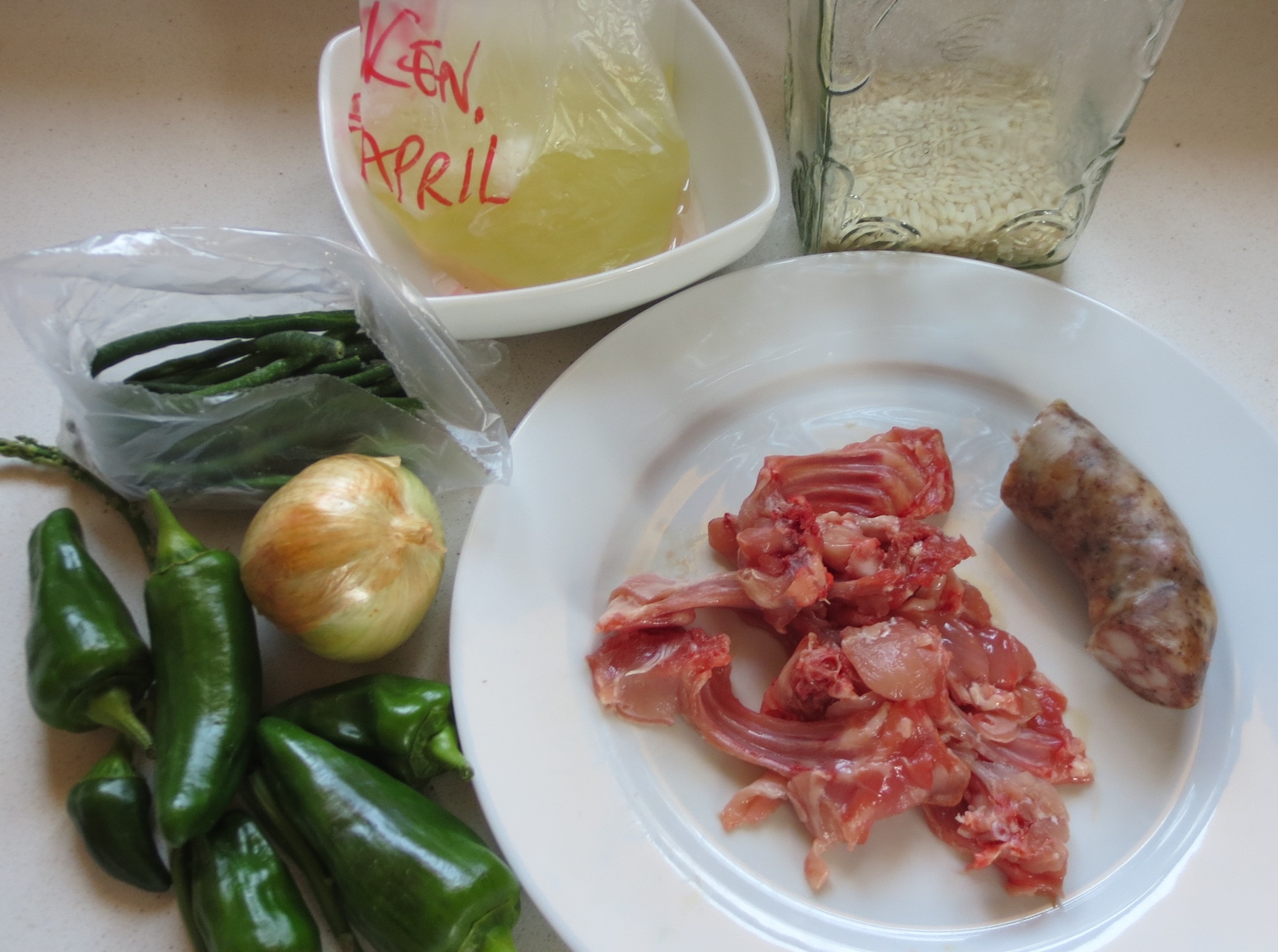
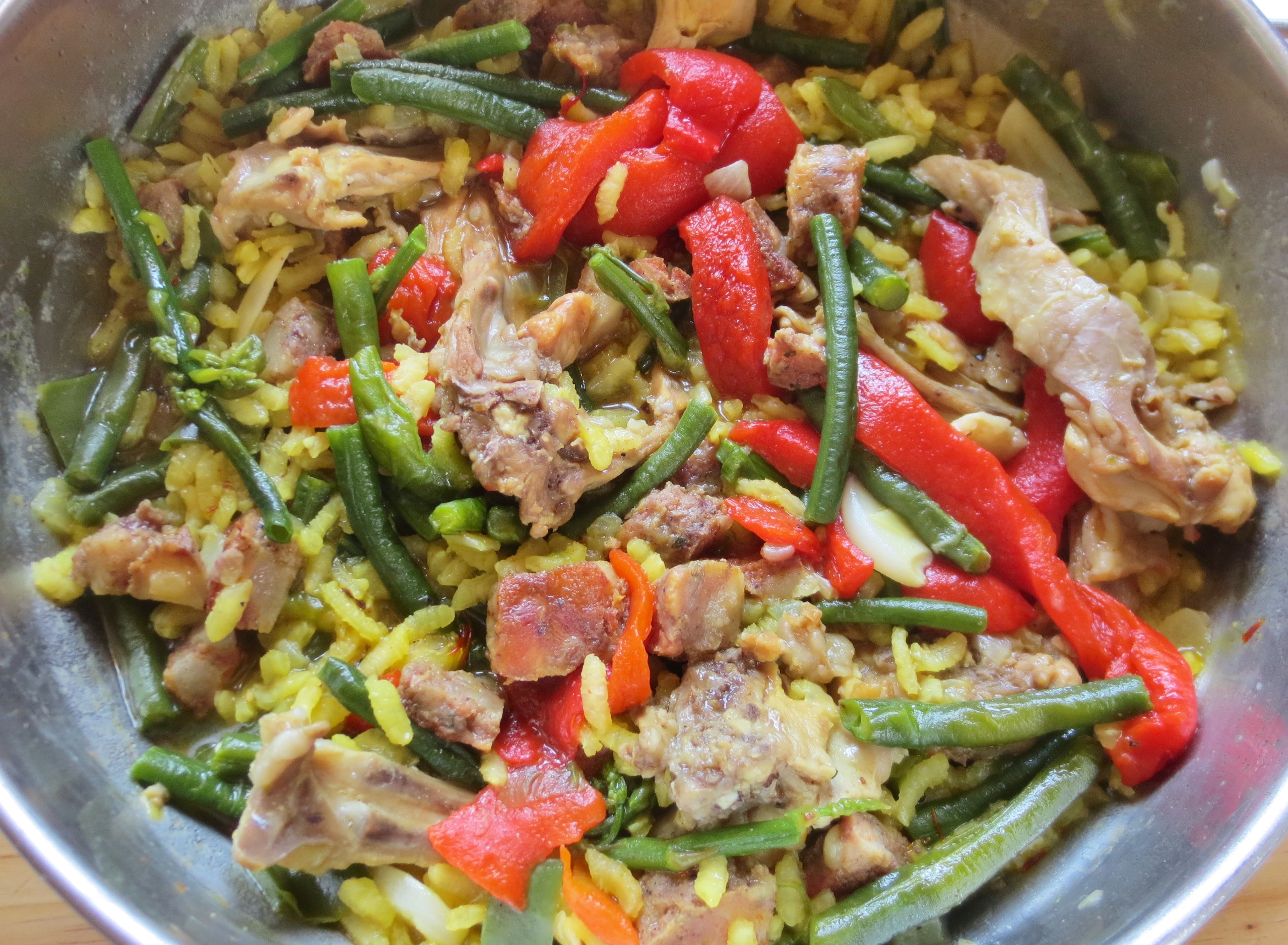
There are as many paella recipes as cooks, and many are simpler and have fewer ingredients than the celebratory Paella Mixta with its several varieties of seafood plus chicken, rabbit, and pork ribs for the meat. I am going to start with my favourite which has as its two main ingredients, rabbit and butifarra sausage. The sausage is quite highly spiced, so if the butifarra is not available, use any other peppery sausage.

IMG_1192

PAELLA DE CONEJO Y BUTIFARRA
For Six
1 rabbit – cut into chunks with the bones in
1 Butifarra sausage of aprox 350 grams
1 onion – cut into small dice
1 red pepper cut into strips or small squares
1 -2 green peppers – cut into small squares
250 grams short grain rice – La bomba or any of the risotto rices
1 – 1.25 litres light stock
Saffron – 2 good pinches
Pimenton – 2 pinches
Salt and freshly ground black pepper.
300 grams French beans – cut into short lengths

IMG_1196

Peel the sausage, cut into quarters lengthways and then into thick slices.

Put into a shallow pan on a low heat for the fat in the sausage to render out. If you are using a very lean sausage, then add some olive oil in which to gently fry the sausage.

Add the onions and fry slowly until transparent.

Add the peppers and again fry slowly for about 10 minutes.

Add the rabbit pieces and fry turning from time to time until sealed all round.

Now add the rice and stir in to make sure that it is coated with all the fat and juices from the other ingredients. Fry for about five minutes to let the rice absorb the juices.

Crumble into the pan the saffron and add the pimento. Stir well.

Now add the stock. Start with about three quarters of the amount stated.

Bring to a simmer and keep the heat low. Cover and let cook for about ten minutes.

Stir the rice. Add the beans.

Add more stock if needed. Check the seasoning and add salt and pepper as needed.

Leave to cook until the rice is cooked but still slightly firm in the centre and the stock has been absorbed.

Turn off the heat and leave the rice covered to rest for about ten minutes.

Serve.

Next time – Arroz Negro – Black Rice made with seafood and a hint of chilli………

Share this:

  • Share on X (Opens in new window) X
  • Share on Facebook (Opens in new window) Facebook
  • Share on WhatsApp (Opens in new window) WhatsApp
  • Email a link to a friend (Opens in new window) Email
Like Loading...

Braised Chicory

12 Monday May 2014

Posted by Nevenka in Vegetable Dishes

≈ Leave a comment

Tags

Braised, braised chicory, Chicory, Vegetables

IMG_0076

At this time of the year the chicories that I have been enjoying all through the winter are starting to get a little big and too bitter to be eaten raw. Actually what happens is that the chicories cut for salads sprout new tender leaves and so these I use for salads, and then other chicories get left and get too big.

After a lot of effort is put in to grow something, it cannot be wasted.

When I was in Sicily a couple of years ago, I was served cold spicy cooked chicories as part of a mixed starter and it was delicious and is the inspiration for this recipe.

This method works well for the pale Belgian chicories as well as lettuce that have grown large.
IMG_1166

4 large heads of Chicory – washed and outer leaves removed
60 ml olive oil
60 ml balsamic vinegar
150-200 ml chicken stock
Large pinch of chilli flakes – to taste
Salt and freshly ground black pepper.

Cutting top to bottom, cut the heads of chicory in half.
Warm the oil in a shallow thick based pan that will take the chicories in one layer. Once the oil is hot add the chicories, cover and fry gently until browned.
Turn the chicories over and fry on the other side, again until browned.
Add the balsamic vinegar, chilli flakes and season with salt and pepper.
Add just enough stock to almost come to the top of the chicory layer.
Leave to cook slowly for 10 minutes.
Turn over the chicories. The liquid should have reduced. If you think that it is too dry, add a little more stock but go easy.
Continue cooking until the chicories are cooked and tender and the liquid reduced to very little.
Serve either as a vegetable with a main course, or cold as part of a mixed starter, or as a pizza topping with some goats cheese.

Share this:

  • Share on X (Opens in new window) X
  • Share on Facebook (Opens in new window) Facebook
  • Share on WhatsApp (Opens in new window) WhatsApp
  • Email a link to a friend (Opens in new window) Email
Like Loading...

Berenjenas en Escabeche – Aubergines in Spicy Sauce

11 Sunday May 2014

Posted by Nevenka in Preserves, Techniques, Vegetable Dishes

≈ Leave a comment

Tags

Aubergine, Berenjenas, Escabeche, preserves. pickles, Vegetables

When you grow aubergines the first year plants will start to give you fruit in June or July and then continue until about November or early December depending on the weather. You can take out the plants at this point and start again the next year, but with the frost free winters here I can leave mine in the ground. They will have a little rest for a month or two and then start to produce fruit again. The fruits tend to be smaller and paler than the summer fruit, but plentiful.

IMG_1118

When there are more than I can eat fresh, I like to cook them in this spicy sauce and bottle them for serving as part of a mixed starter later. Escabeche is a method used a lot here in Spain for preserving usually fish. It is highly flavoured with garlic and smoked paprika, and then vinegar and white wine are used to aid the preserving process.

For a slightly more eastern mood to the escabeche for preserving aubergines I like to add some cumin seeds and use quite a hot piquant paprika.

500 grams  small aubergines

1 head garlic

150 ml olive oil

150 ml white wine

150 ml white wine vinegar

15 ml cumin seeds

30 ml smoked paprika – picante

Salt

To cook the preserve you will need a large shallow thick based pan in which you can cook the aubergines in one layer.

Divide the head of garlic into cloves and peel each one. If some are very large slice them in half.

Wash the aubergines and remove the stalks. Cut the fruits in half from top to bottom.

Heat the oil in the pan and add the garlic.

Once the garlics start to sizzle turn them over and move them to the edges of the pan.

Add the aubergines cut side down and fry gently for 5 to 10 minutes until golden brown.

IMG_1120

Turn over and fry on the other side.

Add the cumin seeds and paprika, then the vinegar and wine. Shake the pan to mix the spices and liquid without disturbing the aubergine pieces.

Add enough water to just cover the aubergines and season with salt, half a teaspoon.

Cook covered for 5 minutes.

Gently turn over each of the aubergines, I use tongs for this, and continue cooking covered until the aubergines are cooked through but not mushy. This should take between 5 and 10 minutes.

Some of the liquid will by now have been absorbed by the aubergines and so will look reduced.

Put the aubergines while still hot in hot sterilised jars, seal them and cool.

IMG_1173

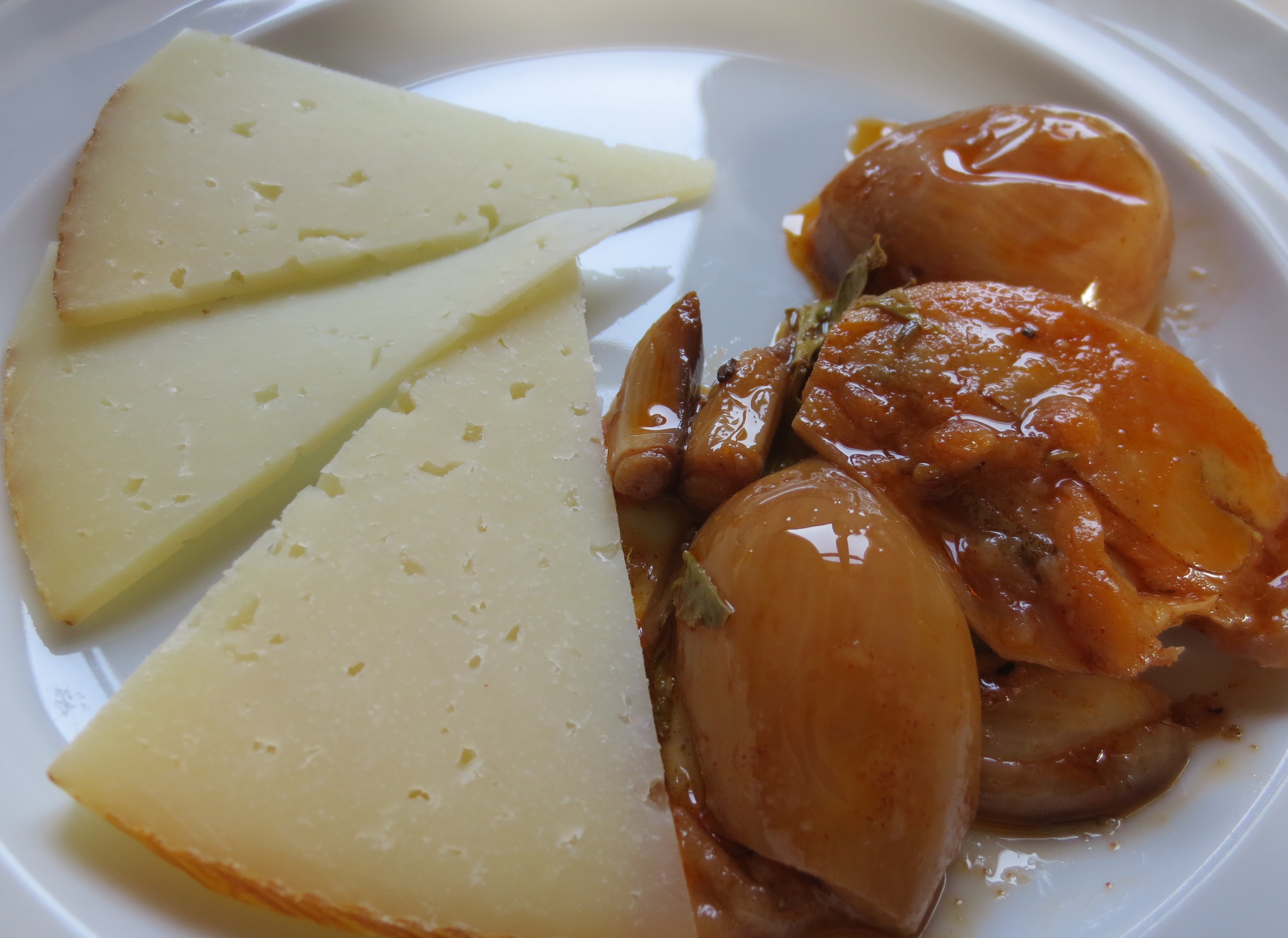
Serve as either part of a mixed starter, with cheese or they are very good with lamb dishes.

IMG_1170


Share this:

  • Share on X (Opens in new window) X
  • Share on Facebook (Opens in new window) Facebook
  • Share on WhatsApp (Opens in new window) WhatsApp
  • Email a link to a friend (Opens in new window) Email
Like Loading...

Polenta………& learning to love it.

01 Thursday May 2014

Posted by Nevenka in Fish, Main Courses, Techniques, Vegetable Dishes

≈ Leave a comment

Tags

Bacon, Fennel, Polenta, Polenta Cake, Polenta Souffle, Vegetables

I know that there are plenty of you out there who are as I previously was with Polenta. You started off curious so tried it in various restaurants and found yourself underwhelmed. It was allright, but you couldn’t see what the fuss was about.

Not types to give up, and armed with the opinion that Italians know about food, so it would be worth giving it another chance, you have a go at cooking it at home. Armed with an authentic Italian recipe from a reliable source you boil, and stir, and stir, and cool, and cut and reheat with a sauce………and still find yourself unexcited.

So you abandon Polenta for a number of years…..

…….then when you have forgotten all about it you are served in a restaurant to accompany the meat, a golden cake lightly browned and crisped on the edges and creamy in the centre. Filled with tiny strips of fried bacon and diced vegetables, flavoured with garlic and chicken stock. It is absolutely delicious. It takes you some time to realise that the main ingredient is the polenta that you have up to now been unimpressed by.

???????????????????????????????????????

A re-evaluation is obviously in order. This is where the path to loving Polenta starts, let me lead you through my trials to success and enjoyment.

Firstly the Polenta itself. I read somewhere that it is only good during the first six months after it is milled. I have tried fresh and It does have a slightly more corn flavour, but not so much that it makes that much difference. Having said that any dried goods – beans, lentils, quinoa, rice, flour, and polenta should not be kept for more than a couple of years and preferably used within a year. These are products where the use by dates should be taken note of, you won’t get food poisoning but the grains lose their ability to reconstitute and stay dry and hard and of course the flavour of them slowly fades.

Cooking liquid. I have read debates as to whether water or milk are the best and most authentic cooking liquids, but I am not impressed with either. Let’s face it, polenta is a pretty bland grain, and so any extra flavour that can be added should be. I like to cook the polenta in a light stock, either chicken, veal, or if you are vegetarian, a vegetable stock.

Stirring. Every recipe I have come across, and the instructions on the polenta packet, tell you to bring the liquid to the boil, whisk in the polenta, stir until boiling again and then keep stirring for forty minutes with the heat turned low. Well, I haven’t got the time or patience to stand around stirring for forty minutes and I suspect neither do Italians or you. I find that stirring from time to time during the first ten minutes will do, then turn off the heat, cover with a well fitting lid and leave it to continue cooking in its own steam for forty minutes. Alternatively once it is back boiling after adding the polenta, pour into a slow cooker and continue cooking on a low setting for half an hour, then turn of the cooker and leave the polenta to cook in the residual heat for another half hour.

BASIC RECIPE – for 8-10 servings

350 grams polenta

1.75-2 litres light stock

salt and freshly ground black pepper

If you want a very firm polenta for leaving to cool and form into a cake, use the smaller amount of stock, and if you want a softer puree consistency for eating immediately, then the larger amount of stock.

Put the stock in a thick based saucepan with half a teaspoon of salt and bring to the boil.

Pour in the polenta in a steady stream stirring continually. Turn down the heat and keep stirring as the polenta thickens, this should take about 10 minutes.

Either put a lid on the polenta and turn of the heat leaving the polenta to continue cooking in its own steam or transfer the polenta to a slow cooker on the lowest setting and leave to cook for 30 minutes before turning off the heat and giving it a stir.

Continue with your chosen recipe.

POLENTA AND VEGETABLE CAKE – Pictured above

I make this when I have a lot of people to feed as almost all can be prepared the day before, all that has to be done on the day is slicing the loaf and putting it onto a hot tray in the oven. Plus it is the vegetable and starch all in one.

It is great with something saucy like a stew. Last time I made it was to go with Pork Bourgignon – see previous post on Pigs Cheeks.

If you want to make a vegetarian version of this substitute nut pieces for the bacon and use olive oil for the frying

100 grams streaky bacon – cut into small dice

30 grams bacon fat – cut into small dice

1 clove garlic – finely chopped

1 small onion or half a large one – finely chopped

200 grams vegetables – cut into small dice – choose three or four from the following – carrots, parsnips, peppers, mushrooms, sweet peas, Florence fennel, broccoli, celeriac, butternut squash. Try to mix the colours to make it interesting.

Thick polenta as master recipe – cooked in vegetable stock if making the meatless version.

Heat a thick based frying pan and add the dice bacon fat. Cook on a low heat until it has rendered down and released its fat.

Add the bacon and cook for five minutes.

Add the onions and garlic, stir in and fry for a couple of minutes.

Add the diced vegetables and fry for about 10 minutes until the vegetables are about half cooked and have lost some of their moisture.

Add the vegetable and bacon mix to the polenta while both are still warm and gently mix the whole together. Season with plenty of freshly ground black pepper and check if it needs more salt.

Turn into a small loaf tin lined with cling film. Gently flatten to make sure that there are no pockets of air and smooth out the top. Fold the cling film over the top and put the loaf in the fridge to cool and firm up.

About 45 minutes before you need to serve the loaf, heat the oven to 180 centigrade. When the oven is hot, put in a shallow baking tray containing a couple of tablespoons of tasty dripping or olive oil.

Take the loaf out of the fridge and remove from tin. Peel off it’s cling film and cut into slabs about one and a half centimetres thick.

Put onto the now hot fat in the baking tray. Put back In the oven and roast for about 15 to 20 minutes until browned and crispy at the edges.

WHITE POLENTA PURÉE WITH FENNEL AND ORANGE.

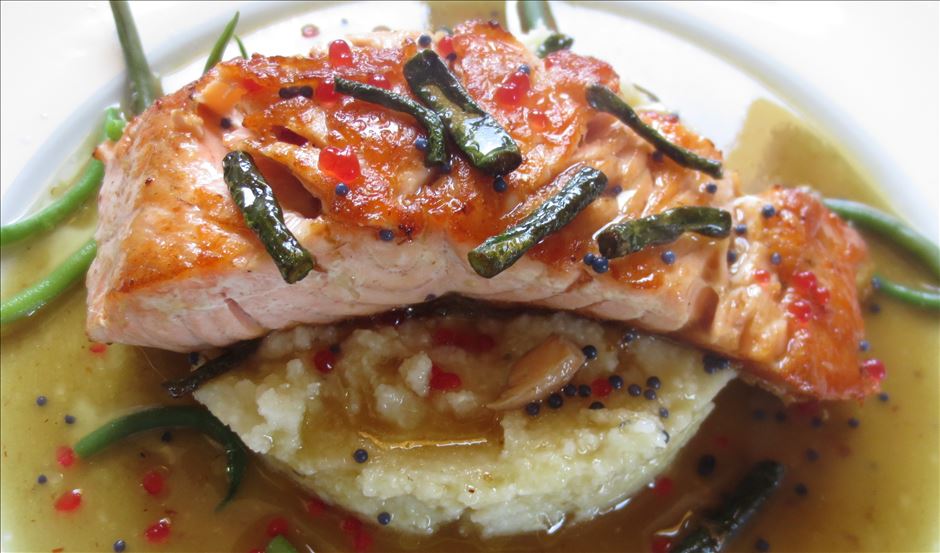
Salmon, White Polenta, Saffron Sauce

White polenta is traditionally eaten with fish in Italy. It has a slightly softer smoother texture. Don’t worry if you can’t find white polenta, this is still good with the more easily available yellow.

Master recipe soft polenta made with white grains.

100 grams Florence fennel – cut into small dice

25 grams butter

Grated zest and juice of one orange

Salt and freshly ground black pepper.

Fry the diced fennel slowly in the butter until cooked but still with a little firmness.

Cook the polenta as the recipe. Add the orange zest and juice. Stir well to mix in.

Add the fennel and stir gently to mix in.

Serve with fish of your choice.

SOUFFLED POLENTA

Use either white or yellow polenta

Firm polenta as master recipe

3 eggs

50 grams finely grated Parmesan cheese

Cook the polenta as recipe and leave to cool a bit.

Heat the oven to 170 centigrade.

Grease an ovenproof dish about the right size to take the soufflé, individual ramekins can be used if you like.

Separate the eggs. Add the yolks to the polenta and beat to mix in.

Add most of the cheese to the polenta keeping back enough to sprinkle on the top of the soufflé. Mix well.

Beat the egg whites until very firm and white.

Fold into the polenta mix trying not to lose too much air about of the egg whites.

Turn into the greased dish and bake for about half an hour until risen and golden on top.

Serve immediately.


Share this:

  • Share on X (Opens in new window) X
  • Share on Facebook (Opens in new window) Facebook
  • Share on WhatsApp (Opens in new window) WhatsApp
  • Email a link to a friend (Opens in new window) Email
Like Loading...

……….More Cheek!

04 Saturday Jan 2014

Posted by Nevenka in Main Courses, Techniques

≈ Leave a comment

Tags

baked eggs, ceps, Eggs, Mushrooms, Pork, pork cheek, rovellones, stews

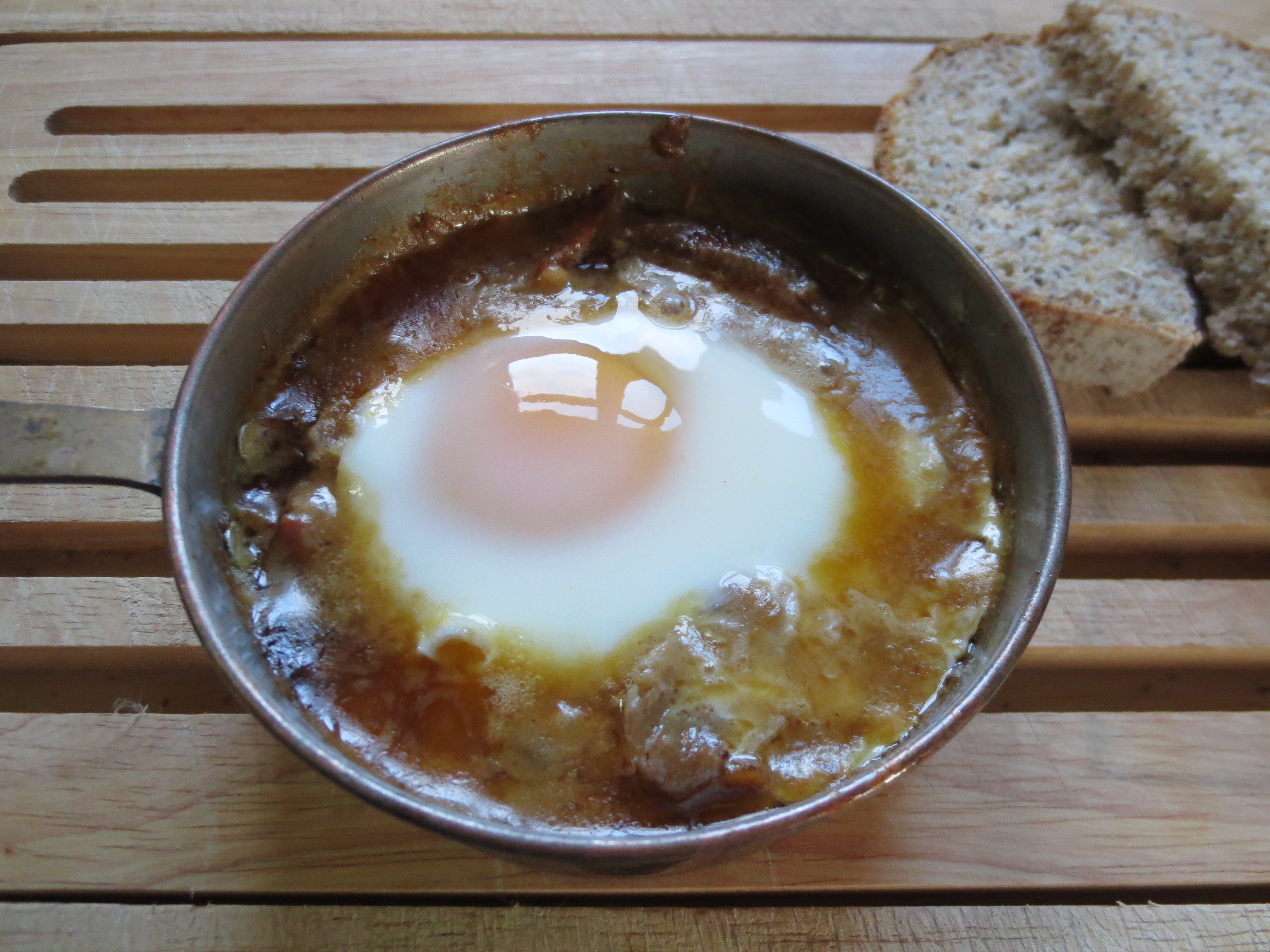
Following on from the previous post, when you serve the Pork Cheek Stewed in White Wine with Wild Mushrooms remember to leave yourself a bit in the pan so that you can behave like a proper Bourgoine and treat yourself to Oeuf Murette or Baked Egg with Pork and Mushroom Gravy.

??????????????????????????????????

During the lunch where I served the Cheeky casserole, we were discussing the merits of this cut of meat, and my friend Jane recounted how she not eaten the cheek stewed before, but had been served it in a local restaurant, butterflied open and grilled. So I thought I would give it a try.IMG_0881

I slice the meat across to be able to open it like a book, and then gave each piece a good hammering with the smooth side of the meat tenderiser.

I then made a salt marinade by crushing a clove of garlic in the mortar with half a teaspoon of salt and a generous amount of freshly ground black pepper. Coat the meat in this and leave to further tenderise for several hours.

Grill and enjoy. It was super succulent and tasty.

IMG_0882

Share this:

  • Share on X (Opens in new window) X
  • Share on Facebook (Opens in new window) Facebook
  • Share on WhatsApp (Opens in new window) WhatsApp
  • Email a link to a friend (Opens in new window) Email
Like Loading...

The Cheek of it!

03 Friday Jan 2014

Posted by Nevenka in Main Courses

≈ 2 Comments

Tags

bourgignon, Mushrooms, Pork, pork cheek, rovellones, stew

PIGS CHEEKS BRAISED IN WHITE WINE WITH WILD MUSHROOMS – CARILLADA DE CERDO GUISADO CON ROVELLONES

Keith Floyd was the inspiration behind this recipe. I was watching afternoon TV while catching up on a huge pile of ironing, and there was Keith from at least twenty-five years ago, in Burgundy making  Boeuf Bourgignon, a, dish for which he was insisting the best cut of beef to use is cheek.

This got me thinking about the pigs cheek that is so popular here, and which I had eaten several times in restaurants and enjoyed immensely, but never cooked with myself. A group of friends were coming to lunch, and I was thinking about what to cook for the main course. With a large group, a casserole is always a good idea as it is better cooked the day before.

Instead of beef and red wine, how about pork and white wine? Being autumn there are rich wild mushrooms, Rovellones, in the shops which would add musky richness to the dish.

The cheeks I bought were on the bone, and as soon as I started to trim the flesh away from the bone, I could see why this cut is considered so highly. The meat is finely streaked throughout with fat, which would make it moist and succulent.

IMG_0879

Prepare the casserole at least one day in advance.

These amounts are for the nine people I fed on the day –

For the stock-

The bones from the cheeks or if you buy the cheeks of the bone, then roughly 500 grams pork bones

2 carrots – peeled and sliced

1 onion – peeled and sliced

1 clove garlic – cut in half

1 bayleaf

Fat for frying

For the stew –

7 pigs cheeks

2 tablespoons flour

Salt and freshly ground black pepper

Duck fat/ dripping/ lard /olive oil for frying

350  grams  streaky bacon – plain or smoked – cut into lardons

750 grams Rovellones or other full flavoured mushrooms

butter for frying

6 cloves garlic – finely chopped

???????????????????????????????????????

Start by removing the flesh from the bones of the cheeks unless the butcher has already done that for you.

Make the stock. In a saucepan warm the fat, and then add the vegetables and fry until golden brown.

Add the bones and continue frying, turning them over from time to time, until they are browned too.

Add the bay leaf and enough water to cover and bring to the boil. Turn down the heat and simmer very slowly for and hour and a half.

When the stock is about half way done, you can start the stew.

Heat some of the fat in a large casserole and add the bacon lardons. Cook over a medium heat turning them over from time to time until they are nicely browned. Remove the lardons to a dish.

Cut the meat into pieces roughly 2 x 2 x 5 centimeters.

Put the flour into a shallow dish and season with salt and a generous amount of black pepper. Toss the meat pieces in the flour.

Turn the heat up under the casserole, add more fat and then some of the meat pieces. The meat wants to be in a single layer and not too closely packed so that it can brown. Once on side of the meat is brown and sealed turn the pieces over to another side.

Once all that batch of pieces are brown, remove them to the dish with the bacon. Add more fat and continue browning the other batch of meat. You will need a decent amount of fat so the meat doesn’t stick and browns well, don’t worry about this we will deal with the surplus later.

Once all the meat is browned, return all to the casserole and add enough stock to just cover the meat. Gently bring to a simmer and then turn the heat down to a very low simmer. Leave to cook for an hour.

Meanwhile prepare the mushrooms. I used Rovellones which are from the same family as Ceps, but any good flavoured mushrooms can be substituted.

Wash the mushrooms if necessary and dry them with a tea towel or paper towels.

Heat the butter in a shallow pan and add the mushrooms together with the chopped garlic. Fry over a brisk heat for about 10 to 15 minutes until the mushrooms are almost cooked.

Add the mushrooms to the casserole and gently stir to mix them in.

Continue simmering the stew slowly for a further 15 minutes.

Turn off the heat. The meat will continue cooking as it slowly cools.

Once cool put into the fridge for several hours or overnight.

Most of the fat in the stew will have come to the surface and solidified, and so you can easily lift it off to make the stew less greasy. It is for this reason that I specify to fry with a fat that will set rather than olive oil. But do keep the tasty  fat to use later in another dish. It will keep for a couple of weeks in the fridge.

Reheat the casserole slowly and serve.

Share this:

  • Share on X (Opens in new window) X
  • Share on Facebook (Opens in new window) Facebook
  • Share on WhatsApp (Opens in new window) WhatsApp
  • Email a link to a friend (Opens in new window) Email
Like Loading...

Blue Cheese – Dressing, Mousse & Ice Cream

27 Wednesday Nov 2013

Posted by Nevenka in Food for One, Sauces, Starters

≈ 2 Comments

Tags

Blue Cheese, Blue Cheese Dressing, Blue Cheese Ice Cream, Blue Cheese Mousse, Ice Cream, Mousse

As I mentioned in the last post, I have been having a go at replicating the Blue Cheese Ice Cream that we were served atop a salad in Bodega Aranda and which was so delicious. I believe I have achieved success.

????????????????????????????????

As a basic recipe I started with one for a blue cheese salad dressing that I learnt from Pam Smith, when I was working at her Restaurante Sin Niumero in Mojacar many moons ago. It is so simple yet wonderful that I am surprised that it is not more widely known. All you need is blue cheese, thick or whipping cream and black pepper.

Then to adapt the recipe for mousse or ice cream the proportions of the ingredients are changed.

To make the salad dressing you need about one quarter volume blue cheese to three quarters cream. Put both in the food processor and beat until well mixed and the cream has started to thicken. Be careful not to overbeat or the mix may curdle. This happens very easily in the hot summer heat here. The dressing will further thicken in the fridge, so you can stop beating when the dressing is a little less thick than you want the end result to be.

Season with black pepper. There is no need for salt as the cheese will have enough in it already.

Store in the fridge until needed. It will keep for up to three days.

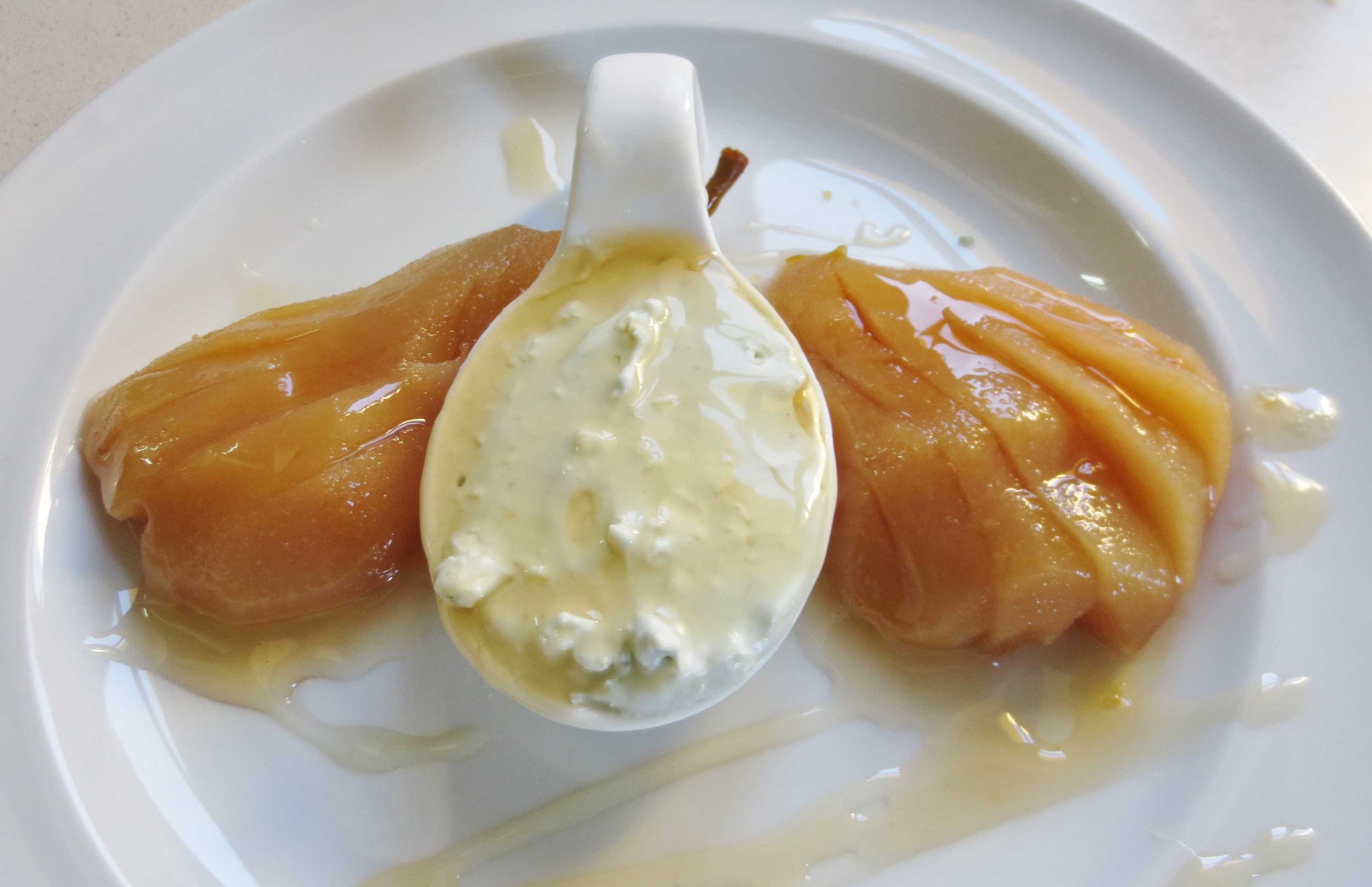
The mousse I like to serve with fruit to offset the sweetness of it. As fruit ripens on the farm, any that is not eaten fresh is preserved. Here I have pears poached in sugar syrup flavoured with cardamoms and saffron. They are put into sterilised jars when hot and then will keep up to three years if kept in a cool dark place. They then provide the basis for a quick and easy dessert.

IMG_0770

When I come to serve the pears, I drain off the syrup which I then reduce by putting it in a pan, bringing it to the boil and continuing to simmer it until it is thickened and viscous. Let it then cool then drizzle over the whole dish when serving.

For the mousse the proportion of cheese to cream is equal and I like to leave some texture to the cheese as you can see above. But if you prefer a smooth mousse then beat a bit more. If you are serving the mousse with fruit then the pepper is optional.

To ensure that the ice cream does not set too hard the choice of cheese is important. It needs to be a full fat blue cheese like Stilton, Roquefort or Cabrales. It is tempting to imagine that a soft cheese would give better results, but these have more water in them which freezes very hard.

The proportions again are half cheese half cream. Beat them together well. Season with black pepper and freeze.

When you come to serve the ice cream, you may need to transfer it from the freezer to the fridge half and hour to an hour before needed so that it can soften a little, it depends on the temperature of your freezer.IMG_0753

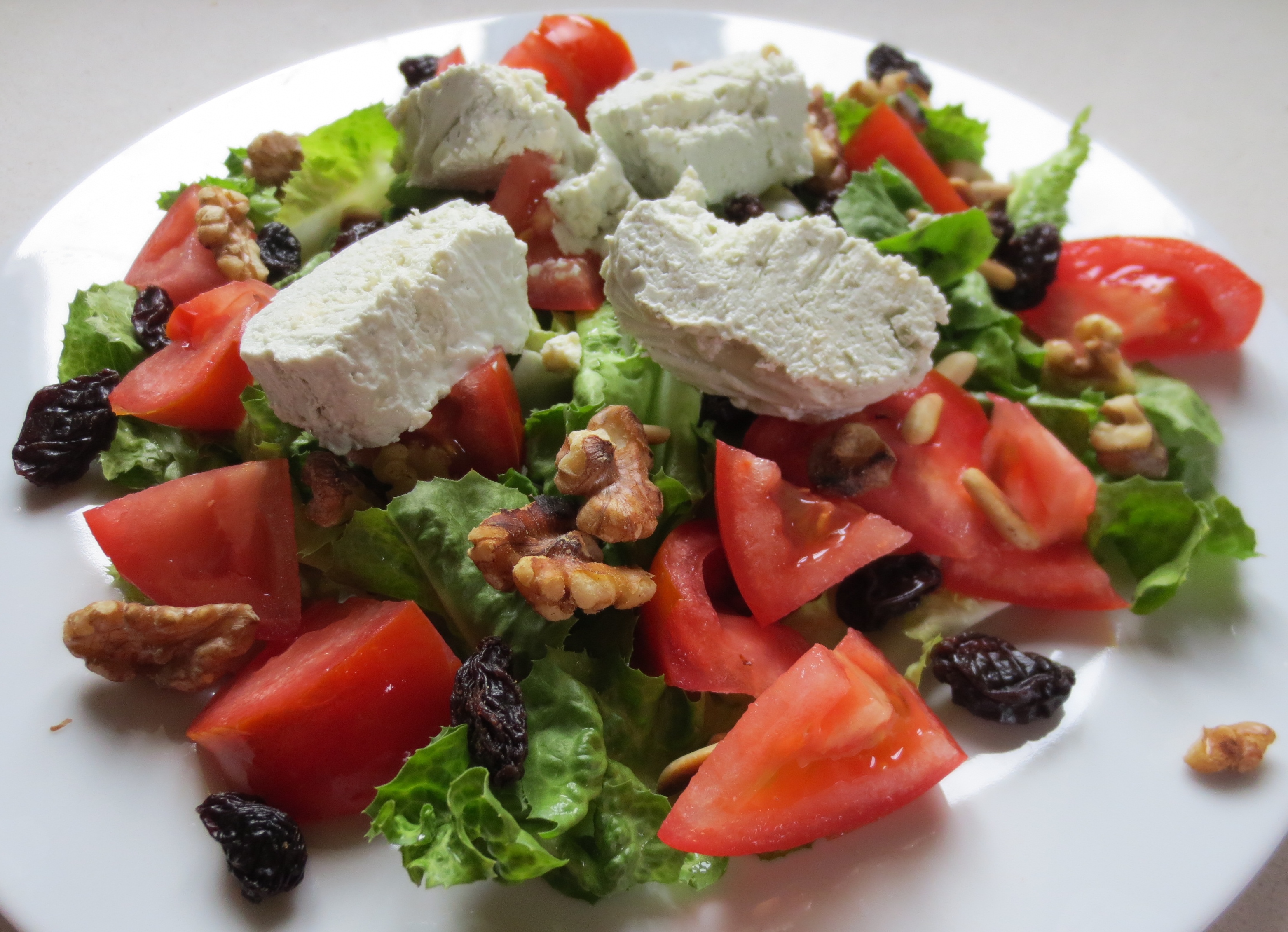
A reminder that the original salad we were served was Corn salad, Tomatoes, Pine Nuts, Walnuts and Raisins with the Ice Cream in a mound on top. The waitress then dressed the salad with Olive oil and sherry vinegar before cutting up the ice cream and then folding it gently into the salad.

For my salad, pictured at the beginning of this post, I replaced the corn salad with some mild Endive leaves and I lightly toasted the nuts to bring out their flavour. The coolness of the ice cream combined with the slight bitterness of the leaves and the warmth of the nuts was wonderful, even on a cold wet day like today, and would be even better on a hot summers day.

Share this:

  • Share on X (Opens in new window) X
  • Share on Facebook (Opens in new window) Facebook
  • Share on WhatsApp (Opens in new window) WhatsApp
  • Email a link to a friend (Opens in new window) Email
Like Loading...
← Older posts
Newer posts →

Blog at WordPress.com.

Privacy & Cookies: This site uses cookies. By continuing to use this website, you agree to their use.
To find out more, including how to control cookies, see here: Cookie Policy
  • Subscribe Subscribed
    • fincafood
    • Join 103 other subscribers
    • Already have a WordPress.com account? Log in now.
    • fincafood
    • Subscribe Subscribed
    • Sign up
    • Log in
    • Report this content
    • View site in Reader
    • Manage subscriptions
    • Collapse this bar
 

Loading Comments...
 

    %d