• About
  • La Micaela Farm Shop

fincafood

~ culinary and horticultural life on a Spanish farm

Category Archives: Main Courses

Sardines with Pine Nut and Raisin Stuffing

01 Saturday Sep 2012

Posted by Nevenka in Fish, Food for One, Main Courses, Starters

≈ Leave a comment

sardines-stuffed-and-bakedI don’t remember now where I came across this recipe for boned sardines that are wrapped around a stuffing of toasted pine nuts, raisins and onions and then moistened with orange and lemon juice before being baked in the oven, but it has been a favourite way of preparing these fish in my kitchen for many years. The combination of the oily fish, with the acid of the citrus and the sweetness of the onions and raisins is very successful – and so summery.

This recipe is for when the sardines are medium to large in size and need to be  gutted and deboned. I use two or three per person as a starter and four or five if it is to be a light main course.

12 medium sardines

1 medium onion – very finely chopped

Olive oil for frying the onions

25 gms pine nuts – dry roasted in a thick based shallow pan

25 gms raisins or currants

chopped fresh flat leaved parsley

fresh bay leaves

100 ml freshly squeezed orange juice

100 ml freshly squeezed lemon juice

Salt and black pepper

Start by descaling the sardines and then cut off their heads, gut them and remove the backbones. Open them out flat.

Prepare the stuffing.

Fry the onions until lightly browned. Add the pine nuts, raisins and parsley and mix well.

Take a small amount of the stuffing and place it at the wide end of the opened out sardine. Roll the fish around the stuffing, starting at the wide end and rolling towards the tail.

Put the fish into a shallow oven proof dish side by side with the tails sticking up. It can be pretty to use individual dishes per person if you have them. I use ramekins that will take two to three fish each if I am making this as a starter, or shallow bowls with four or five fish in each as a main course.

Once you have arranged all the fish, put a bay leaf in between each fish.

For cooking liquid, mix the lemon and orange juice. Pour over the fish to cover half a centimetre up from the base of the dish.

Bake at 180 degrees centigrade for 20 minutes.

Serve with a side salad and fresh bread.

An alternative stuffing is chopped capers, olives and chillies, with a white wine and lemon juice mix for the cooking liquid.

Share this:

  • Share on X (Opens in new window) X
  • Share on Facebook (Opens in new window) Facebook
  • Share on WhatsApp (Opens in new window) WhatsApp
  • Email a link to a friend (Opens in new window) Email
Like Loading...

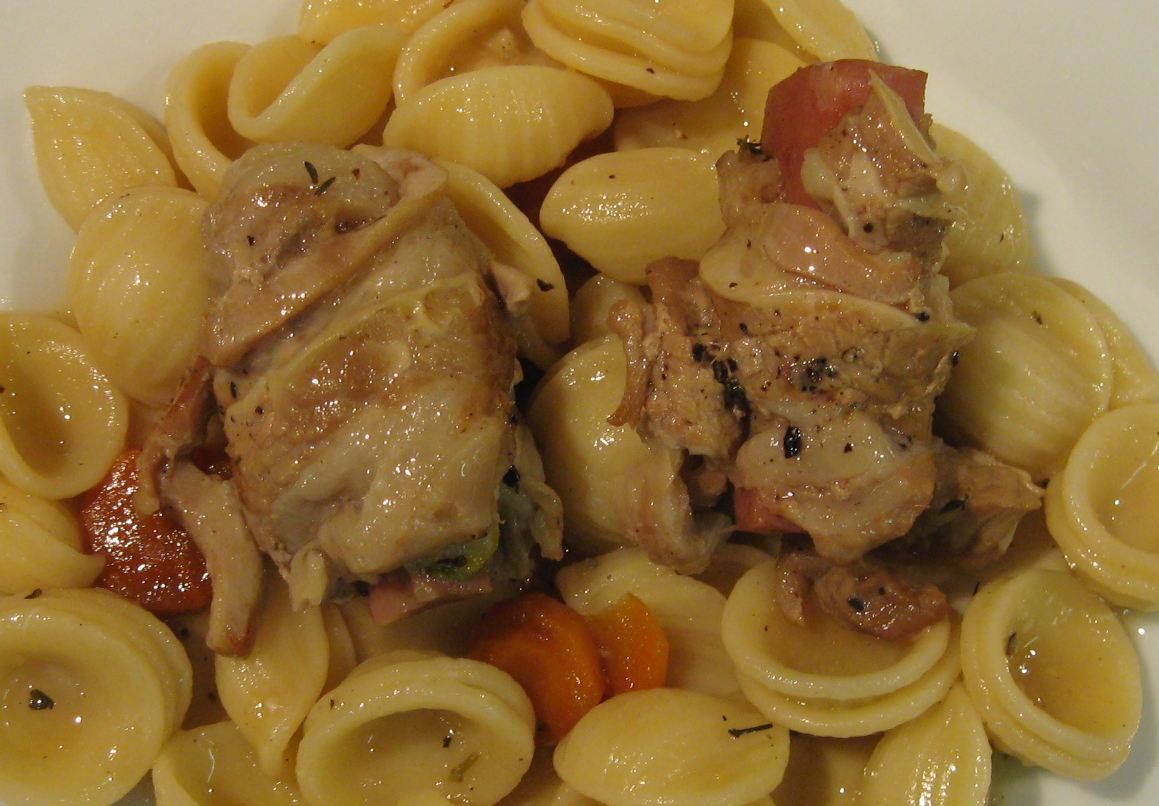
Veal and Mortadella Rolls with Orecchiette

20 Monday Aug 2012

Posted by Nevenka in Main Courses, Shopping

≈ 1 Comment

I am in the Alps this week, in theory escaping from the Spanish heat to the glacial coolness of the mountains, but France is in the midst of a heatwave. Even so, the nights are lovely and cool.

The Mont Blanc Tunnel is only ten minutes away, so I love to go through for an Italian fix while I am here. The Aosta Valley is so beautiful with its grey stone houses topped with huge round slates that over time develop wonderful hues, castles and fortresses that in ancient, and probably not so ancient times, were bases from which to defend the valley and rushing rivers that even at this time of the year are frothing with melt water from high up the mountains. The steep sides of the valley are terraced and planted with neat rows of vines each with a pretty rose bush at the end to act as an early warning system for mildew. Lower down are orchards of fruit trees enclosed by dry stone walls that have been there for centuries. In the high alpine meadows graze herds of cattle which provide the milk for the best butter that I have ever tasted, and a range of distinctive cheeses. Bleu d’Aoste, Fontina and Fromadzo as well as fresh cheeses that have to be eaten within a couple of days of being made.

For me, one of the joys of travelling is to be able to sample fresh food in its place of origin. I love Mozerella di Bufala, which in theory is available outside Italy, but until you have tasted it in Italy, you haven’t really tried it. The lightness is just not equal in the Mozerella for export. A new find for me is Burratina, a variation of Mozerella that is even lighter and creamier in the centre. So I have to buy some to take back to France to share with my friends.

I am having a group of chums round so that I can catch up with them in my brief stay here. This is the dinner that I prepared for them.

To start a salad of Batavia, fresh and sundried tomatoes dressed with pesto, toasted local walnuts, all topped with a generous portion of Burratina.

Veal and Mortadella Rolls with Orecchiette Pasta – For 8veal_and _mortadella_rolls

Belly of veal in slices, 1 slice per person

Mortadella in a piece

Olive oil for frying

1 onion, finely chopped

5 cloves of garlic, finely chopped

white wine

fresh or dried thyme

salt and freshly ground black pepper

6 carrots

butter for frying

Orecchiette

Cut each slice of veal belly in two. Cut the mortadella into batons that will fit with the width of the veal slices. Wrap the veal round the mortadella and secure with a cocktail stick. Season them with salt and pepper.

Heat the oil in a shallow pan that has a lid and will take all the rolls in one layer. Fry the rolls turning them  to lightly brown them on all sides.

Add the chopped onions and garlic, and continue frying for five minutes.

Add the white wine to come to just over half way up the rolls. Add a pinch or two of thyme.

Cover and cook at a simmer for an hour, turning the rolls after half an hour. Turn the heat down to the minimum and continue cooking for another hour and a half. By this time the sauce should have reduced slightly and be a thicker consistency. If the sauce reduces too much and the dish becomes dry, add a little chicken stock or water.

Peel and slice the carrots. fry in butter in a covered pan turning from time to time until golden on both sides. Add to the veal rolls.

Cook the pasta in plenty of salted water to which a splash of olive oil has been added until al dente.

Remove the veal rolls to a warm dish and remove the cocktail sticks.

Add the pasta to the white wine sauce and stir to amalgamate.

Serve a mound of pasta topped with two veal rolls per person.

For dessert freshly made Peach Ice Cream served with fresh peaches and a Ginger Biscuit.peach_ice_cream_

Share this:

  • Share on X (Opens in new window) X
  • Share on Facebook (Opens in new window) Facebook
  • Share on WhatsApp (Opens in new window) WhatsApp
  • Email a link to a friend (Opens in new window) Email
Like Loading...

Chicken with Garlic and White Wine

16 Thursday Aug 2012

Posted by Nevenka in Food for One, Main Courses

≈ Leave a comment

chicken_braised_with_garlic_and_white_wineThis is an everyday dish that is full of flavour and has a sophistication that belies its simplicity. And its just as easy to make for one or eight. Although the sauce looks creamy, it doesn’t contain cream and is not brimming over with calories.

A simple dish like this only needs simple accompaniment – plain boiled potatoes or pasta. If you like you can take the flesh off the bones of the chicken and reheat it with the sauce to go with pasta. A fresh crisp green salad on the side would complete the meal.

Per person

1 leg of chicken

2 cloves of garlic

white wine

olive oil or butter

salt and pepper

In a shallow pan that has a lid, heat a small amount of either oil or butter.

Season the chicken with salt and pepper and fry until lightly browned on all sides.

Peel and slice the garlic and add to the pan with the chicken. Continue frying for a few more minutes to lightly brown the garlic.

Add enough white wine to come half way up the chicken. Turn the heat down, cover and simmer for 40 minutes turning the chicken every 10 minutes or so.

After this time the sauce should have reduced, thickened and become creamy looking. If it still looks too liquid, continue cooking with the lid off until it thickens.

Check the seasoning and serve. As simple as that!

You can of course vary the flavourings. Any type of mushroom can be added at the same time as the garlic. Fresh chopped tarragon added half way through the cooking turns it into Tarragon Chicken. For a more robust dish, fry some lardons of smoked bacon with the initial frying of the chicken and then continue with the rest of the recipe.

Share this:

  • Share on X (Opens in new window) X
  • Share on Facebook (Opens in new window) Facebook
  • Share on WhatsApp (Opens in new window) WhatsApp
  • Email a link to a friend (Opens in new window) Email
Like Loading...

Roast Pork Belly with Green Olive Stuffing

29 Sunday Jul 2012

Posted by Nevenka in Main Courses

≈ Leave a comment

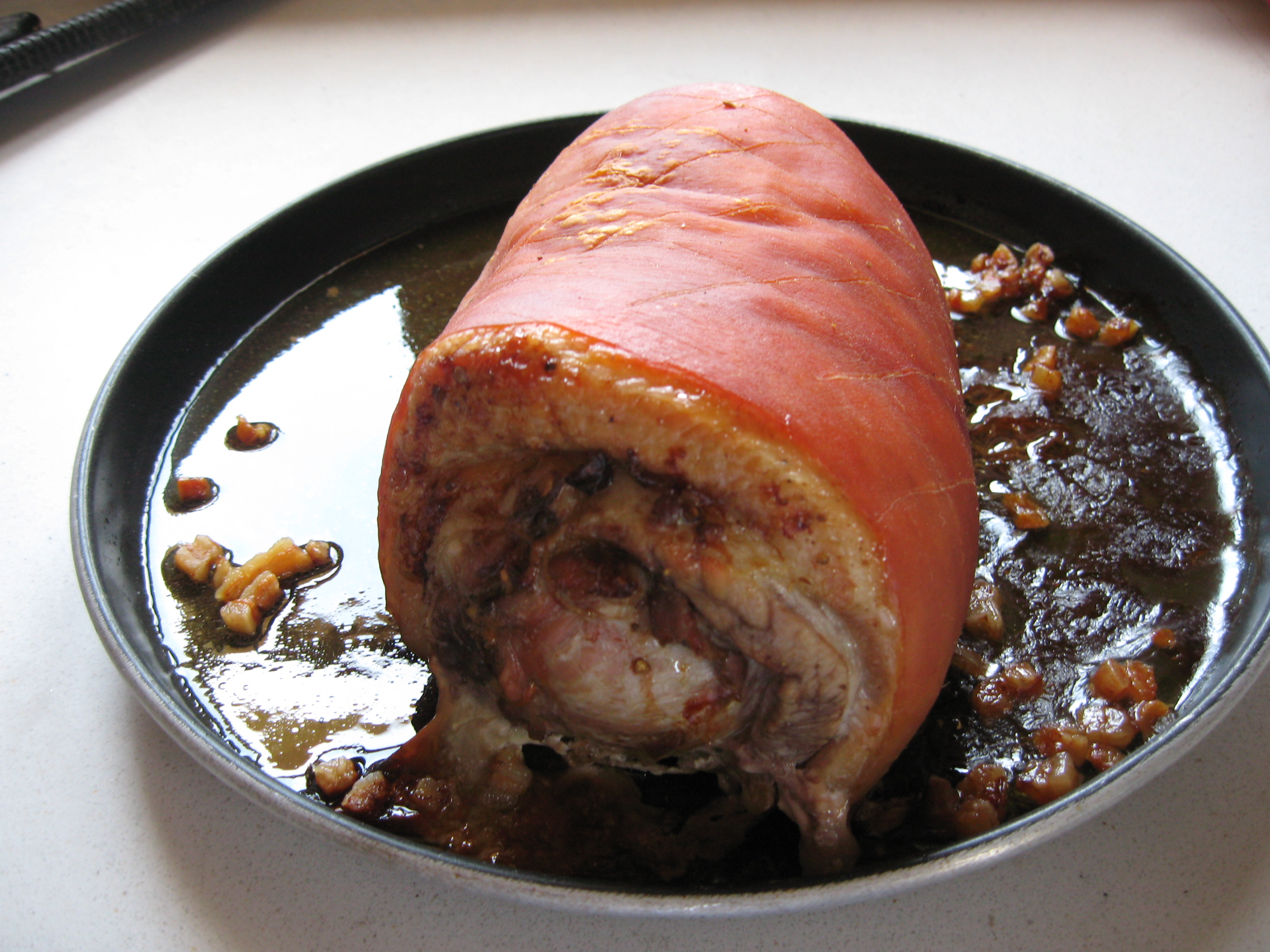
Inspired by the pork butchery course, on returning home to Spain I felt the need to treat my friends to a good piece of roast pork, but Spanish style of course……..roast_pork_belly_with_green_olive_stuffing

I first had a slice of this as a tapa in Bar Lucero in Cuevas De Almanzora.  On  a dreary winter day when we had had a dreary morning chasing officialdome – a frequent occurrence here –  to brighten ourselves a bit we stopped for a small glass of and a tapa before going home for lunch. It was a cold slice and the mix of the salty olives, garlic and lots of coarsely ground black pepper as a seasoning to the slightly fatty pork immediately caught the attention of my taste buds. It was further seasoned with a squeeze of fresh lemon and drizzled with olive oil. Suitably brightened we stayed for another glass so we could check out what other tapas were good. The pork however remained the star of the show.roast_pork_belly_with_green_olive _stuffing

For a piece of belly pork weighing about 1.5 kilos – with or without skin, and if there are any bones remove them or have the butcher remove them for you.

200 gms green olives – the bright green ones that have been crushed to open the skin and then cured in brine are best, but if you can only get the ones that are cured to a yellowy green colour and are softer in texture then use those.

6 fat cloves of sweet garlic

3 large eggs – hard boiled

1 table spoon coarsely ground black pepper

Peel and finely chop the garlic.

Coarsely chop the olives removing the stones if they have them.

Mix the olives and garlic together.

If your pork belly has skin and you want crackling, then score the skin either in stripes or a diamond pattern. Salt the skin and leave for half an hour for the salt to draw out any moisture. Wipe dry with kitchen roll.

Lay the pork on a board skin/fat side down and season all over with the black pepper. Spread the olive mix evenly over the surface. There is no need for salt as the olives are salty.

Peel the eggs and slice them. Lay the slices over the olive layer. Roll the pork and tie it.

Roast at 160 Centigrade for 3 hours. If you have crackling, then roast for 2.5 hours at 160 Centigrade then turn the oven up to 240 Centigrade and roast for another half hour.

Remove the meat from the oven and let rest in a warm place for 20 minutes before carving.

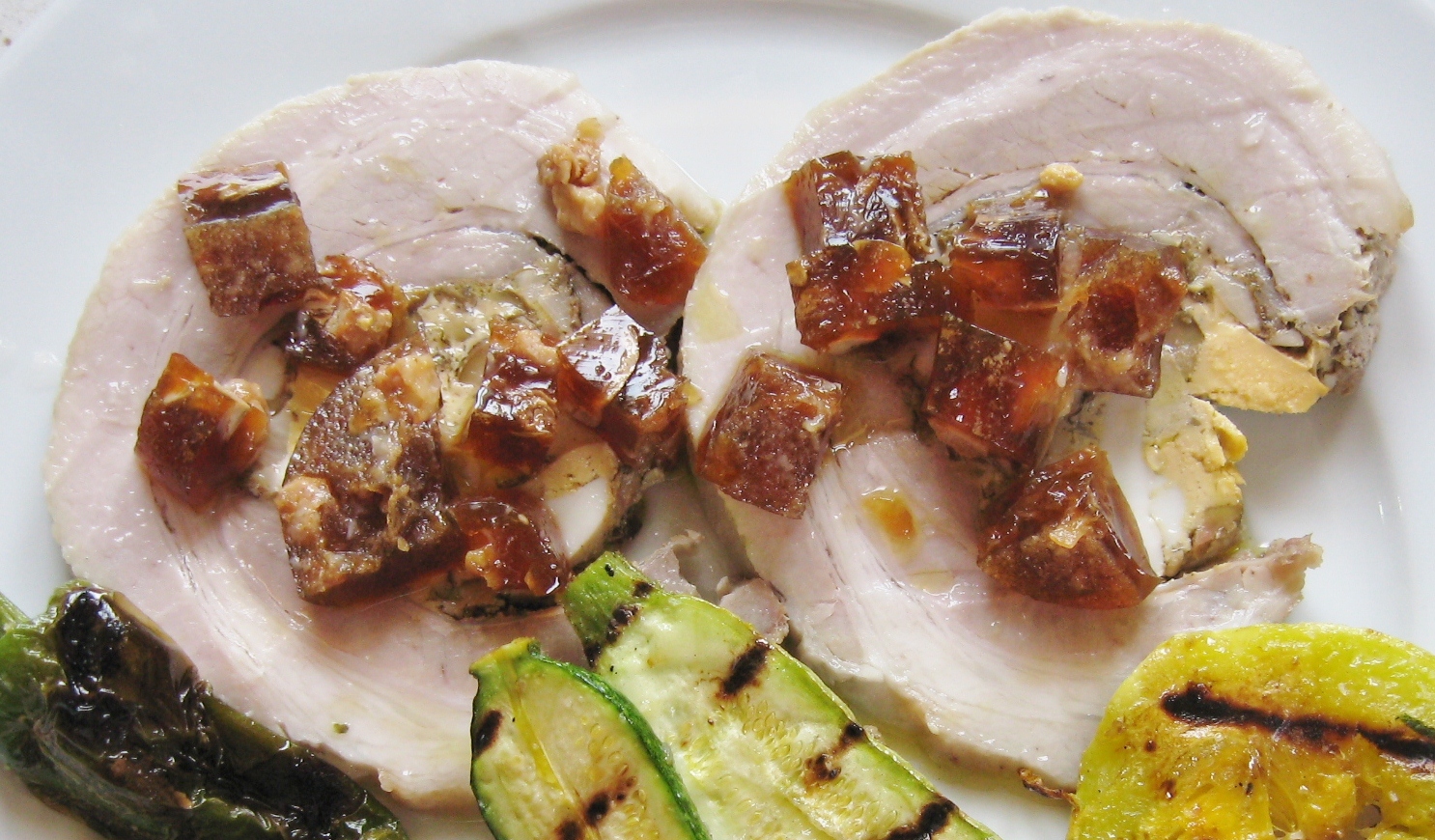
To serve cold I like to not only season the meat with lemon juice and olive oil as described above, but I save the juices and fat that have come out of the meat while it was cooking and I let that go cold in the fridge. Then you can remove the fat from the top, and save for frying potatoes, and below will be some lovely brown tasty jelly. Cut this into cubes and serve these as an extra seasoning on the cold slices of pork.roast_pork_belly_with_green_olive_stuffing_cold_serving

Share this:

  • Share on X (Opens in new window) X
  • Share on Facebook (Opens in new window) Facebook
  • Share on WhatsApp (Opens in new window) WhatsApp
  • Email a link to a friend (Opens in new window) Email
Like Loading...

Skate Wings with Caper Sauce

18 Wednesday Jul 2012

Posted by Nevenka in Fish, Food for One, Main Courses

≈ Leave a comment

I have been on my travels in recent weeks and whenever I am away from my home in southern Spain there are two things that always miss – the quality of the fresh fruit – and fresh fish. So on my return from my latest trip I hot-footed it to my local market to see what fish looked good. It is the season now for Bonito which is a variety related to Tuna, and that looked really good and fresh, but what really caught the attention of my mental taste buds was the Skate.

You could have the skinned wings only, or at a more economical price the whole fish. In these straightened times I thought you would like to know how to deal with the whole fish, from which there were two portions of a wing each, the body made enough soup for eight,  and there were a couple of meals for the cats as well – all for less than 4€!

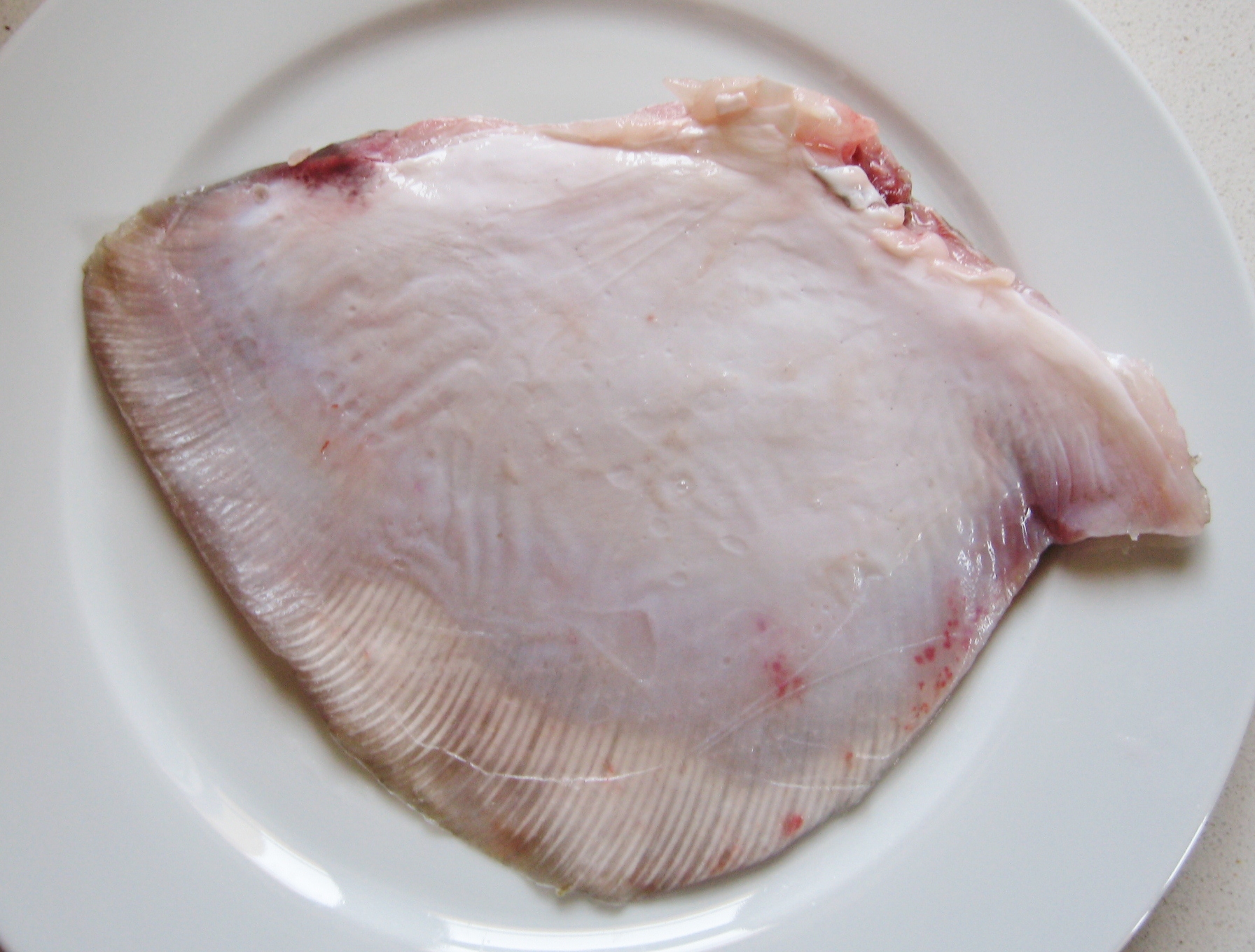
Skate has no scales, but the skin feels a little slimy and it has some sharp barbs around its head area, so rubber gloves are essential for handling it. Firstly wash it, and then put it on a board and cut off the wings. Remove the guts from the body and give to a grateful cat. Cut the body into three or four pieces for making into soup. The recipe will be in next post.skate_wingAs I mentioned above the fishmonger will skin the skate wings for you, but I prefer to cook them with the skin on as the skate cooks so quickly that it is too easy to overcook them if they are already skinned. Once cooked the skin peels off very easily.

To cook the wing put it in a pan with some sliced onion, a sliced clove of garlic and a pinch of salt. Put in enough water to just cover the fish. Put the pan over a medium heat and bring slowly to a simmer. If you want you can add sliced potatoes at this stage to cook with the fish. For a wing the size above – it is pictured on a standard sized dinner plate – simmer for seven minutes.

Prepare the sauce. In a small saucepan put about 20 gms butter, the juice of half a lemon and dessertspoon of chopped capers. Leave on one side until you are ready for it.

Remove the fish to a warmed plate. You can leave your potatoes cooking with the onions while you skin the fish. Put the sauce on a very gentle heat. Starting from the thicker side of the fish using a smooth bladed knife gently push the skin away from the flesh and then slide it off the plate. Turn the fish over and do the same the other side. The darker side of the wing always has tougher and thicker skin than the pale side.removing_the_skin_from_a_skate_wingKeep an eye on your sauce and stir it or swirl it around from time to time. You do not want the butter to melt entirely, just enough to mix with the lemon and capers, and then remove it from the heat.skate_with_caper_sauce

Transfer the fish to a clean warm plate. Drain the potatoes reserving the liquid to go towards the soup, and put the potatoes on the plate with the fish. Pour over the sauce. Season well with lots of freshly ground black pepper and serve.

I will continue with the fish soup recipe tomorrow.

Share this:

  • Share on X (Opens in new window) X
  • Share on Facebook (Opens in new window) Facebook
  • Share on WhatsApp (Opens in new window) WhatsApp
  • Email a link to a friend (Opens in new window) Email
Like Loading...

Spanish Style Liver

05 Thursday Jul 2012

Posted by Nevenka in Food for One, Main Courses

≈ Leave a comment

I actually bought liver this week to recook the recipe in the previous post so that I could retake the picture of it without the camera shake, but on the day I didn’t fancy eating that, I fancied something more spicy. The liver was already cut into lovely thin escalopes perfect for cooking it the way that the locals here like it.

The liver is cooked simply with garlic and then the pan juices are seasoned with the Pimenton that is so popular here and with wine vinegar. The most prized Pimenton in Spain comes from La Vera in Estremadura where the peppers are dried over oak fires before being ground. This drying gives the Pimenton its distinctive smokey taste. It comes in Dulce – Sweet, Picante – Spicy and Agri-Dulce – Sweet and Sour. For this recipe I like to use a mixture of the Dulce and Picante.

So for one person peel and slice 3 large cloves of garlic and put the slices to fry gently in a shallow pan with some good olive oil.

Season the slices of liver with salt and freshly ground black pepper, and once the garlic starts to colour, add the slices to the pan. Cook gently for five minutes and then turn over and cook for five minutes on the other side.

Remove the liver to a warm plate and keep warm.

Add to the pan juices a good large pinch of sweet Smoked Pimenton and a pinch of the spicy. Stir this round for a minute and then add a couple of tablespoons of red wine or sherry vinegar. Swirl this around the pan over the heat to collect up all the juices and immediately pour it over the liver.

I served my liver with the baby courgettes that are so sweet straight from the garden and then grilled after being annointed with garlic and oil, and a little mashed potatoes.

Share this:

  • Share on X (Opens in new window) X
  • Share on Facebook (Opens in new window) Facebook
  • Share on WhatsApp (Opens in new window) WhatsApp
  • Email a link to a friend (Opens in new window) Email
Like Loading...

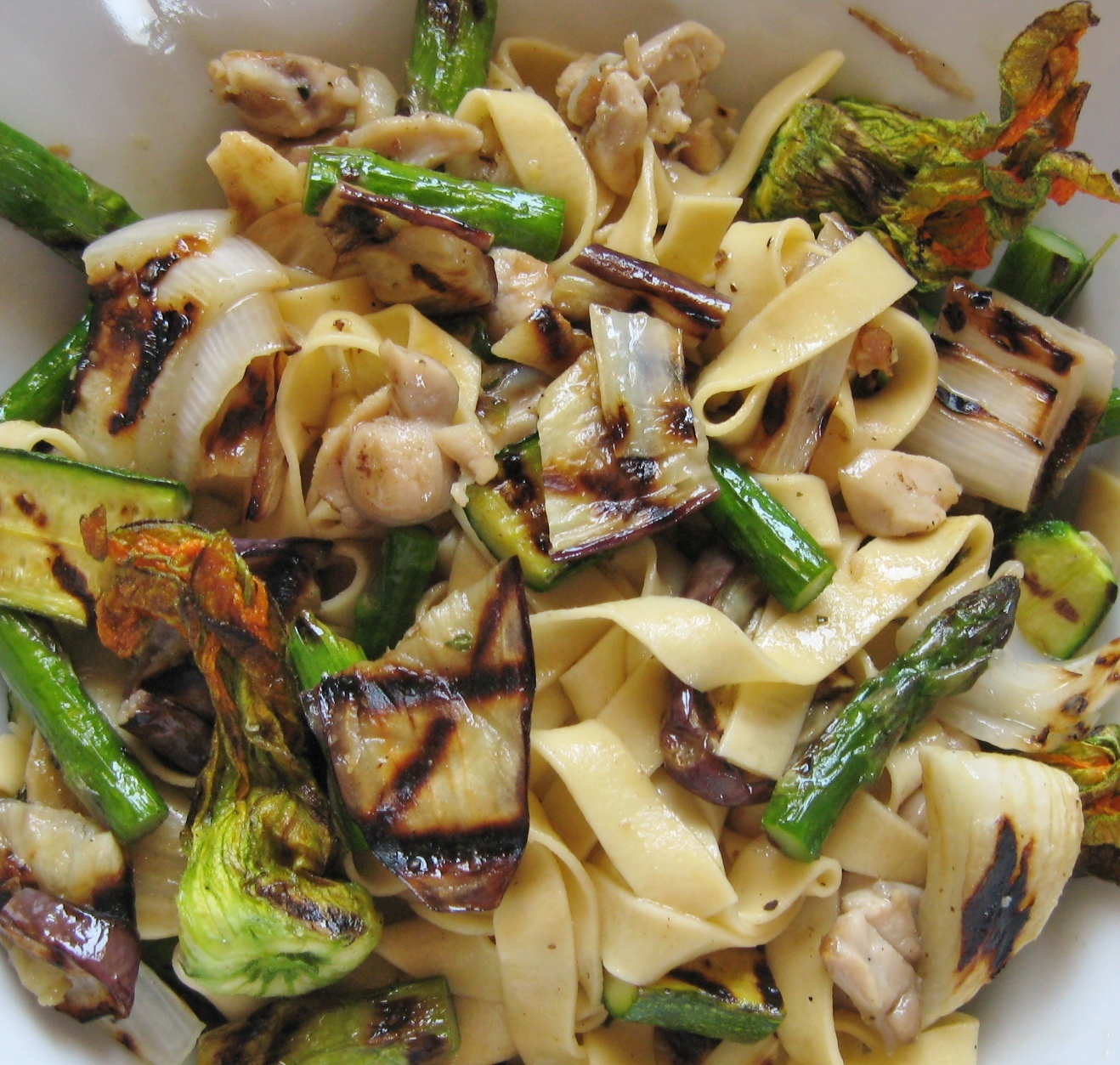
Tagliatelle with Rabbit and Grilled Spring Vegetables

15 Tuesday May 2012

Posted by Nevenka in Food for One, Main Courses

≈ 2 Comments

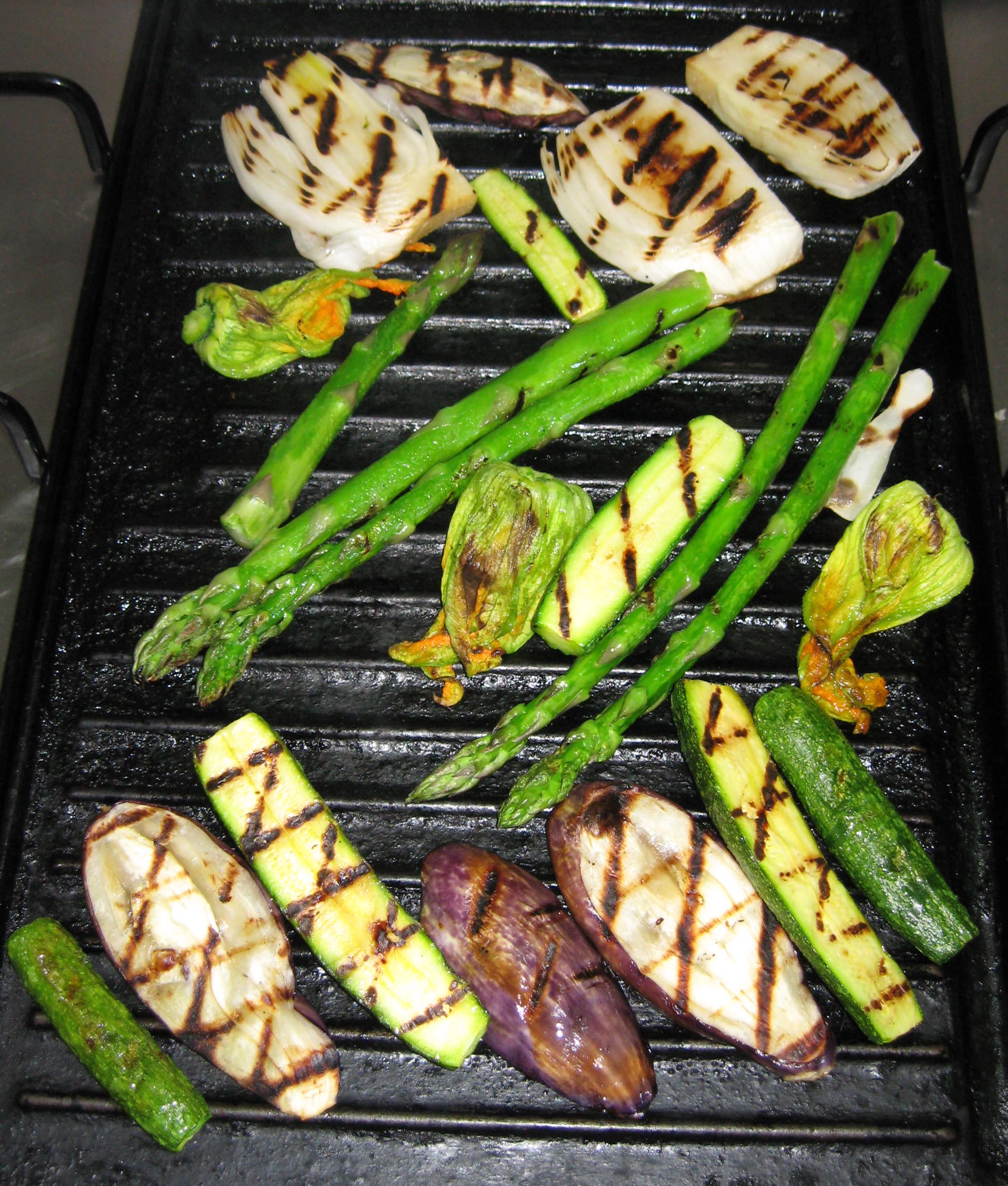
There is something about grilling or griddling vegetables that really concentrates their flavour, and when you have the first baby vegetables ready in the spring it is the best way to maximise their special flavour. I frequently have just a plate of the mixed vegetables, but today I wanted to make a more substantial main course. For a vegetarian option substitute some mozerella, the proper made with buffalo milk, in my opinion mozerella cannot be made with anything else, for the rabbit.

Per person

20 gms 00 pasta flour

1 large egg yolk

pinch of salt

100 gms rabbit meat

olive oil

small sprig each of fresh oregano and thyme

6 cloves sweet garlic

100 ml chicken stock

Mixture of spring vegetables – a selection of the following –

baby courgettes and their flowers if you have them, green asparagus, sweet onion, baby aubergine, Florence fennel.

For the pasta – put the flour, egg yolk and salt in a small food processor and blend to a dough. Remove from the blender and with floured hands form into a ball. Wrap in cling film and put into the fridge to rest until needed later.

Peel the cloves of garlic. If some are much bigger than others, halve them so that they all cook evenly.

Cut the rabbit into small pieces.

Heat a tablespoon of olive oil in a small frying pan, add the garlic and fry for a couple of minutes. Add the rabbit and continue frying for another 8-10 minutes  stirring from time to time.

Add the chicken stock and the herbs. Stir again to mix in all the brownings from the bottom of the pan. Simmer for 10 minutes. Season the rabbit. If the rabbit is done before the rest of the dish, then turn it off and let it continue slowly cooking in its stock until needed.

Put a pan of water on to heat up for the pasta. Add salt and a dash of olive oil to it.

Prepare the vegetables. Cut the courgettes in half lengthways, slice the onion into thick slices, slice the aubergine. The vegetables are left quite large at this point so that they are quicker to turn over during cooking. Put all the vegetables including the asparagus into a container and smear with olive oil.

Put the vegetables under the grill on a medium heat or on a griddle over a lowish heat. Cook turning every few minutes until the vegetables are browned and cooked but still have some bite. Season with salt.

While the vegetables are cooking, roll the pasta with a pasta machine in the usual way until it is pale and pliable. Then start rolling the pasta thinner until you reach no7 on most machines. Then cut into tagliatelle.

Once the water is boiling, add the pasta and cook for 3-4 minutes until cooked al dente. Drain.

Reheat the rabbit if needed and add the pasta. Remove the vegetables from the grill or griddle and cut into bite sized pieces. Add to the pasta and rabbit and mix well.

If you are making the vegetarian version of this dish, once you have grilled the vegetables and cut them up, then cooked the pasta and drained it, mix the two. Then add mozerella ripped into small pieces, mix in and serve.

Share this:

  • Share on X (Opens in new window) X
  • Share on Facebook (Opens in new window) Facebook
  • Share on WhatsApp (Opens in new window) WhatsApp
  • Email a link to a friend (Opens in new window) Email
Like Loading...

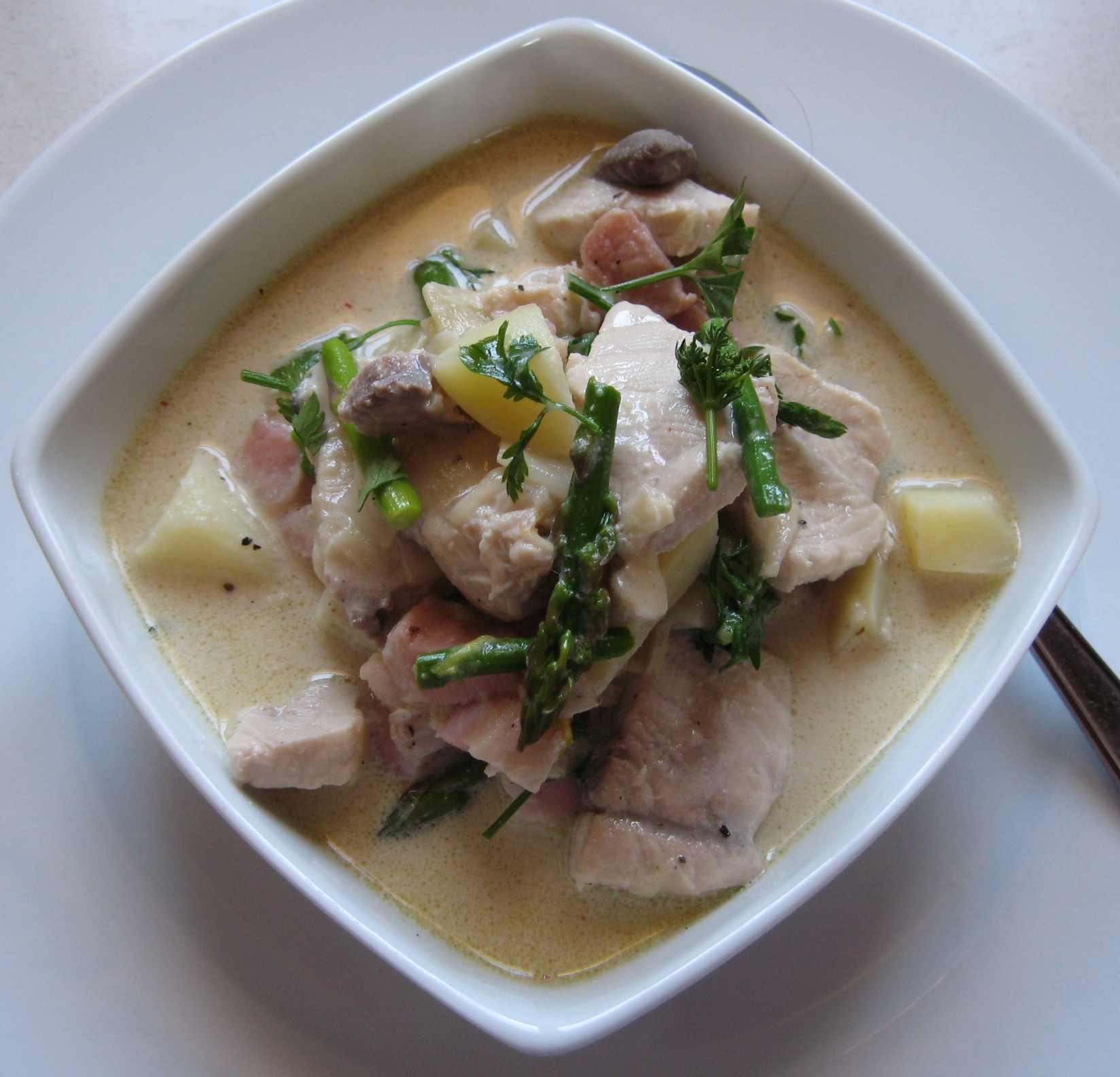
Fish Chowder

13 Sunday May 2012

Posted by Nevenka in Food for One, Main Courses, Starters

≈ 2 Comments

Tags

Chowder, Marrajo

The garden is so bursting with gorgeous vegetables that it is hard to decide what to cook with first. The potatoes that were planted in January are now all ready, and as there is little that is better than a freshly dug new organic potato, I think that they will have to be included in lunch. Yesterday we had them simply boiled with two dipping sauces. One a garlic mayonaise made with almonds in the place of the egg and the other spicy, a Mojo Picon from the Canary Islands made with picante smoked paprika, vinegar, garlic and olive oil.

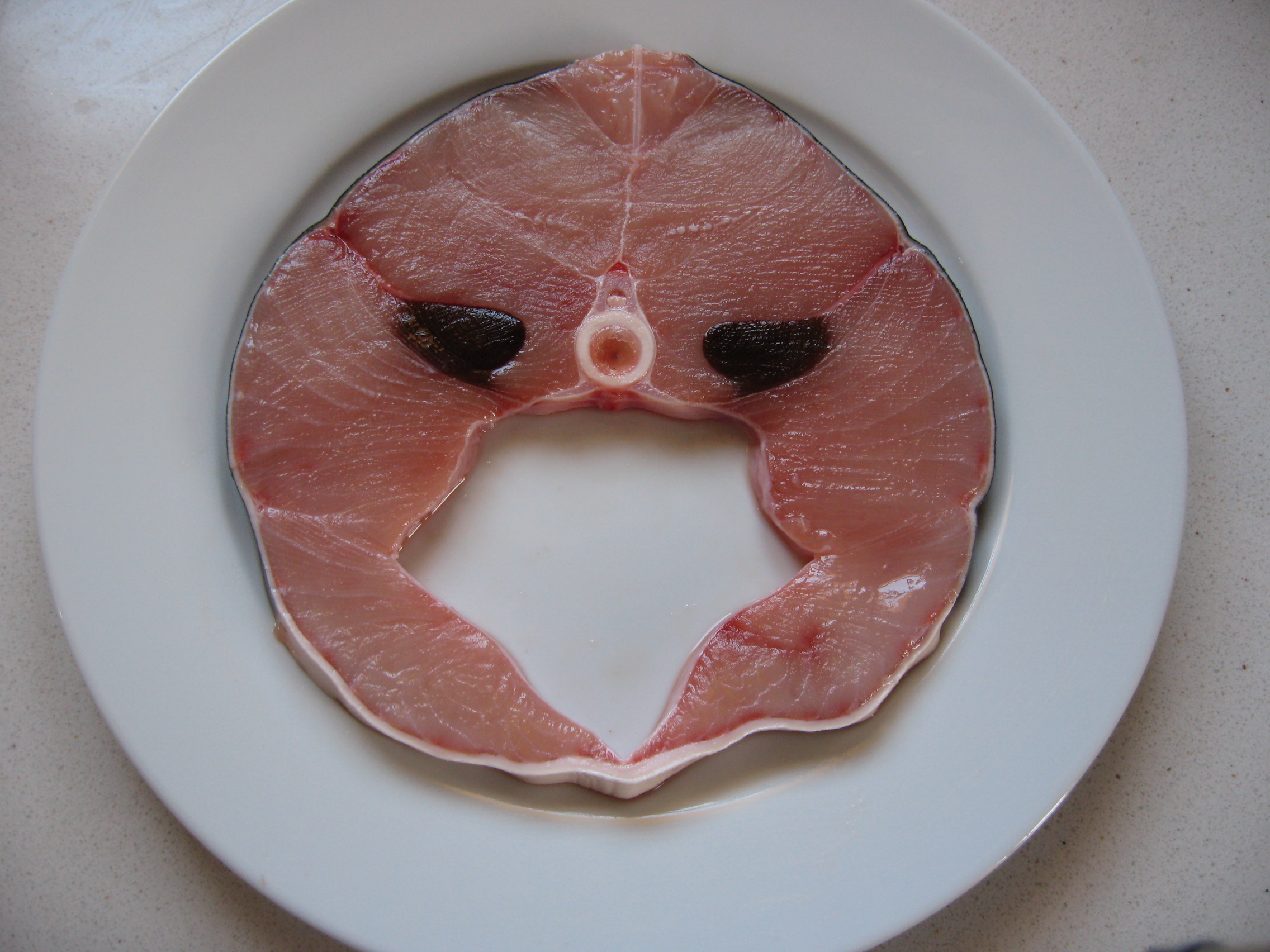
But back to today. I love fish and being by the sea there is always a good selection of fresh fish. It is impossible to decide before arriving at the market exactly what will be the best fish on the day. Today I have chosen Marrajo. It is a meaty white fish, most likely from the same family as Swordfish and Shark. The skin is certainly siimilar to both of the above. There are several varieties of the above caught in the Mediterranean Sea, each of which have local names which can vary in places not really very far from one another. A fish can have one name here in the local fishing port of Garrucha, and another in Almeria City which is less than 100 km away.Image

So potatoes, fish, there is some home cured streaky bacon in the larder, fresh onions and some green asparagus. A creamy Fish Chowder will make a light lunch and is easy to cook for one.

FISH CHOWDER

Chowders hail from the Atlantic coast of the United States and are famously made in Maine with clams. There I am sure as many variations as there are cooks, but the elements that have to be included for it to class as a chowder are as follows. Bacon, potatoes, onions, milk or cream, fish or shellfish of some sort. You then add other vegetables depending on what you have and what is in season. Sweet corn being very american, fits extremely well. Peas, asparagus as I have included today, pumpkin or squash cut in small cubes, celeriac cut the same.

I like to use chicken stock as the main cooking liquid and then finish with a bit of cream to enrich the soup, but you can use just milk in place of the stock.Image

Per person

Olive oil

A quarter of an Onion – cut into dice

75 gms Streaky bacon cut into lardons

100-150 gms meaty white fish – I used a type of shark called Marrajo

100 gms potatoes – peeled and cut into dice about 1.5 cm square

150 ml approx chicken stock

6 stems of asparagus

2-3 tablespoons thick fresh cream

salt and pepper

Fresh flat leaved parsley

Blanch the potatoes. Put the cubes in a saucepan with salted water and bring to the boil. Simmer 1 minute and immediately drain.

Warm the olive oil in a shallow saucepan, add the onions and let cook slowly for a couple of minutes until translucent.

Add the bacon and fry for 7-10 minutes stirring from time to time.

Add the stock and the potatoes. Bring to a simmer and cook slowly for another 7-10 minutes until the potatoes are almost done.

Add the fish cut into cubes and the asparagus cut into bite sized pieces.

Cook slowly a few more minutes until the fish is just cooked.

Add salt and pepper and then the cream. As soon as the cream is amalgamated and warm, sprinkle over the freshly chopped parsley and serve.

Share this:

  • Share on X (Opens in new window) X
  • Share on Facebook (Opens in new window) Facebook
  • Share on WhatsApp (Opens in new window) WhatsApp
  • Email a link to a friend (Opens in new window) Email
Like Loading...

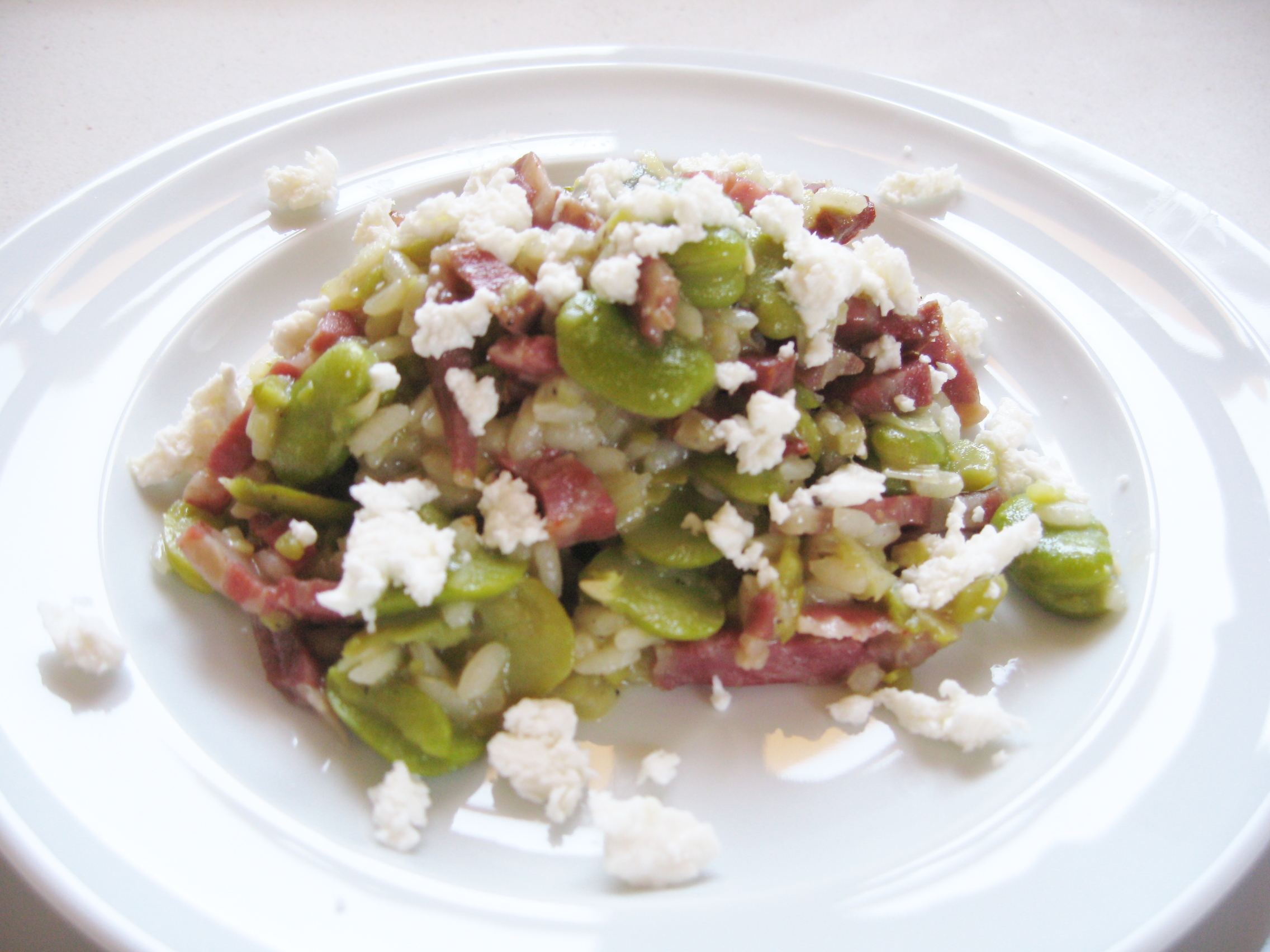
Broad Bean Risotto

04 Friday May 2012

Posted by Nevenka in Main Courses, Starters

≈ 1 Comment

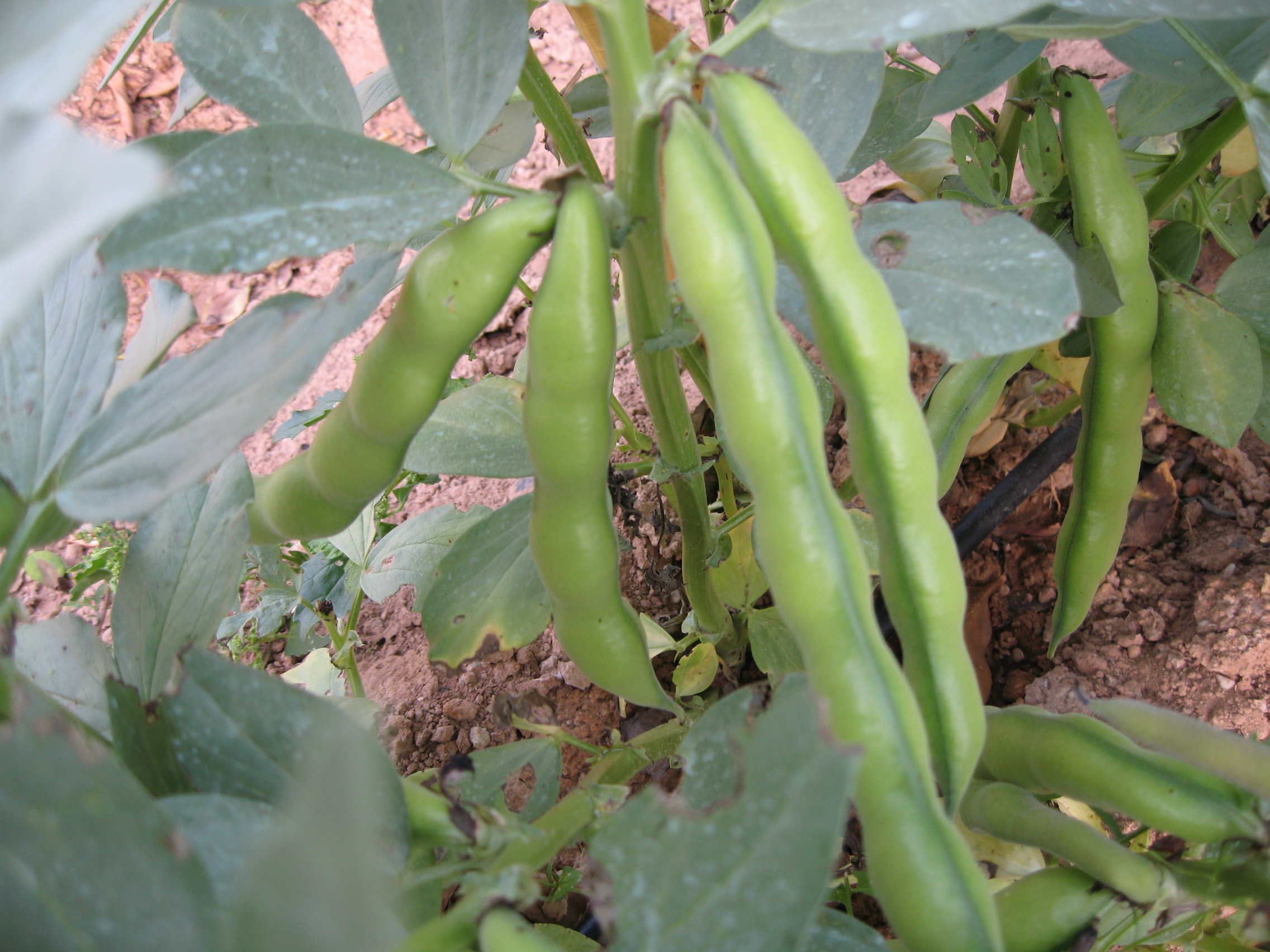
While I have been away on my travels the vegetable garden has been very busy and is overflowing with Mange-toute Peas, Broad Beans, Asparagus and Loquats amongst other things. I will talk about the Loquats later. Lets talk about broad beans today.

Normally I pick the beans when they are small and very tender, but of course in my absence they have matured into big beans. Still very useable, but they just need a bit more work to remove the skin from each individual bean once they have been removed from their pods.

BROAD BEAN RISOTTO 

Per person-

beans – shelled and skin removed if tough – 80 gms

risotto rice – 30 gms

butter – 15 gms

onion – finely chopped – 1 tbsp

raw ham – parma,  serrano, bayonne – 40 gms

light stock – 150-200 ml

white wine – 40 ml

sea salt and freshly ground black pepper

If you grow your own beans then this dish is ideal if you have a mixture of small tender beans and more mature ones with floury flesh. If this is the case then prepare the beans separately.

The small tender ones just want to go into a saucepan with a little of the butter. Put them on a low heat and swirl around until they are bright green. Add a small amount of water to go half the way up the beans, cover and cook for a couple of minutes until half cooked. Remove from the pan and put to one side until later.

The large beans will need their skin removed from each individual bean, then treat in the same way as the tender ones, but cook a little longer until they are  mashable. Mash them into a rough pulp with their cooking liquid. They don’t want to be a smooth puree, this is a rustic dish after all.

If you only have large beans then cook them all together as above but now divide them in two and mash half. Put them separately to one side until later.

Fry the onion in butter until transparent. Add the ham cut into small strips, stir and cook for a minute.

Add the rice and stir to coat in the butter. Cook for a minute or two for the rice to absorb the butter a little.

Pour in the wine and let it bubble away for a couple of minutes.

Add the mashed beans to the pan and then enough of the stock to cover all the contents of the pan by about a centimetre. Cover and leave to cook slowly for 5-7 minutes.

Check the pan and add more stock if necessary. Add the rest of the beans and stir them in. Season with salt and pepper.

Continue cooking until the rice and beans are done. Add more stock as the risotto cooks if you think it is needed. As you know you are aiming for a wet texture but not a soupy one, so add stock in small amounts if you are unfamiliar with the rice that you are using or are not experienced at making risottos.

Serve sprinkled with ricotta or another fresh sheeps cheese.

Share this:

  • Share on X (Opens in new window) X
  • Share on Facebook (Opens in new window) Facebook
  • Share on WhatsApp (Opens in new window) WhatsApp
  • Email a link to a friend (Opens in new window) Email
Like Loading...

Fish Cous Cous and Chard with Pine Nuts and Golden Raisins

18 Wednesday Apr 2012

Posted by Nevenka in Main Courses, Vegetable Dishes

≈ Leave a comment

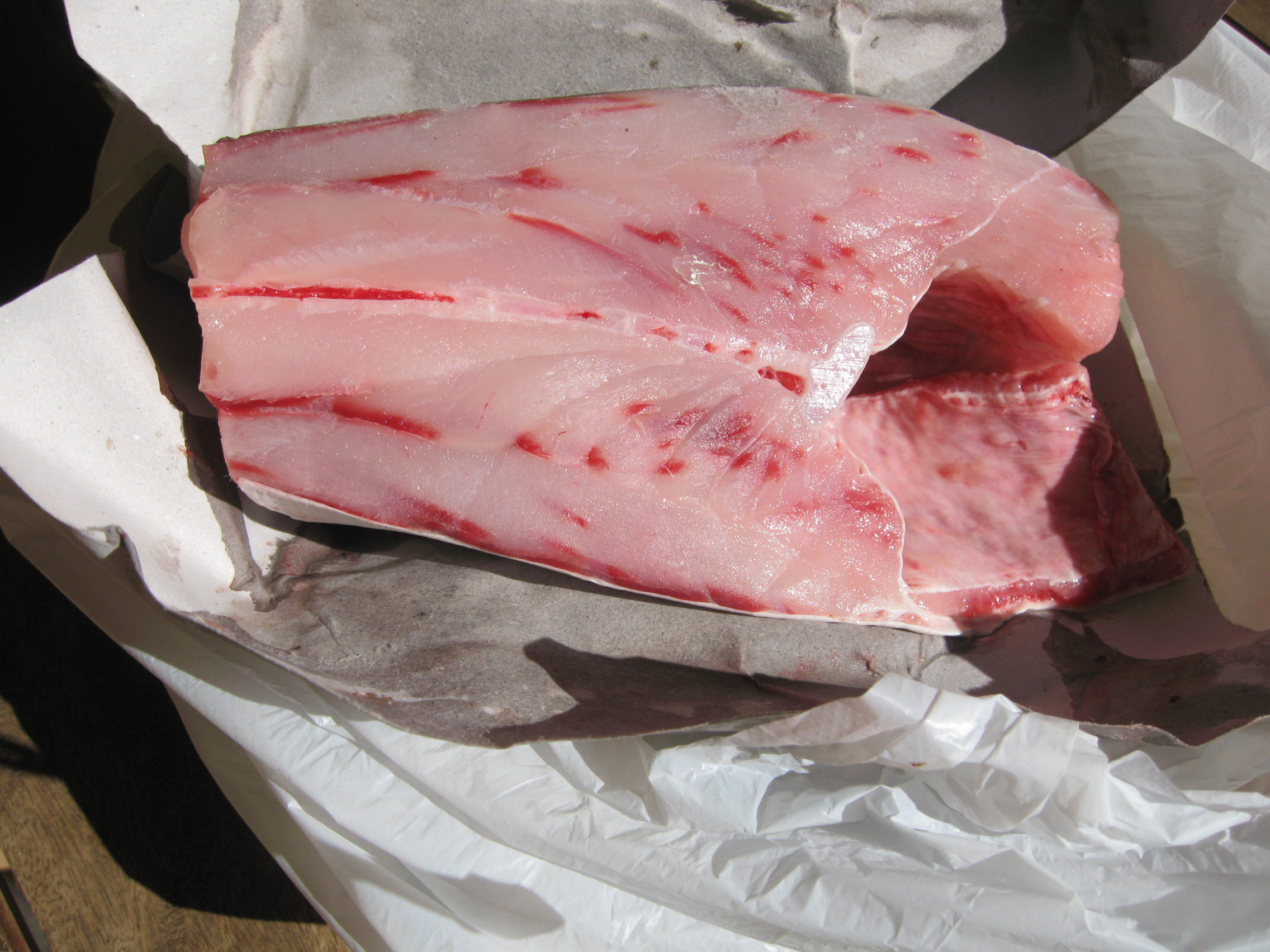
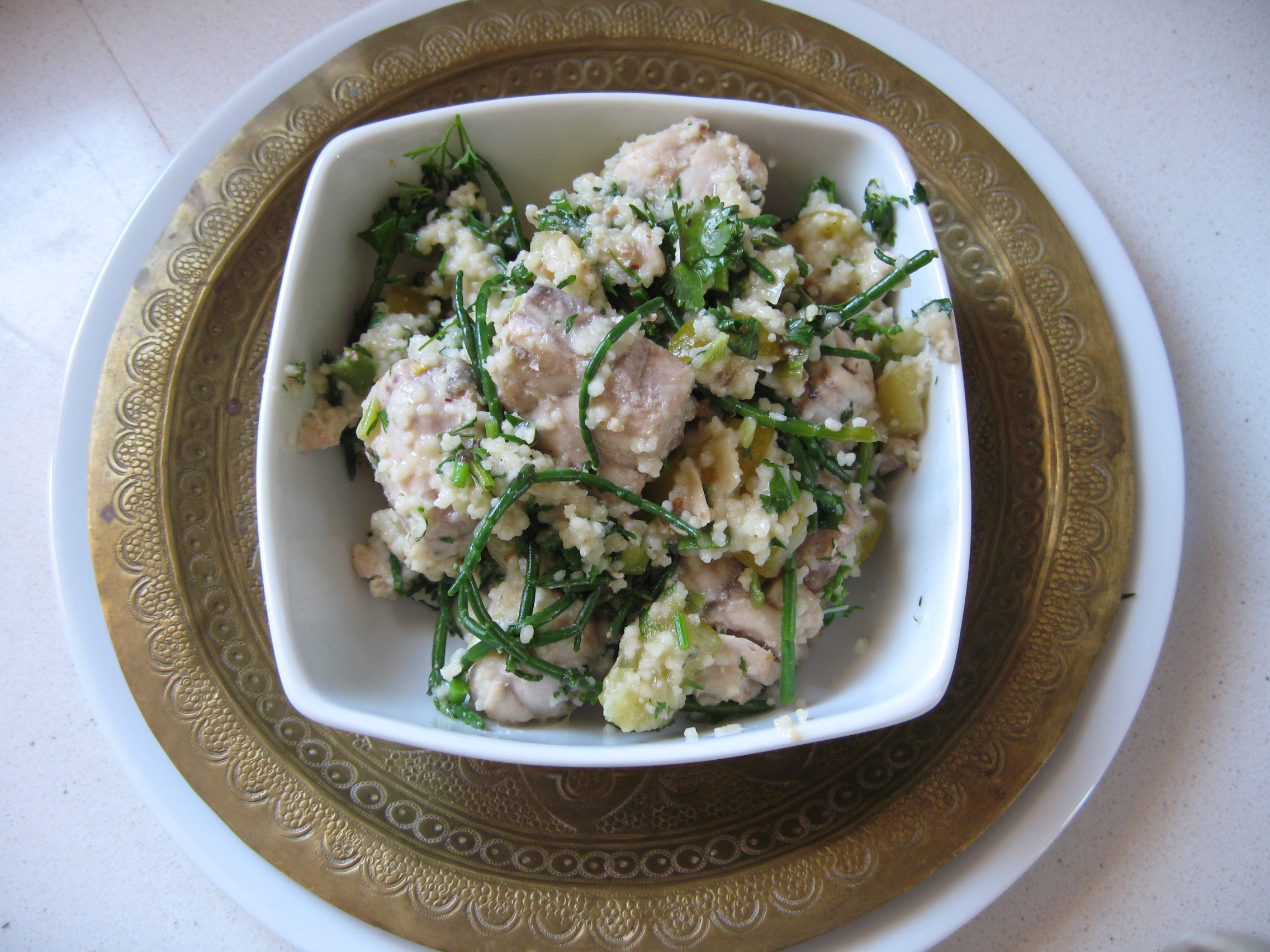
I have bought from my favourite stall in the local market a gorgeous chunk of skate. It has obviously come from a very large fish and looks really meaty – meaty enough to make me think of pairing it with some spices. The current best seller in my farm shop is Salt and Sweet Preserved Limes flavoured with fenugreek, mustard and star anise. It will be perfect to flavour the fish. The natural next step in the thought process is to think of the salted lemons of Morocco, and then to think of the cous cous that such dishes are usually served with. Although it is not mentioned in the recipe and is entirely optional, I threw in a handful of samphire.

FISH COUS COUS WITH SALT & SWEET LIMES

Cous cous – medium ground

Olive oil

1 clove garlic or a stick of spring garlic

120 gms fish per person – a meaty white fish such as swordfish or shark.

1 salt and sweet preserved lime per person

Fresh coriander and parsley – finely chopped

Firstly put the kettle on to boil.

Weigh out the cous cous – 25 gms per person if you are exercising portion control – 50 gms per person if they are very hungry – or somewhere between the two for a normal appetite.

Put the cous cous into a plastic container into which it fits without being shallow. If I am making cous cous just for myself, I have a small beaker that I use. If I am making for four or more people I have a plastic rice cooker for the microwave that does the job. Pour in enough boiling water to cover the cous cous by about a centimeter. Cover and leave to swell for 15 to 20 minutes.

Heat a shallow pan and add some olive oil. When hot add the garlic, stir and cook until slightly browned.

Cut the fish into chunks. Add to the pan and cover. Cook a few minutes. Stir and then leave to cook a couple more minutes.

Chop up the lime, in big chunks if you like a strong blast of lime or smaller if you want the flavour to be more amalgamated. Add to the fish. Cook a minute for the flavours to blend. Be careful that the fish is not overcooked. It is difficult to be precise as every variety of fish cooks differently.

Add the cous cous and the herbs. Again cook a minute to blend the flavours.

Serve with Harissa on the side and Acelgas con Pasas y Pinones………

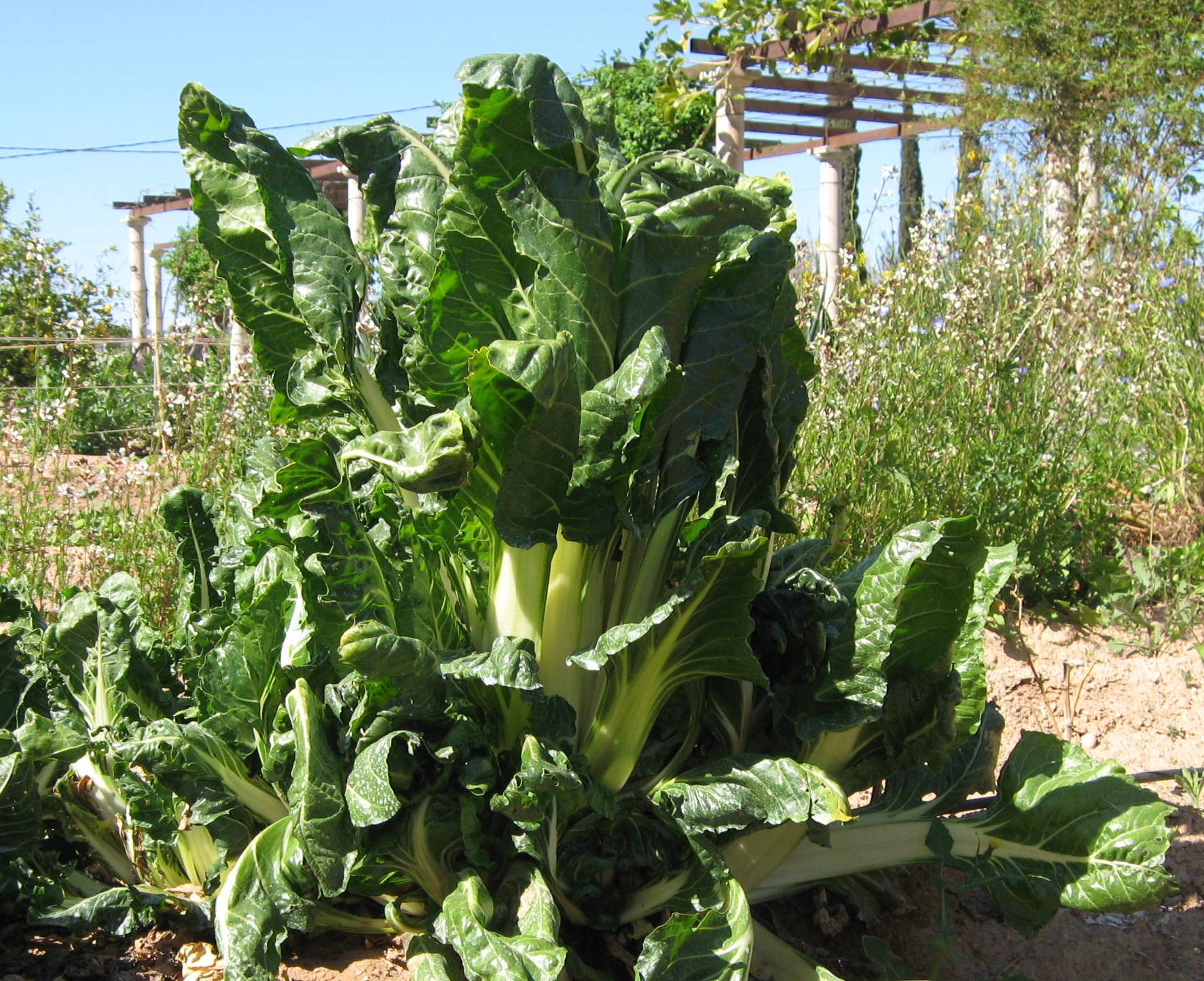
Chard, or Acelgas in spanish, is grown in this part of spain in place of spinach. It suits much better the soil and the climate here. For the home grower it has the advantage of cropping over a very long period, in fact the plants that I am trimming for this recipe were planted a year ago. This recipe is incredibly simple, but the sum of the flavours is greater than the parts.

ACELGAS CON PASAS Y PINONES – Swiss chard with pine nuts and raisins

In a heavy based shallow pan toast the pine nuts over a low heat, shaking from time to time to turn until they are an even golden brown. Empty them onto a plate until later.

Wash the chard thoroughly. Discard the tough white stems. Finely chop the green leaves.

Once the pine nuts have been removed from their pan, add some olive oil to the pan back on a low heat. Add the chard, cover and leave to wilt for a couple of minutes.

Stir, season with salt, add the raisins. Cover and cook a couple more minutes. Add the pine nuts, stir again and cook again for another two minutes.

Turn off the heat and leave to slowly finish cooking in the residual heat for a further five minutes.

Share this:

  • Share on X (Opens in new window) X
  • Share on Facebook (Opens in new window) Facebook
  • Share on WhatsApp (Opens in new window) WhatsApp
  • Email a link to a friend (Opens in new window) Email
Like Loading...
← Older posts
Newer posts →

Blog at WordPress.com.

Privacy & Cookies: This site uses cookies. By continuing to use this website, you agree to their use.
To find out more, including how to control cookies, see here: Cookie Policy
  • Subscribe Subscribed
    • fincafood
    • Join 103 other subscribers
    • Already have a WordPress.com account? Log in now.
    • fincafood
    • Subscribe Subscribed
    • Sign up
    • Log in
    • Report this content
    • View site in Reader
    • Manage subscriptions
    • Collapse this bar
 

Loading Comments...
 

    %d